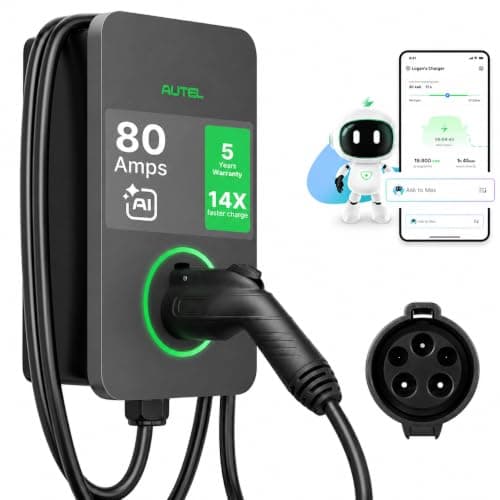
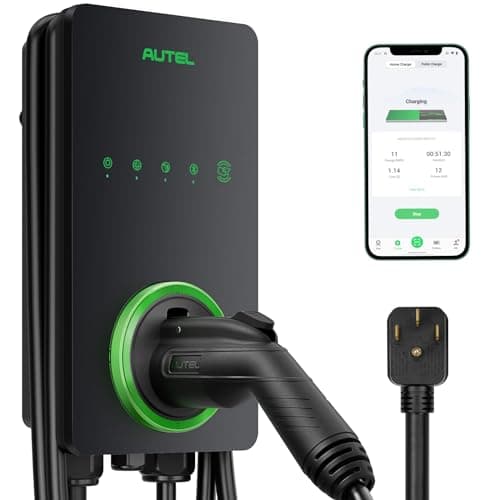
The Autel MaxiCharger is the charger to buy when it has to live outside. It is weather-sealed and built like rugged outdoor gear, and it pairs that with one of the better apps in the category - so you get smart scheduling without the setup feeling fragile.
In our best outdoor chargers roundup the MaxiCharger ranks near the top, and this is the longer look at why. As always, we compile the published specs and do the math rather than bench-testing hardware - documented research on a well-regarded unit, not a lab teardown.
Who it is for
The buyer mounting a charger on an exterior wall, in a carport, or anywhere weather is a factor - the MaxiCharger's sealed, rugged body is made for it. It also suits the buyer who wants smart features but has been burned by flaky charger apps: Autel's app is a genuine strength. It is the wrong pick only for someone chasing the absolute fastest home speed - this is a 40-amp plug-in unit, so if your car accepts 48 amps and you want all of it, look at a hardwired 48-amp charger instead.
The specs that matter
Autel rates this version at up to 40 amps / 9.6 kW with a NEMA 14-50 plug, a J1772 connector, a 25-foot cable, and Wi-Fi plus Bluetooth app control. Two numbers do the real work:
- 40 amps, plug-in. That is the ceiling for any NEMA 14-50 charger - the plug sits on a 50-amp circuit and the continuous-load rule caps draw at 40. For most cars 40 amps is an easy overnight full charge; our amperage guide shows when the jump to 48 is worth it.
- Weather-sealed body. The rugged, outdoor-rated enclosure is the reason to pick this over a comparable indoor unit - it is built to sit in sun, rain and cold. See our cold-weather picks.
What is good
Two real strengths. The build is rugged and weather-sealed, which is exactly what an outdoor install needs and where flimsier chargers struggle. And the app is one of the better ones - scheduling, monitoring and updates that work without a fight, which is not a given in this category. As a plug-in unit it is also portable: unplug the 14-50 and it moves with you, useful for renters. For a smart, tough, 40-amp charger, it is an easy recommendation.
Where it falls short
The main limit is speed: at 40 amps it is a step behind the 48-amp hardwired units, so if your car accepts 48 amps and you want the shortest possible charge, this is not the fastest path. Being plug-in is the trade for that - the same NEMA 14-50 that makes it portable is what caps it at 40 amps. And like any connected charger, the smart features assume you will set up Wi-Fi. For an outdoor install where a 40-amp overnight charge is plenty, none of that stings.
The MaxiCharger lineup, model by model
Autel sells more home variants than any other brand on this site, and the names do not make the differences obvious. Per Autel Energy's own product pages, the range breaks down like this:
- MaxiCharger AC Elite Home - the flagship home line, sold as a 40-amp NEMA 14-50 unit, a 40-amp NEMA 6-50 unit, or a 50-amp hardwired unit, each offered with either a separate holster or an in-body one. Up to 50 amps / 12 kW at the top. The unit reviewed above is the 40-amp NEMA 14-50 with the in-body holster.
- MaxiCharger AC Lite Home - the trimmed-down line, in 40-amp and 50-amp versions. Autel publishes the 50-amp AC Lite at 6-50 amps adjustable, 12 kW at 240 volts, a 25-foot cable, hardwired, NEMA 4X, rated -40 to 131 F, CSA and Energy Star certified on a 3-year warranty, with a J1772 or a NACS connector.
- MaxiCharger AC 80A - the 19.2 kW unit, hardwired on a 100-amp circuit, with dual-network Wi-Fi plus Wi-SUN and tamper-resistant hardware. Real but specialist: almost no car on sale can draw all 80 amps.
Two things worth knowing before you shop the listings. First, the holster distinction is not cosmetic - the in-body version keeps the handle in the box and the wall tidy, the separate version lets you mount the holster where the car actually parks. Second, every current model is offered with a NACS connector as well as J1772, so there is no reason to buy the wrong plug and live with an adapter.
Installation notes
The 40-amp plug-in units want a properly rated NEMA 14-50 (or 6-50) on a 50-amp circuit; the 50-amp and 80-amp units are hardwired, and the 80-amp one needs a dedicated 100-amp circuit that many 200-amp services simply cannot spare. Have a licensed electrician run the load calculation before you order the fast one - the circuit, not the charger, is the expensive part. If you are installing outdoors, the MaxiCharger's weather rating is the reason to pick it, but siting still follows NEC Article 625 for mounting height and wet-location hardware. Autel also documents local dynamic load balancing across a group of MaxiChargers, which is the alternative to a second circuit for a second car.
Bottom line
The MaxiCharger is the range to shop when the charger has to live outside and you still want a genuinely good app. Buy the 40-amp AC Elite plug-in if a rated outlet exists and 9.6 kW covers your driving, which it does for most people. Step to a 50-amp hardwired AC Lite if the circuit is going in new. Buy the 80-amp only if you have checked your car's onboard AC acceptance rate and it really is 19.2 kW - otherwise you are paying for a 100-amp circuit to feed a 48-amp car. If you want the same weatherproofing without the app, the sealed Grizzl-E lineup is the other way to solve an outdoor install.
The MaxiCharger lineup, side by side
Every figure below is Autel's own published specification, from the Autel Energy lineup page, the AC Lite Home 50A product page and the MaxiCharger AC Home datasheet cited in Sources. We compile specs and do the electrical arithmetic - we do not bench-test hardware.
| Model | Amps / kW | Connector | Plug or hardwired | Cable | Smart / Wi-Fi | Safety listing |
|---|
| AC Elite Home 40A (NEMA 14-50) | 16-40A / 9.6 kW | J1772 or NACS | NEMA 14-50 plug, 50A circuit | 25 ft | Wi-Fi + Bluetooth, scheduling, in-body or separate holster | Weather-rated enclosure, UL/CSA per model |
| AC Elite Home 40A (NEMA 6-50) | 16-40A / 9.6 kW | J1772 or NACS | NEMA 6-50 plug, no neutral needed | 25 ft | Same app and feature set | Weather-rated enclosure, UL/CSA per model |
| AC Elite Home 50A | Up to 50A / 12 kW | J1772 or NACS | Hardwired | 25 ft | Same app and feature set | Weather-rated enclosure, UL/CSA per model |
| AC Lite Home 50A | 6-50A / 12 kW | J1772 or NACS | Hardwired | 25 ft | Bluetooth, Wi-Fi, Ethernet; scheduling and cost tracking | CSA certified, Energy Star, NEMA 4X, -40 to 131 F |
| MaxiCharger AC 80A | Up to 80A / 19.2 kW | J1772 | Hardwired, 100A circuit | 25 ft | Dual-network Wi-Fi + Wi-SUN, remote locking | UL certified by CSA, 5-year warranty |
How to pick the right MaxiCharger
Level 1 versus Level 2
Level 1 is the 120-volt cord that came with the car: about 12 amps and roughly 5 miles of range an hour per the US Department of Energy. Level 2 is 240 volts, about 2.9 to 19.2 kW - and the Autel range happens to span almost that entire band, from 9.6 kW at the bottom to 19.2 kW at the top. If you drive under 40 miles a day and can leave the car plugged in overnight, Level 1 genuinely works and no charger on this page is necessary.
Amps to kW, and why 80 amps is rarely the answer
Amps x 240 volts / 1000 = kW: 40 amps is 9.6 kW, 50 is 12, 80 is 19.2. Because EV charging is a continuous load the breaker is sized to 125 percent of the draw, so those need 50-amp, 60-amp and 100-amp circuits respectively. The catch on the 80-amp unit is not the charger - it is that the large majority of EVs on sale accept at most 11.5 kW of AC, so an 80-amp charger on a 100-amp circuit still delivers 11.5 kW to that car. Check the vehicle's onboard AC acceptance rate first; our amperage guide lists it by model.
NACS or J1772
Autel offers current home models with either connector, so buy the one on your car: NACS (SAE J3400) for a Tesla and most 2025-and-later EVs, J1772 for anything older. Adapters work in both directions but add a part to a nightly routine and a weather-exposed connection. Our J1772 vs NACS guide covers which cars shipped with which.
Hardwired or plug-in
Autel is unusual in offering both a NEMA 14-50 and a NEMA 6-50 plug-in option, which matters if your garage has the older three-wire welder outlet. Plug-in keeps the charger portable and caps it at 40 amps; hardwired unlocks 50 and 80 amps and removes the receptacle from the current path. On a continuous 40-amp draw a bargain receptacle is the failure point, so a plug-in install deserves a listed, industrial-grade NEMA 14-50 outlet.
Load management instead of a bigger panel
Autel documents local dynamic load balancing for MaxiCharger groups - you nominate one charger as the master and it balances the group so they collectively stay inside one circuit's limit. That is the cheap answer to a second EV, and it is worth pricing before you assume you need a service upgrade to add one. See our load-balancing picks, and best outdoor chargersfor where the MaxiCharger's weather rating puts it against the field.