HUB 04 · Charging Costs
Do EV Chargers Use a Lot of Electricity?
It is the biggest single load in most homes, but not the budget-buster it sounds like. Here is what a charger actually adds - in kWh, in dollars, and versus your dryer.
We earn a commission when you buy through our Amazon links, at no extra cost to you. It never affects our rankings, and we say so when the cheaper product is the better buy. How this works.
Short answer: an EV charger is usually the single largest electrical load in a home while it is running - but because it only runs a few hours a day and electricity is cheap per mile, the monthly cost is far smaller than the big wattage number suggests. For a typical driver it adds roughly the electricity of running a second refrigerator plus a bit - real, but not a budget-buster. Here is the honest math.
How much power it draws while charging
A Level 2 charger pulls a lot instantaneously: 7.7 kW at 32 amps, 9.6 kW at 40, or 11.5 kW at 48. For comparison, an electric dryer is about 3-5 kW and a central AC unit 3-4 kW, so yes, the charger is the heaviest hitter on your panel while it works. That is why it needs its own dedicated circuit. But instantaneous draw is not the bill - the bill is kilowatt-hours, and that depends on how long it runs.
How much energy it actually uses
Energy is what you pay for, and it is set by how much you drive, not by the charger's wattage. The rule of thumb: EVs use about 0.30-0.35 kWh per mile. So:
- 1,000 miles a month = roughly 300-350 kWh added at the wall (after ~10% charging losses).
- That is about 10-12 kWh a day - similar to running a second refrigerator around the clock, or a couple of loads in an electric dryer.
- Drive less and it drops proportionally; a 600-mile month is closer to 200 kWh.
In other words, the charger's big wattage runs for only a few hours, and the total energy tracks your mileage. A car parked all weekend uses nothing.
What that costs
At the US average residential rate of about $0.16-0.17/kWh, 300-350 kWh a month is roughly $50-60 - to drive 1,000 miles. Put next to a tank of gas that would cover the same distance, it is a large saving; put next to your whole electric bill, it is a noticeable but manageable line item. Your local rate is the entire story, and it varies widely by state - run your own number below.
Run it for your car
Cost-to-charge calculator
Put in your electricity rate, your battery size and your car's efficiency. The math is the same one shown above, with a 10% charging loss included so the number is realistic.
- $8.09
- A 10% to 80% charge
- $11.56
- A full (empty to 100%) charge
- $0.05
- Cost per mile
- $5.08
- Cost per 100 miles
Estimate only. Actual cost depends on your exact utility rate (including any time-of-use pricing and fees), your car's real efficiency, temperature, and charging losses. Check your electric bill for your true rate.
The full breakdown, including cost per mile and the formula, is in cost to charge at home, and the gas comparison is in EV vs gas.
How it compares to your other appliances
| Load | Power while running | Rough monthly energy |
|---|---|---|
| EV charger (1,000 mi/mo) | 7.7-11.5 kW | ~300-350 kWh |
| Central air conditioning | 3-4 kW | ~200-500 kWh (seasonal) |
| Electric water heater | 4-4.5 kW | ~300-400 kWh |
| Refrigerator | 0.1-0.4 kW | ~30-60 kWh |
So an EV charger is in the same league as heating water or cooling the house - a major appliance, not an off-the-charts anomaly. And unlike those, it directly replaces gasoline, so the energy it adds is offset by fuel you stop buying.
How to use less (and pay less)
The energy is fixed by your miles, but the cost is not - two levers cut it:
- Charge off-peak. On a time-of-use plan, shifting charging to cheap overnight hours can cut the per-kWh rate substantially - see off-peak charging. A smart charger like the Emporia schedules it automatically and shows you exactly how much you use.
- Add solar. Home solar can offset much of the charging energy - the math is in charging an EV with solar.
Bottom line: an EV charger is the biggest load in the house while it runs, but a moderate, mileage-linked one over a month - and cheaper per mile than gasoline, cheaper still off-peak.
The gear
Recommended gear for this guide
The products this guide refers to, with prices pulled live from Amazon and dated on each card.
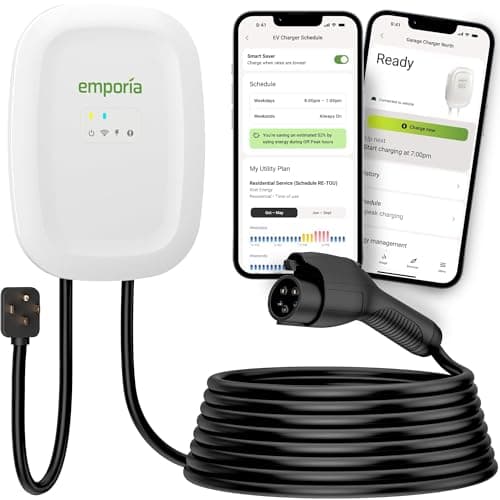
Most homes that want speed and smarts
Emporia Level 2 (48A)
The charger that refuses to charge you extra for being smart: full 48-amp speed and real energy monitoring at roughly the price of a plain plug-in box.
#ad · As an Amazon Associate we earn from qualifying purchases.
Questions
Frequently asked
Do EV chargers use a lot of electricity?
They draw a lot while running - 7.7 to 11.5 kW, the biggest load in most homes - but only for a few hours a day. Over a month, driving 1,000 miles adds about 300-350 kWh, similar to an electric water heater, and costs roughly $50-60 at average US rates.
How much will an EV charger add to my electric bill?
For about 1,000 miles of driving a month, roughly $50-60 at the US average rate of $0.16-0.17/kWh - to replace a lot of gasoline. It scales with your mileage and your local rate, and drops further if you charge off-peak. Use the calculator to run your own figure.
Does an EV charger use more electricity than an air conditioner?
Over a month it is in the same range - an EV charger for average driving uses about 300-350 kWh, comparable to a water heater and often similar to seasonal AC use. It draws more power at any instant, but runs fewer hours, so the monthly energy is broadly similar.
Keep reading
Related
More in this section
More Charging Costs
Receipts
Sources
- US EIA - average price of electricity (residential rates)
- US DOE / fueleconomy.gov - EV charging basics
- US DOE AFDC - charging at home
- US DOE / fueleconomy.gov - EVs and cost of driving
We do not run a testing lab, and we do not pretend to. Where a measured number came from someone else's lab, we name them and link them. Where we could not verify something, we say so on the page rather than quietly leaving it out. Read our full method.