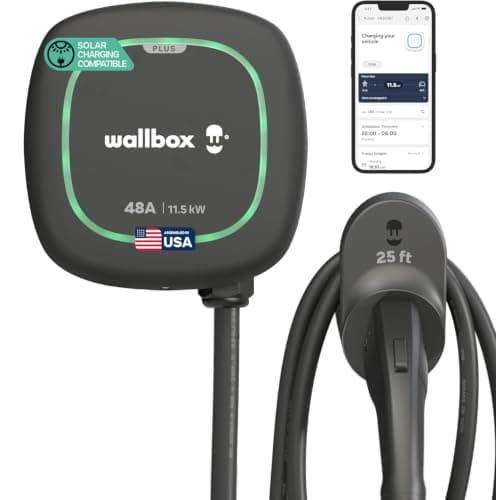
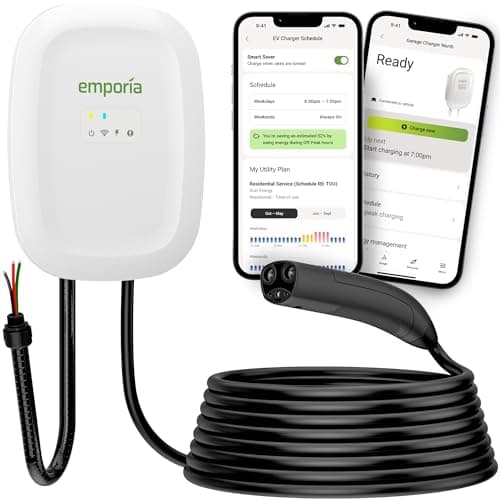
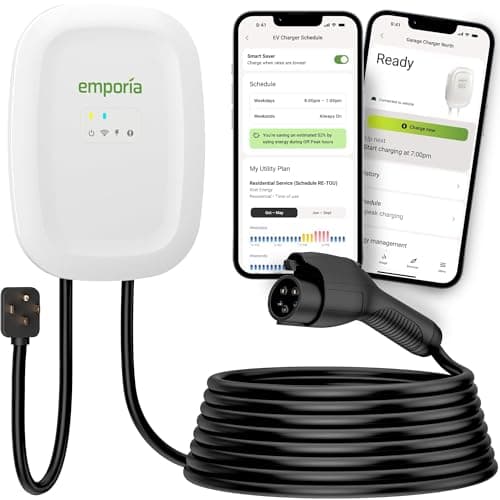
Two chargers on this page genuinely track your solar output and charge from the surplus: the Emporia Level 2, using Emporia's Vue panel monitor, and the Wallbox Pulsar Plus, using Wallbox's Eco-Smart mode and its Power Meter. Buy the Emporia - it is far cheaper, its current adjusts in single-amp steps, and the same app does the energy accounting. Buy the Wallbox if you want Full Green and Eco blending modes and a compact hardwired box. Everything else here is the manual version: schedule the charge for midday and dial the amps to suit your array.
Start with the thing manufacturers are careful not to say plainly: no home Level 2 charger connects to your solar panels. There is no DC link, no special wiring to the inverter, nothing. Every charger on this page draws AC from your main panel exactly like the dryer does. If the sun is producing at that moment, the electrons arriving at the car happen to be yours; if it is not, they come from the grid. The charger cannot tell and does not care.
So "solar-compatible" has to mean something narrower and more useful: can this charger be told how much surplus your house is producing, and throttle itself to match? That requires a current sensor somewhere in the panel measuring production and household consumption, and a charger that will take instructions from it. Only two products here do it automatically. The rest can be scheduled and dialled by hand, which is a perfectly reasonable second best, and this page is honest about which is which. The wider economics live in charging an EV with solar panels.
The three tiers of solar-compatible
- Tier 1 - automatic surplus following. A panel-mounted energy monitor tracks production and consumption in real time; when production exceeds household use, the charger starts and ramps its current to soak up the difference, backing off as clouds arrive. Emporia calls this Excess Solar and drives it from its Vue monitor, starting at the minimum current and increasing as surplus allows. Wallbox calls it Eco-Smart and drives it from its Power Meter, with a Full Green mode that charges only on surplus and an Eco mode that blends surplus with a little grid power so the session does not stall.
- Tier 2 - manual matching.Set a schedule for the middle of the day and set the charger's current to something your array can usually cover. Crude, free, and about 80 percent as good if you work from home or the car sits in the driveway on weekends. Every app-equipped charger here can do this.
- Tier 3 - nothing. A charger with no app and no adjustable current charges at full rate whenever it is plugged in. Fine, but it is not a solar product.
The math that decides whether any of this is worth doing
This is where most solar-charging advice quietly falls apart, and it turns on your export arrangement rather than your hardware:
- If your utility credits exports at the full retail rate (classic one-for-one net metering), then a kilowatt-hour sent to the grid and a kilowatt-hour put into your car are worth exactly the same. Excess-solar charging saves you nothing, and you may as well charge overnight on the cheapest time-of-use window instead. Tier 1 hardware is a nice gadget, not an investment.
- If your export credit is well below retail - the direction almost every state has moved - the arithmetic flips hard. Every kilowatt-hour you self-consume avoids the full retail price you would otherwise pay, instead of earning you a fraction of it. Now the gap between exporting and self-consuming is the whole value of surplus charging, and it repays a monitor quickly for a household that charges a lot.
Find your export rate before you buy anything. Then compare it against what off-peak charging would save you on the same bill - off-peak and time-of-use charging is often the bigger lever, and the two strategies compete for the same charging hours.
Array size versus charger size
A second reality check. A 6 kW residential array on a clear day peaks somewhere near its rating and produces meaningfully less either side of noon, and your house is using some of that already. A 40-amp charger wants 9.6 kW. So surplus charging almost never runs at full speed - it runs at whatever your instantaneous surplus supports, which is why fine current control matters far more than top speed on this page. Emporia adjusts in single-amp steps from 6 to 48 amps; that granularity is the actual feature.
There is also a floor. The J1772 control pilot signals available current to the car, and the minimum it can request is 6 amps - about 1.4 kW at 240 volts. Below that the session cannot continue at all, so a charger following a fading array will pause rather than trickle. That is normal behaviour, not a fault, and it is the reason Wallbox's blended Eco mode exists.
The picks
The Emporia Level 2 is the pick because it turns solar charging from a premium feature into a cheap one. The charger is already the best-value full-speed unit we track; adding the Vue panel monitor - a separate purchase, and you should budget for it - gives you real-time production and consumption data, automatic excess-solar charging, and the energy accounting that tells you how much of the charge came from the roof. Single-amp current steps are what let it actually track a moving surplus.
The Wallbox Pulsar Plus has the more sophisticated solar logic. With the Wallbox Power Meter installed, Eco-Smart gives you Full Green (charge only from surplus) and Eco (blend surplus with grid power to keep the session moving), and the same meter powers Power Boost load management so the charger also protects a tight panel. It is a hardwired 48-amp unit in the smallest body here. It is also the more expensive route once you have bought the meter.
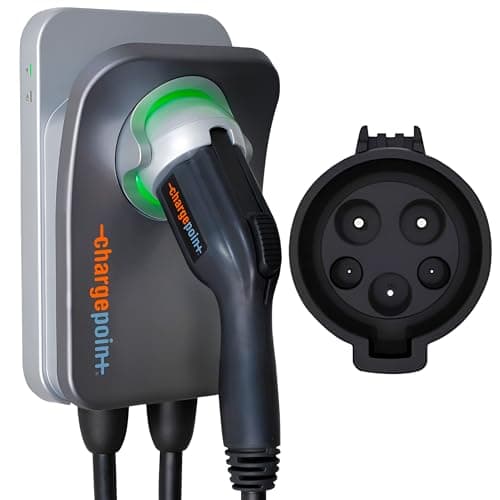
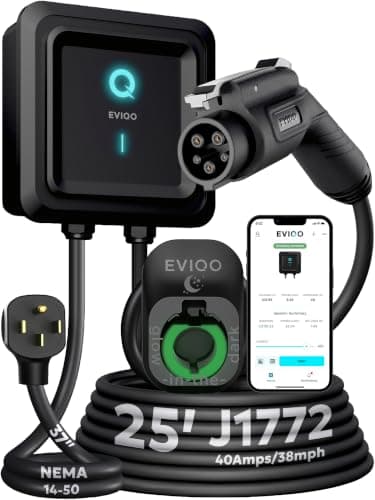
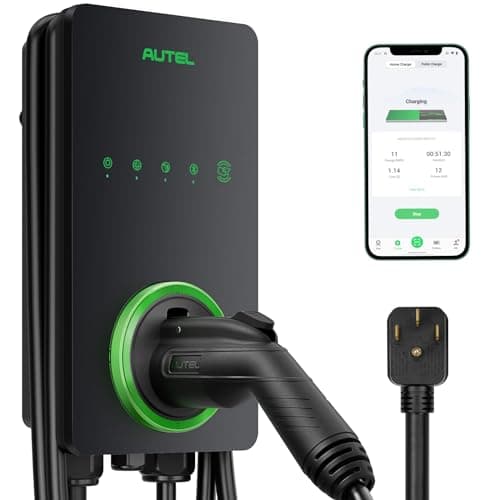
The Emporia NACS is the same Emporia proposition for a Tesla-style port - identical app, identical excess-solar behaviour, no adapter. The ChargePoint Home Flex has no surplus-following mode, and we are not going to pretend otherwise; what it has is selectable output from 16 to 50 amps and the best rate-aware scheduler on the site, which makes it the strongest Tier 2 unit and the right buy if you also charge in public. The EVIQO Level 2 is the budget Tier 2 pick - app scheduling, 6 to 40 amps of adjustment, UL and ETL listings, IP66. The Autel MaxiCharger rounds it out with app scheduling, adjustable current and a Bluetooth fallback for when the garage Wi-Fi drops mid-afternoon.
Solar charging is not the same as powering your house from the car. Bidirectional charging - V2H and V2G - sends energy the other way and needs completely different equipment, plus utility approval. None of the chargers on this page do it. See what bidirectional charging is for where that technology actually stands.
How the six compare
| Charger | Amps / kW | Plug type | Cable | Solar capability | Safety listing | Price tier |
|---|
| Emporia Level 2 | 6-48A / up to 11.5 kW | NEMA 14-50 plug (40A) or hardwired (48A) | 25 ft | Automatic excess-solar with the Vue monitor (sold separately); 1-amp steps | UL listed, Energy Star | Value |
| Wallbox Pulsar Plus | 48A / 11.5 kW | Hardwired | 25 ft | Eco-Smart Full Green / Eco modes with the Power Meter (sold separately) | UL listed, Energy Star | Premium |
| Emporia NACS | Up to 48A / 11.5 kW | Hardwired (NACS connector) | 24 ft | Same Emporia excess-solar behaviour, native NACS plug | UL listed (2594/2231/2251/817/991), Energy Star | Value |
| ChargePoint Home Flex | 16-50A / up to 12.0 kW | NEMA 14-50 plug (to 40A) or hardwired (to 50A) | 23 ft | No surplus following; midday schedules + selectable amps | UL / cUL (UL 2594, UL 2231), Energy Star | Premium |
| EVIQO Level 2 | 6-40A / 9.6 kW | NEMA 14-50 plug | 25 ft | No surplus following; app schedule + 6-40A control | UL and ETL, IP66 / NEMA 4 | Budget |
| Autel MaxiCharger | 40A / 9.6 kW | NEMA 14-50 plug | 25 ft + holster | No surplus following; app schedule + adjustable current, Bluetooth fallback | NEMA 4X weather-rated shell; no UL mark named in our spec set | Mid |
Solar behaviour above is as documented by Emporia and Wallbox in their own support material. We compile published specifications and manufacturer documentation; we do not run a test lab and we have not measured any of these systems against an array - our methodology says so plainly.
The buyer's guide
1. Budget for the sensor, not just the charger
Tier 1 needs two purchases. The Emporia route is the charger plus an Emporia Vue panel monitor; the Wallbox route is the charger plus a Wallbox Power Meter, which is a professionally installed clamp. Neither is included with the charger, and a page that quotes you the charger price alone is not telling you what solar charging costs. Price both halves before you decide Tier 2 is not good enough.
2. Level 1 vs Level 2 in a solar house
A 120-volt Level 1 cord draws 1.4 to 1.9 kW and adds roughly 3-5 miles of range per hour. That is close to the minimum a J1772 session can run at, and it happens to be a load a modest array can cover on its own - so if the car is home all day and you drive little, Level 1 is accidentally the most solar-friendly setup there is. Level 2 at 240 volts is 3.8 to 12 kW, which is more than most rooftop arrays can supply from surplus alone. See Level 1 vs Level 2.
3. Amps to kW, and matching it to your array
Volts times amps over 1,000. At 240 volts: 6A = 1.4 kW, 16A = 3.8 kW, 24A = 5.8 kW, 32A = 7.7 kW, 40A = 9.6 kW, 48A = 11.5 kW. Take your array's realistic midday surplus, subtract what the house is using, and set the charger to the amperage just below the result. A 6 kW array with a quiet house often lands around 16-24 amps. The arithmetic is in what kW means in EV charging.
4. NACS vs J1772 changes nothing about solar
The connector is a shape. The Emporia J1772 and the Emporia NACS run the same app and the same excess-solar logic. Pick the plug your car has - how to check - and then pick on capability. If your household mixes both, a J1772 charger plus an adapter is usually cheaper than a NACS unit plus an adapter pointing the other way.
5. Hardwired vs plug-in, and where the sensor goes
A NEMA 14-50 plug caps a charger at 40 amps / 9.6 kW; a hardwire unlocks 48. For solar specifically the install choice matters less than usual, because surplus charging rarely runs at the ceiling anyway. What does matter is that Tier 1 requires an electrician inside your panel to fit current transformers whichever charger you choose - so if you are hiring one anyway, hardwiring costs little extra. See hardwired vs plug-in.
6. Load management is the same sensor doing a second job
The clamp that spots your solar surplus is also the clamp that spots your house pulling hard, which is what lets a full-speed charger run on a panel that could not otherwise carry it. Wallbox's Power Meter drives both Eco-Smart and Power Boost from one install. If your service is tight as well as solar-equipped, that is two problems solved by one accessory - chargers with load balancing has the detail.
So, which one?
Emporia Level 2 plus a Vue monitor is the answer for most solar homes: real surplus following, single-amp control, full energy accounting, at the lowest hardware cost in the field. Wallbox Pulsar Plus plus a Power Meter if you want blended Eco charging and load management in one compact hardwired unit. Emporia NACS if the driveway is Tesla-shaped. And if your utility still pays full retail for exports, buy the ChargePoint Home Flex or the EVIQO, schedule the charge for the cheapest hours instead, and spend the monitor money on something else.