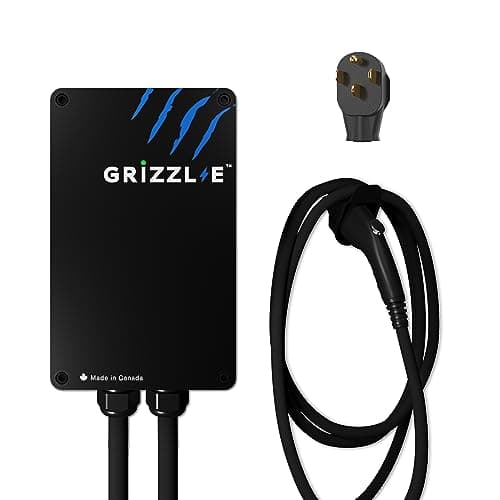
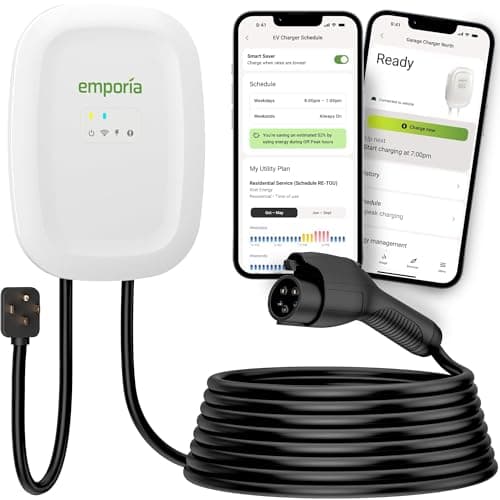
Buy the Emporia Level 2 if you want speed and real smart features without paying a premium for them - it is 48-amp capable when hardwired and adds energy monitoring and scheduling for about the price of a plain charger. Buy the Grizzl-E Classic if you would rather never open an app: a sealed, UL-certified cast-aluminum box that just charges and keeps working even if a company's servers go dark. They answer opposite questions.
These two anchor the top of our best Level 2 chargers roundup - the Emporia as the overall winner, the Grizzl-E as the no-app pick. Here is how they compare on the things that actually decide it. We compile published specs and do the math rather than bench-testing either unit.
Speed
The Emporia, by a nose. It is rated up to 48 amps / 11.5 kWwhen hardwired, against the Grizzl-E Classic's fixed 40 amps / 9.6 kW. The catch is that the Emporia only hits 48 amps hardwired on a 60-amp circuit and with a car that accepts it - the plug-in version is capped at 40 amps, the same as the Grizzl-E. On a 50-amp circuit the two charge at an identical rate. Whether the Emporia's headroom is real for you depends on your panel and car.
Smart features
A clean win for the Emporia, because it is the only one that has any. Its Wi-Fi app brings scheduling and genuine energy monitoring - the features that save real money on a time-of-use electricity plan by shifting charging to cheaper overnight hours. The Grizzl-E has none of that on purpose: no app, no Wi-Fi, nothing in the cloud. If smart features are the point, this is not close; if they are what you are trying to avoid, keep reading.
Build and durability
The Grizzl-E takes this one decisively. Its cast-aluminum, UL-certified enclosure is rated for indoor and outdoor use and built to outlast plastic-bodied rivals, with no app or cloud service that can be deprecated out from under it. The Emporia is a well-made unit, but its value case leans on software staying supported. For a sealed set-and-forget box on an exposed wall, the Grizzl-E is the sturdier answer - it also leads our best outdoor chargers ranking.
Value
The Emporia, for most buyers - and this is the surprise. It usually costs about what the Grizzl-E does, yet adds 48-amp capability and a real app on top. You are not paying extra for smart; you are getting it for roughly free. The Grizzl-E's value is different: it spends the same money on a tougher shell and a longer service life instead of features. Neither is overpriced; they just buy you different things.
The verdict
Emporia for speed, smarts and value; Grizzl-E for durability and a life with no app in it. Read the full Emporia and Grizzl-E reviews for the detail, and before you buy either, confirm which circuit your panel can support in the amperage guide.
How to choose between them
Amps to kW: what the speed numbers mean
At 240 volts, 48 amps is about 11.5 kW and 40 amps about 9.6 kW - a real but modest gap, roughly 40 versus 30-some miles of range per hour depending on the car. Because charging is a continuous load, 48 amps needs a 60-amp breaker and 40 amps needs a 50-amp breaker. The Emporia only reaches 48 amps hardwired; go plug-in and it, like the Grizzl-E, tops out at 40.
Smart vs deliberately dumb
A smart charger earns its keep on a time-of-use rate, where automatic scheduling moves charging to cheap off-peak hours, and in a two-car home, where load management lets units share one circuit safely. On a flat rate with a single car, a dumb charger like the Grizzl-E does the identical core job with nothing to fail. Decide whether you will actually use the software before you pay for it - though with the Emporia, you barely pay extra either way.
Certification and weather
Both are safe choices here: the Grizzl-E is UL certified with a cast-aluminum outdoor-rated shell, and the Emporia is a listed unit as well. A home charger pushes 40-plus amps for hours unattended, so a UL or ETL listing is the one spec we never compromise on. For an exposed wall or carport, the Grizzl-E's enclosure has the edge.