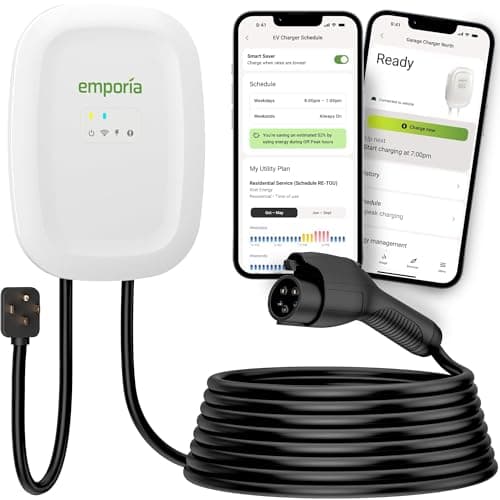
For most two-car garages the answer is one charger with a 25-foot cable, mounted between the bays - and the Emporia Level 2 is that charger. It reaches either bay from a central position, runs at 48 amps hardwired, and logs what the charging costs. If both bays hold an EV today, the Grizzl-E Duo puts two 25-foot cables on one circuit instead. If one of the two cars is a Tesla, the Tesla Universal Wall Connector serves both connector standards and shares power with a second unit later.
A two-car garage is not the same problem as two EVs, and conflating them is how people overspend. The overwhelming majority of two-bay garages contain one electric car - the other bay has a gas car, a workbench, or the bikes. What makes the garage hard is not electrical capacity. It is geometry: there is one sensible place to put a charger, the car does not always park in the same bay, and charge ports are on different corners of different cars.
So this page ranks on reach, mounting flexibility and the upgrade path to a second car. If you genuinely have two EVs charging every night, the hardware question is different and we have a dedicated page for it - best dual-port chargers - plus the wiring options in installing two chargers in one garage.
Measure before you shop
Almost every two-car-garage regret is a measuring failure, and it takes ten minutes to avoid. Stand where the charger will mount and run a tape to the charge port for every way you might park: the near bay nose-in, the near bay backed in, the far bay nose-in, the far bay backed in. The cable does not travel in a straight line - it drops from the unit, crosses the floor or the car's flank, and reaches the port. Take the worst of those four numbers and add a couple of feet of slack. That is your minimum cable length.
For a typical two-bay garage the worst case usually lands between 18 and 24 feet, which is why 25 feet is the number that solves this category and why four of the six picks here ship exactly that. Our cable length guide has the full method, and the long-cable roundup ranks the 25-foot field on reach alone.
Where the charger goes
The mounting position does more work than the hardware. Three rules that hold in nearly every two-bay garage:
- Mount between the bays, not in a corner. A charger on the shared wall between the two parking positions halves the worst-case run compared with one tucked beside the panel. The charger does not have to live next to the panel - the feed from the panel is a separate run an electrician handles, and distance from the panel is a wiring cost, not a constraint on where the box goes.
- Mount high enough to clear a car door. Code sets a floor here: the coupling means has to be stored at least 18 inches above the floor indoors, and at least 24 inches above grade outdoors. In practice most installers land around chest height, which keeps the cable off the floor and the connector out of the grit.
- Leave room for the cable to live. Twenty-five feet of heavy cable coiled on a hook needs about a foot and a half of clear wall beside the unit. Plan it in, or the cable ends up on the floor where it gets driven over.
Our where to mount an EV charger guide walks the full siting decision, including detached garages and the outdoor case.
Reach and mounting at a glance
| Charger | Amps / kW | Plug type | Cable | Two-bay approach | Smart / Wi-Fi | Safety listing | Price tier |
|---|
| Emporia Level 2 | 6-48A / up to 11.5 kW | NEMA 14-50 plug (40A) or hardwired (48A) | 25 ft | One unit, centre-mounted, reaches both bays | Wi-Fi, energy monitoring | UL listed, Energy Star | Value |
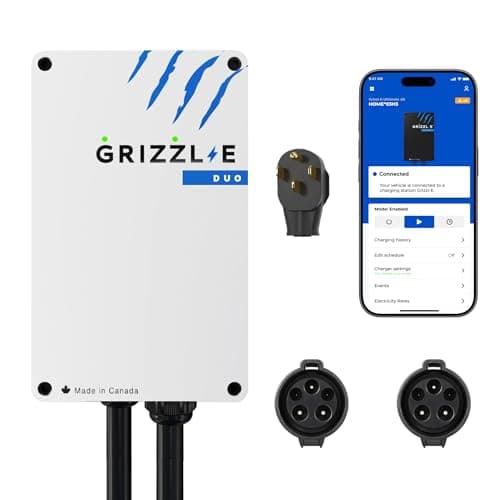
| Grizzl-E Duo | 40A shared / 9.6 kW | NEMA 14-50 plug, two J1772 cables | 2 x 25 ft | Two cables, one circuit, one box | Wi-Fi, Grizzl-E Connect | UL certified, Energy Star, NEMA 4X | Mid |
| Tesla Universal Wall Connector | Up to 48A / 11.5 kW | Hardwired, NACS with built-in J1772 adapter | 24 ft | Serves both connectors; power sharing across up to six units | Wi-Fi, Tesla app | UL listed, NEMA 3R | Premium |
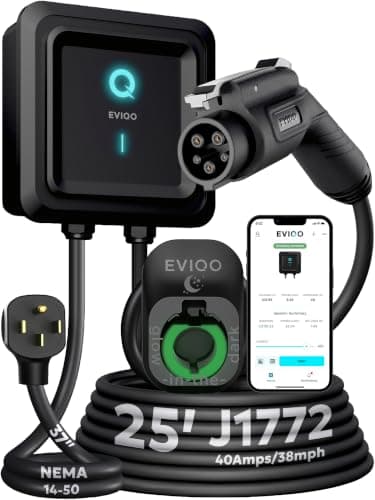
| EVIQO Level 2 | 40A / 9.6 kW | NEMA 14-50 plug | 25 ft | One unit, centre-mounted, on a budget | Wi-Fi app scheduling | UL and ETL, IP66 / NEMA 4 | Value |
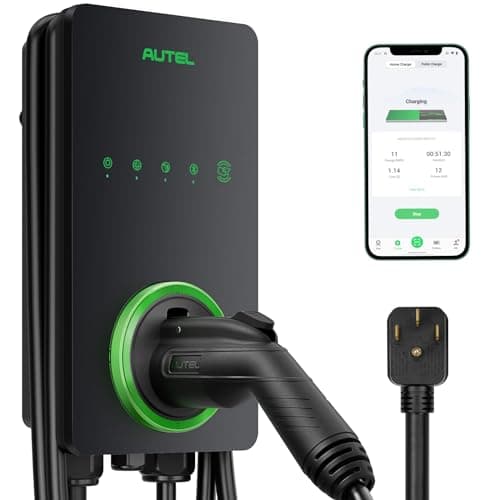
| Autel MaxiCharger | 40A / 9.6 kW | NEMA 14-50 plug | 25 ft + in-body holster | One unit with cable management built in | Wi-Fi + Bluetooth | Weather-rated enclosure | Mid |
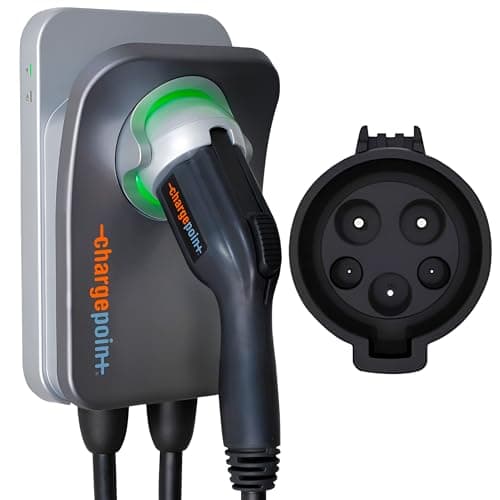
| ChargePoint Home Flex | 16-50A / up to 12.0 kW | NEMA 14-50 plug (40A) or hardwired (50A) | 23 ft | One unit; shortest cable here, so mount carefully | Wi-Fi, ChargePoint app | UL / cUL per UL 2594 and UL 2231 | Premium |
The picks
The Emporia Level 2 is the default for a reason. Twenty-five feet of cable covers both bays from a central mount, 48 amps hardwired means it is not the bottleneck if you later buy a faster car, and the energy monitoring tells you what the garage is costing you. Current adjusts in single-amp steps from 6 to 48, which is exactly what you want when the circuit turns out smaller than hoped.
The Grizzl-E Duo is the answer when both bays already hold an EV. It is one cast-metal box with two 25-foot cables that splits a single 40-amp circuit between two cars - so a two-EV garage does not need a second 240-volt run. Wi-Fi and the Grizzl-E Connect app come with it, and charging carries on when the connection does not.
The Tesla Universal Wall Connector earns its place on the mixed-driveway case: a NACS cable with a J1772 adapter built into the housing, so one unit serves a Tesla in one bay and a J1772 car in the other without an adapter living loose in the garage. It also shares power with up to six Tesla units on the same circuit, which is the cleanest upgrade path here if the second bay goes electric later.
The EVIQO Level 2 is the budget version of the Emporia argument - the same 25 feet with both UL and ETL listings and an IP66 rating, at 40 amps. The Autel MaxiCharger ships with a holster built into the body, which in a two-bay garage is worth more than it sounds: it is the difference between the cable living on a hook and living on the floor. The ChargePoint Home Flex is the polished option, but note its cable is 23 feet rather than 25 - in a wide garage those two feet are exactly the ones you measure for.
One charger, two EVs, taking turns is completely normal.Most two-EV households do not need both cars charging simultaneously - a typical day's driving replaces in an hour or two, and the cars are parked for eight. Before buying dual-port hardware, check whether simply alternating nights solves it. Our can two EVs share one charger page works through when that stops being enough.
The two-car-garage buying guide
Level 1 versus Level 2, briefly
Level 1 is the cord that came with the car plugged into a normal 120-volt outlet: about 1.4 kW, a few miles of range an hour. In a two-car garage it has one real use - a plug-in hybrid in the second bay, which can genuinely live on it. For a full battery EV, Level 2 at 240 volts is the upgrade that makes the garage work. Every pick on this page is Level 2.
Amps to kilowatts, and what you actually need
The arithmetic is just volts times amps. At 240 volts: 32 amps is 7.7 kW, 40 amps is 9.6 kW, 48 amps is 11.5 kW. Divide roughly by 0.3 kWh per mile and a 40-amp charger adds somewhere near 30 miles of range an hour. For a two-bay garage where the car sits overnight, 40 amps is comfortably enough for almost everyone, and 48 amps is headroom rather than necessity. Our what amp charger do I need guide runs the numbers against real daily mileage.
NACS versus J1772 in a mixed garage
If the two bays hold different connector standards - a Tesla and a J1772 car - you have three honest options, and only one of them is annoying. Buy a J1772 charger and keep a J1772-to-NACS adapter for the Tesla; buy the Tesla Universal Wall Connector, which has the J1772 adapter built into the housing so nothing gets lost; or buy two chargers. For Level 2 AC the two connectors deliver identical power at the same amperage, so this is purely a question of what you want to handle at 11pm in the dark. The connector comparison covers it.
Hardwired or plug-in
In a garage that already has a NEMA 14-50 receptacle, plug-in is a genuine convenience: the install is a bracket and a plug, and you can take the charger with you if you move. The trade-off is a 40-amp ceiling, because the receptacle is a 50-amp device and continuous-load rules cap it there. Hardwiring unlocks 48 amps and removes the receptacle - which matters, because the receptacle is the single most common failure point in home charging. The full argument is in hardwired versus plug-in.
Load management, when the second bay goes electric
The day the second car becomes an EV, the question is whether your panel can carry a second charging circuit. Usually the cheaper answer is not another circuit but load management: two chargers wired to the same circuit that talk to each other so the breaker is never exceeded, each car charging at full speed when it is alone and sharing when both are plugged in. Wallbox calls its version Power Boost, Grizzl-E calls its version Ultimate Load Balancing, and Tesla Wall Connectors share power natively across up to several units. That is the upgrade path worth protecting when you choose today's charger - and it is why the Tesla Universal and the Grizzl-E family score well here even in a one-EV garage.
Cable management is not optional in a shared garage
A 25-foot cable in a two-bay garage crosses a walkway. Left on the floor it gets stepped on, run over, and dragged through grit that works into the connector contacts - a common cause of intermittent charging faults. A wall holster to dock the connector nose-down and a J-hook to carry the slack in wide loops costs very little and solves both. Our holsters and organizers page ranks the parts.
So, which one?
One EV in a two-bay garage: buy the Emporia Level 2 and mount it between the bays. Two EVs, one circuit, no app wanted: the Grizzl-E Duo. A Tesla plus a J1772 car: the Tesla Universal Wall Connector. Tightest budget with the same reach: the EVIQO. Whatever you choose, measure all four parking positions first - the charger that fits your garage is the one whose cable reaches the worst of them.