HUB 03 · Charging Guides
40-Amp vs 48-Amp EV Charger: Which to Buy
Two amperages, two very different installs. Here is the continuous-load math, the onboard-charger catch, and the roughly two-mile-an-hour reality.
We earn a commission when you buy through our Amazon links, at no extra cost to you. It never affects our rankings, and we say so when the cheaper product is the better buy. How this works.
A 40-amp charger delivers 9.6 kilowatts; a 48-amp charger delivers 11.5. That sounds like a clear win for 48 amps, but the decision is really about your panel and your car, not the spec sheet. A 40-amp unit usually installs on a circuit many homes can already spare and can be plug-in; a 48-amp unit demands a larger dedicated circuit and must be hardwired. And many cars cannot use 48 amps at all. This guide shows the arithmetic so you buy the one that actually helps you.
The circuit each one needs
EV charging is a continuous load, so the National Electrical Code requires the branch circuit to be sized at 125 percent of the charger's draw. That single rule sets the whole comparison. A 40-amp charger needs a 50-amp circuit (40 times 1.25 equals 50), which is typically wired with 6 AWG copper and can terminate in a NEMA 14-50 outlet - so a 40-amp charger can be plug-in and even portable. A 48-amp charger needs a 60-amp circuit (48 times 1.25 equals 60), also 6 AWG copper, and because no standard household receptacle is rated for a continuous 48-amp draw, a 48-amp charger must be hardwired.
| Spec | 40-amp charger | 48-amp charger |
|---|---|---|
| Power at 240V | 9.6 kW | 11.5 kW |
| Required circuit (125%) | 50A breaker | 60A breaker |
| Typical copper wire | 6 AWG | 6 AWG |
| Connection | Plug-in (NEMA 14-50) or hardwired | Hardwired only |
| Range added per hour | ~29-38 miles | ~35-46 miles |
| Panel demand | Lower - many homes have room | Higher - a full 60A circuit |
The plug-in-versus-hardwired split is a real practical difference, not just a wiring detail. A plug-in 40-amp unit can be unplugged and taken with you, and it is easier to swap. A hardwired 48-amp unit is a permanent fixture. We cover the trade-offs in hardwired vs plug-in and the circuit sizing in 60-amp vs 50-amp circuit.
The catch most buyers miss: your car's onboard charger
A home charger only supplies AC; the car's onboard charger converts it and sets the real ceiling. Many EVs have an onboard AC charger that caps at 7.7 kilowatts (32 amps) or 9.6 kilowatts (40 amps). If your car tops out at 9.6 kilowatts, a 48-amp wall unit does absolutely nothing extra for it - the car simply pulls 40 amps and ignores the rest. You would pay for a 60-amp circuit and a hardwired install to charge at exactly the same speed a 40-amp unit gives you.
So the first thing to check is your vehicle's onboard AC charging rate. Only cars that accept the full 11.5 kilowatts / 48 amps can turn a 48-amp charger into faster charging. If yours caps lower, buy for the cap. We explain how to find that number in what amp EV charger do I need, and the broader 32-versus-48 case in 32-amp vs 48-amp charger.
The real-world difference is smaller than it looks
Even for a car that can use all 48 amps, the gap is modest. The step from 9.6 to 11.5 kilowatts is about 20 percent more power, which at three to four miles per kilowatt hour works out to only a few extra miles of range per hour - very roughly two to eight miles depending on efficiency. Overnight, that is the difference between a car that is full at 3 a.m. and one that is full at 1 a.m. For most drivers who plug in for eight or more hours, both finish long before morning, and the difference never matters.
When 48 amps is genuinely worth it
Buy the 48-amp unit when three things line up: your panel can spare a dedicated 60-amp circuit, your car's onboard charger actually accepts 11.5 kilowatts, and you can hardwire it. The classic case is a large battery paired with a fast onboard charger and a short daily charging window - a car you plug in late and need topped up early, or two big EVs sharing time. If any of those three is missing, a 40-amp charger is the smarter buy: cheaper to install, often plug-in, and no slower for your actual car.
Sizing and installing a 240V circuit, breaker and outlet is standard NEC territory and a job for a licensed electrician - not a DIY project. Use this guide to know which amperage to ask for, then have a pro confirm your panel has capacity and install the circuit to code.
For a 48-amp install, the Grizzl-E Ultimate is a dedicated, rugged hardwired unit built for the full 11.5 kilowatts, while the value-focused Emporia also reaches 48 amps when hardwired and adds energy monitoring. Compare the full lists in best 48-amp chargers and best 40-amp chargers, or see both amp classes ranked together in the best Level 2 home chargers we've compared.
The gear
Recommended gear for this guide
The products this guide refers to, with prices pulled live from Amazon and dated on each card.
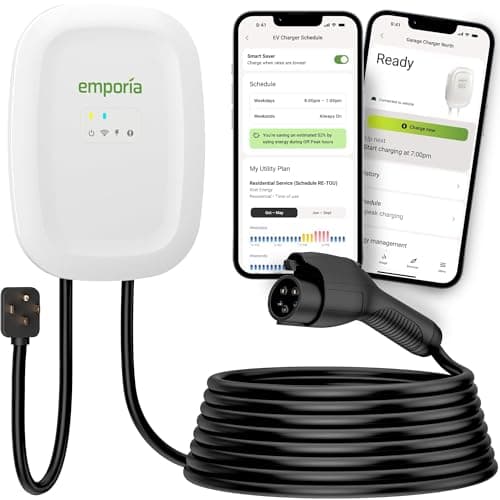
Most homes that want speed and smarts
Emporia Level 2 (48A)
The charger that refuses to charge you extra for being smart: full 48-amp speed and real energy monitoring at roughly the price of a plain plug-in box.
- Guide
A permanent, weatherproof 48A install
Grizzl-E Ultimate (48A)
A dedicated 48-amp charger in a cast-aluminum, IP67 shell - the toughest full-speed box here, built to be hardwired to a wall and left to work.
#ad · As an Amazon Associate we earn from qualifying purchases.
Questions
Frequently asked
Is a 48-amp charger always faster than a 40-amp one?
Only if your car can accept 11.5 kilowatts. Many EVs cap their onboard AC charging at 7.7 or 9.6 kilowatts, and for those a 48-amp charger delivers the exact same speed as a 40-amp one. Check your vehicle's onboard charging rate before paying for the faster unit.
Can I plug in a 48-amp charger like a 40-amp one?
No. A 48-amp charger must be hardwired, because no standard household receptacle is rated for a continuous 48-amp draw. A 40-amp charger can be plug-in on a NEMA 14-50 outlet or hardwired. See hardwired vs plug-in.
What size breaker and wire does each need?
A 40-amp charger needs a 50-amp breaker on typically 6 AWG copper; a 48-amp charger needs a 60-amp breaker, also usually 6 AWG copper. Both follow the NEC continuous-load rule of sizing the circuit to 125 percent of the charger's draw. Your electrician confirms the exact gauge for your run.
If my panel is tight, which should I pick?
A 40-amp charger on a 50-amp circuit, or an adjustable charger dialed down further. A 48-amp unit needs a full 60-amp circuit your panel may not be able to spare. See do I need a panel upgrade.
Keep reading
Related
- What Amp EV Charger Do I NeedHow to read your car and panel before choosing amperage.
- 32-Amp vs 48-Amp ChargerThe wider speed comparison across the common amperages.
- 60-Amp vs 50-Amp CircuitThe circuit each amperage requires, and what your panel can spare.
- Best 48-Amp ChargersOur ranked hardwired picks for full 11.5 kW charging.
- Best 40-Amp ChargersThe plug-in-friendly units most homes should start with.
More in this section
More Charging Guides
Receipts
Sources
- EC&M - NEC requirements for EV equipment (Article 625: continuous load, circuit sizing, GFCI)
- US DOE / fueleconomy.gov - EV charging basics
- US DOE AFDC - charging at home
We do not run a testing lab, and we do not pretend to. Where a measured number came from someone else's lab, we name them and link them. Where we could not verify something, we say so on the page rather than quietly leaving it out. Read our full method.