HUB 03 · Charging Guides
Can a Portable EV Charger Be Your Main Charger?
For most people, yes. A 40-amp portable on a proper 14-50 charges every bit as fast as a plug-in wall unit - you just give up the tidy mounted look and gain a charger that travels.
We earn a commission when you buy through our Amazon links, at no extra cost to you. It never affects our rankings, and we say so when the cheaper product is the better buy. How this works.
Yes - for most people a portable EV charger works perfectly well as the main, everyday home charger. A 40-amp portable plugged into a proper NEMA 14-50 delivers the same 9.6 kW as almost every plug-in wall unit, so the charging speed is identical. What you trade away is mostly cosmetic and convenience, not capability. Here is the honest breakdown of when a portable is all you need and when a wall unit earns its place.
Same speed as a plug-in wall unit
This is the part people underestimate. A quality 40-amp portable like the EVDANCE or the WOLFBOX puts out 40 amps / 9.6 kW on a 50-amp circuit - the exact same output as a plug-in Emporia, EVIQO, or ChargePoint on the same outlet. Plug-in wall units are themselves capped at 40 amps (only hardwiring unlocks 48), so a portable and a plug-in wall charger add range at the same rate overnight. If your car accepts 40 amps or less - and many do - a portable leaves nothing on the table. The amperage question is in what amp charger do I need.
What you give up
The trade-offs are real but modest. A portable lives on a wall hook or the floor rather than mounting cleanly like a fixture, so the install looks less tidy. Most portables have simpler features - a delay timer rather than a full Wi-Fi app - though that is plenty for off-peak charging. And a portable is capped at 40 amps, so if you specifically want the 48-amp / 11.5 kW speed a hardwired unit gives (and your car and panel can use it), a portable will not get you there. The full comparison is in portable vs wall-mounted.
What you gain
In exchange you get flexibility a fixed unit cannot match. The same charger that lives in your garage unplugs and comes on a road trip, works at a friend's or a rental's outlet, and moves with you when you change homes - no de-install, no electrician. That is why portables are the natural pick for renters and anyone who might move, as covered in best chargers for apartments and moving your charger. A dual-level portable like the WOLFBOX even charges from a 120-volt outlet, so one device covers home and emergency use.
The one non-negotiable: a real dedicated circuit
A portable is not permission to skip proper wiring. Running one at 40 amps for hours every night requires a properly installed, dedicated NEMA 14-50 circuit with an industrial-grade receptacle - exactly what a plug-in wall unit needs. You cannot safely make a portable your daily charger by plugging it into a dryer outlet or a tired old receptacle; the outlet must be rated and dedicated, per the dedicated-circuit rule. The portable saves you the mounting and the hardwire, not the circuit.
A portable used as a daily home charger still needs a dedicated, properly rated 240-volt circuit and an industrial-grade NEMA 14-50, installed by a licensed electrician - never a dryer outlet or a worn receptacle. Running a continuous 40-amp load on an inadequate outlet is a fire risk. Use this guide to decide portable vs wall, then have a pro install the circuit to code.
So a portable absolutely can be your main charger - same speed, more flexibility - as long as it lives on a real dedicated circuit. Choose a wall unit instead only if you want the tidy permanent look or the 48-amp hardwired speed - in which case the best Level 2 chargers for home is the ranking to read. Otherwise, a good 40-amp portable does the daily job and travels too.
The gear
Recommended gear for this guide
The products this guide refers to, with prices pulled live from Amazon and dated on each card.
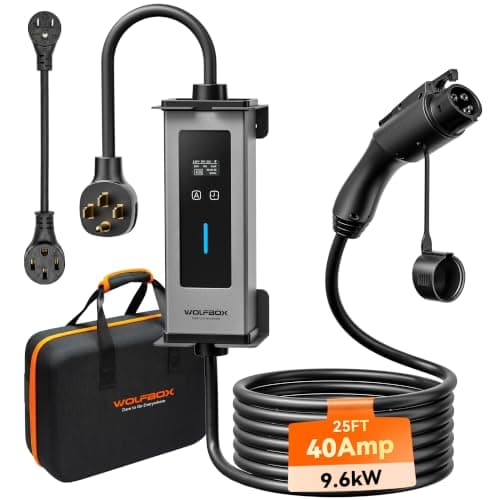
One charger for home and travel
WOLFBOX 40A Portable (Level 1/2)
A dual-level portable that doubles as a wall box — 40 amps on a NEMA 14-50, or Level 1 on a standard outlet with the included adapters. One weatherproof charger for the garage and the road.
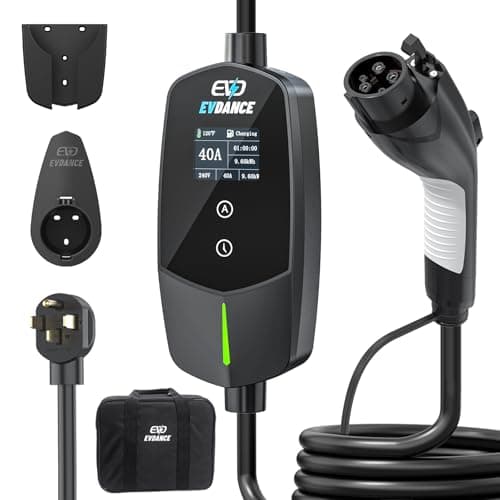
Off-peak charging without an app
EVDANCE 40A Portable
A 40-amp portable with adjustable current and a built-in delay timer on a long 25-foot cable — off-peak charging without needing an app.
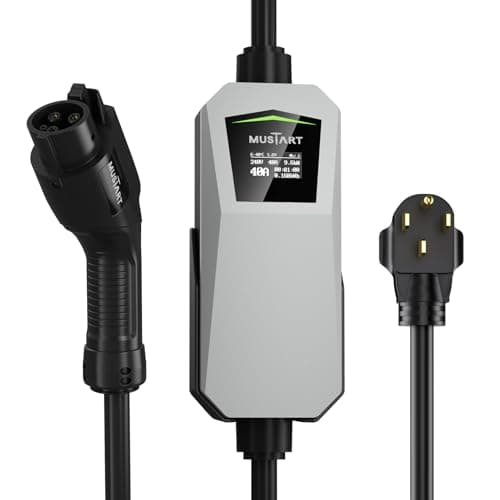
The cheapest capable portable
MUSTART 40A Portable
A budget 40-amp portable with an LCD readout — the value pick when you just need 240V charging that moves with you.
#ad · As an Amazon Associate we earn from qualifying purchases.
Questions
Frequently asked
Is a portable EV charger as fast as a wall charger?
At the same amperage, yes. A 40-amp portable on a proper NEMA 14-50 delivers 9.6 kW - identical to a plug-in wall unit, which is also capped at 40 amps. Only hardwiring a wall unit unlocks 48 amps, which a portable cannot match.
Can I use a portable charger every day?
Yes, provided it runs on a dedicated, properly rated NEMA 14-50 circuit with an industrial-grade receptacle. Daily 40-amp charging is a heavy continuous load - it needs a real circuit, not a dryer outlet.
What is the downside of a portable as a main charger?
Mostly cosmetics and features: it lives on a hook rather than mounting cleanly, and most portables have simpler scheduling than a full smart wall unit. It is also capped at 40 amps, so it cannot reach 48-amp hardwired speed.
Who should choose a portable over a wall charger?
Renters, frequent movers, and anyone who wants one charger for home and travel. If you own the home and want a tidy permanent install or 48-amp speed, a wall unit fits better - see portable vs wall-mounted.
Keep reading
Related
- Charging with Street ParkingThe hardest parking situation, and the routines that actually work curbside.
- Portable vs Wall-MountedThe full trade-off between the two form factors.
- Best Portable EV ChargersThe 40A portables that can serve as a main charger.
- Do EV Chargers Need Their Own Circuit?The dedicated circuit a daily-use portable still requires.
- Best Chargers for ApartmentsWhy portables suit renters and movers.
- Can I Use a Dryer Outlet?The outlet you must not run a daily portable on.
More in this section
More Charging Guides
Receipts
Sources
- EC&M - NEC requirements for EV equipment (Article 625)
- US DOE AFDC - charging an EV at home
- US DOE / fueleconomy.gov - EV charging basics
We do not run a testing lab, and we do not pretend to. Where a measured number came from someone else's lab, we name them and link them. Where we could not verify something, we say so on the page rather than quietly leaving it out. Read our full method.