HUB 04 · Charging Costs
What It Costs to Charge a Tesla at Home
The arithmetic, not a guess. Charging cost is your battery's kWh times your electricity rate - here is the formula, worked for a Model 3 and Model Y, with a calculator for your own rate.
We earn a commission when you buy through our Amazon links, at no extra cost to you. It never affects our rankings, and we say so when the cheaper product is the better buy. How this works.
Charging a Tesla at home is dramatically cheaper than filling a gas tank, and the cost is simple to work out: it is the energy you put in times your electricity rate. Because both of those vary - by model and by where you live - we will not hand you a single number and call it fact. Instead here is the formula, worked through for the common Teslas at sample rates you can swap for your own, plus a calculator so you get your real figure.
The formula
Home charging cost has two inputs: how many kilowatt-hours (kWh) you add, and your electricity rate in dollars per kWh. To fill from near-empty to full, the energy is roughly the battery's usable capacity, plus about 10% for charging losses (the energy that becomes heat rather than range):
Cost of a full charge = battery kWh x 1.1 x your rate ($/kWh)
Your rate is the number that matters most, and it is on your utility bill. US residential rates vary widely by state (the EIA publishes the state table), so the same Tesla costs noticeably more to charge in a high-rate state than a low-rate one - the swing is the whole subject of EV charging cost by state.
Worked examples
Tesla battery sizes are public specs. A Model 3 or Model Y Rear-Wheel Drive carries roughly a 60 kWh usable pack; a Long Range Model 3 or Model Y is roughly 75-79 kWh. Using the formula at a couple of sample rates (replace these with your own):
| Scenario | Energy (with ~10% loss) | At $0.13/kWh | At $0.18/kWh |
|---|---|---|---|
| Model 3/Y RWD (~60 kWh) full charge | ~66 kWh | ~$8.60 | ~$11.90 |
| Model 3/Y Long Range (~78 kWh) full charge | ~86 kWh | ~$11.20 | ~$15.50 |
| Daily top-up (~40 miles at ~250 Wh/mi) | ~11 kWh | ~$1.45 | ~$2.00 |
The rates above ($0.13 and $0.18 per kWh) are illustrative brackets, not your rate - the point is the method. Notice the daily reality: most people never run the battery flat, so the number that matters is the small daily top-up, which is a couple of dollars, not the full-charge figure. To do it with your exact battery, mileage and rate, use the calculator on cost to charge at home.
Cost per mile is the honest yardstick
Because battery sizes differ, the cleanest comparison is cost per mile. A Tesla using around 250 Wh/mile (0.25 kWh/mile) at a $0.15 rate costs about 3.75 cents per mile to drive - a fraction of what gas costs the same distance. That normalized figure, and how it compares to a gas car, is the focus of cost per mile and EV vs gas.
Off-peak rates cut it further
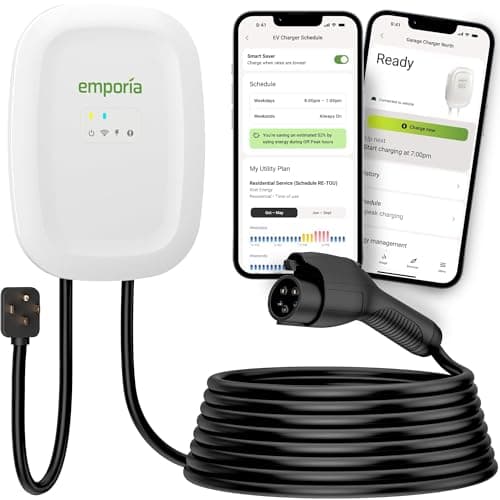
If your utility offers time-of-use pricing, charging overnight can drop your rate well below the daytime figure, making an already-cheap fill cheaper still. Both the Tesla app and a smart charger like the Emporia can schedule charging into that cheap window automatically - the mechanics are in off-peak and time-of-use charging. For the charger itself, a Tesla can use any Level 2 unit with its included J1772 adapter, or a native-NACS unit like the Tesla Universal Wall Connector - the picks are in best chargers for a Tesla.
The takeaway: charging a Tesla at home is a few dollars for a daily top-up and low double digits for a full charge, scaled by your local rate. Run the formula with your own number rather than trusting any single headline figure.
The gear
Recommended gear for this guide
The products this guide refers to, with prices pulled live from Amazon and dated on each card.
- Guide
Mixed Tesla + non-Tesla households
Tesla Universal Wall Connector
The one wall unit with a built-in NACS plug AND a J1772 adapter — the future-proof pick for a driveway that mixes a Tesla and a non-Tesla EV.
Most homes that want speed and smarts
Emporia Level 2 (48A)
The charger that refuses to charge you extra for being smart: full 48-amp speed and real energy monitoring at roughly the price of a plain plug-in box.
#ad · As an Amazon Associate we earn from qualifying purchases.
Questions
Frequently asked
How much does it cost to fully charge a Tesla at home?
Roughly the battery size in kWh (about 60 for a RWD, ~78 for a Long Range) times 1.1 for losses, times your electricity rate. At a $0.13-$0.18 sample rate that is about $9-$16 for a full charge - but use your own rate, since it varies a lot by state.
What does it cost per day to charge a Tesla?
For a typical ~40-mile day (~11 kWh), only a couple of dollars at common rates. Since most people top up daily rather than running the battery flat, this small number - not the full-charge figure - is what you actually pay most days.
Is charging a Tesla at home cheaper than a Supercharger?
Almost always, yes. Home electricity is far cheaper per kWh than public DC fast charging, and off-peak rates widen the gap. Superchargers win on speed for trips, not on cost - see public charging cost.
How do I lower my Tesla charging cost?
Charge on an off-peak time-of-use rate if your utility offers one, and let the Tesla app or a smart charger schedule it automatically. See off-peak charging.
Keep reading
Related
- Cost to Charge at Home (Calculator)Plug in your own battery, mileage and rate for an exact figure.
- Cost per MileThe normalized yardstick that fixes for battery size.
- EV vs Gas CostHow that per-mile figure stacks up against a gas car.
- EV Charging Cost by StateWhy your rate - and your state - swings the total.
- Best Chargers for a TeslaThe home units that pair with a Tesla's NACS port.
More in this section
More Charging Costs
Receipts
Sources
- US DOE / fueleconomy.gov - EV charging & efficiency
- US EIA - average residential electricity price by state
- US DOE AFDC - charging an EV at home
We do not run a testing lab, and we do not pretend to. Where a measured number came from someone else's lab, we name them and link them. Where we could not verify something, we say so on the page rather than quietly leaving it out. Read our full method.