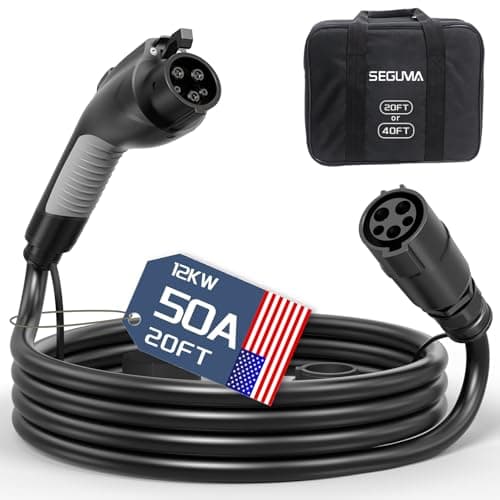
If your charger's cable is genuinely a few feet short, the SEGUMA 50A 20ft J1772 extension is the one to buy: it is the only cable here that states both a UL listing and 50-amp headroom at a length you can still coil on a hook. The EVDANCE 40A 21ft is the value pick for a normal 40-amp setup, the EVDANCE 50A NACS cable does the same job for a Tesla, the SEGUMA 40-footer exists for the driveway nothing else reaches, and the VEVOR is the budget option if the cable will only come out occasionally.
First, the distinction that decides whether this page applies to you at all. An EVSE extension cableis a J1772-to-J1772 (or NACS-to-NACS) cable that plugs into your charger's connector and presents the same connector at the far end. It sits on the vehicle side of the charger and carries the charging current plus the J1772 control-pilot and proximity-pilot signalling the car uses to negotiate the session. That is a completely different object from a household extension cord, which would sit on the supply side, between the wall and the charger. Charger manuals prohibit the second one, Tesla's included: the Mobile Connector manual says in as many words not to use an extension cord, a multi-outlet adapter, a power strip or a conversion plug to plug it in. Our extension cord safety guide covers why. Nothing on this page changes that answer.
Before you buy one at all: three better fixes
An extension is the second-best solution to a reach problem, and it is worth spending five minutes on the first-best ones. Every extra coupling in the path is a new place for resistance and heat, and every extra foot of cable is more voltage drop.
- Move the charger. A unit relocated a few feet along the wall, or to the other side of the garage, often closes the gap outright. See where to mount an EV charger.
- Buy a charger with a longer cable. Twenty-five feet is common and reaches either bay of a two-car garage. Our long-cable charger roundup lists the units that ship with one.
- Add an outlet where you actually park. A properly installed NEMA 14-50 at the right end of the garage is the safe version of extending reach, and it leaves you a reusable receptacle. See the best 14-50 outlets and the outlet guide.
If none of those work - a detached garage, a rented driveway, a charge port on the wrong corner of a car you did not choose - an extension cable is a reasonable answer. Buy the shortest one that closes the gap, buy the one with a listing, and inspect the couplings.
What the code says about length
The National Electrical Code caps the output cable of a listed charger at 25 feet of usable length under Article 625.17, unless the unit ships with a cable management system as part of its listing. For portable equipment the measurement runs from the attachment plug to the vehicle connector; for a fixed unit, from where the cable exits the enclosure to the vehicle connector.
An aftermarket extension is not part of that listing, so 625.17 does not literally govern it - but the number is still the most useful benchmark on this page. It tells you what the people who write the code think a reasonable EVSE cable run is. A 25-foot charger cable plus a 20-foot extension is already 45 feet; plus a 40-foot extension it is 65 feet. That is a lot of conductor, a lot of voltage drop, and a lot of cable to coil, store and avoid driving over. Treat 625.17's 25 feet as the shape of the right answer, not as permission to stack.
The picks
The SEGUMA 50A 20ft wins because it is the only cable in this category that states a UL listing and a 50-amp rating at a sane length. On a 40-amp charger that is real margin: the cable is never the thing running at its ceiling. The manufacturer lists 100 percent copper TPE, silver-plated contacts and IP66 weather protection.
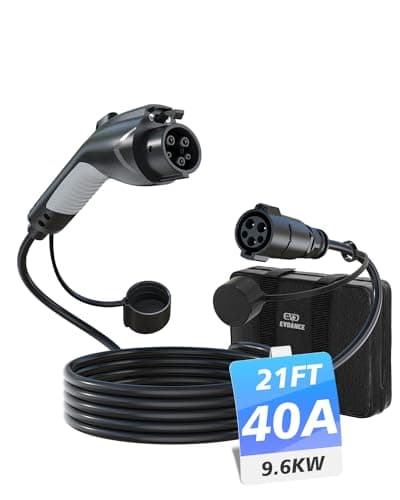
The EVDANCE 40A 21ft is the everyday pick. Forty amps matches the ceiling of the plug-in chargers most people own, EVDANCE is a real EV-charging brand rather than a one-listing seller, and the price does not start to rival the charger. It names IP66 and a 12-month warranty but no UL listing, which is the honest trade against the SEGUMA.
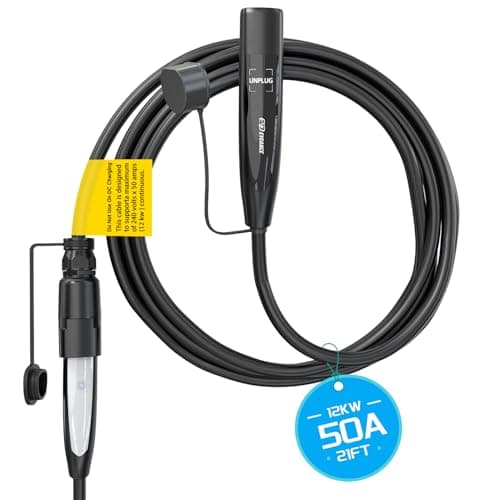
The EVDANCE 50A 21ft NACSis the same product cut for Tesla and native-NACS cars, with the connector on both ends so you are not stacking an adapter on top of an extension. It is rated above a Wall Connector's 48-amp ceiling and the manufacturer explicitly excludes Superchargers - as any passive cable must.
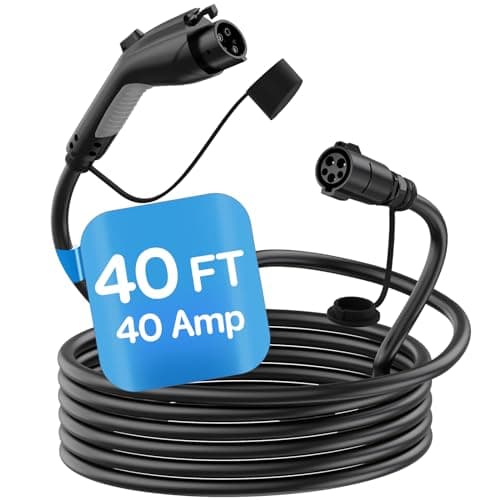
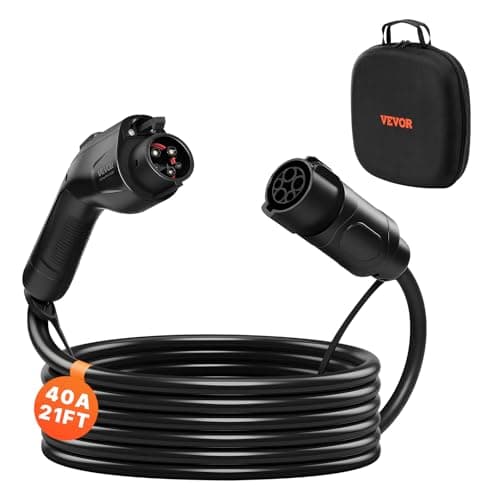
The SEGUMA 40A 40ft is the specialist. It ranks above the cheaper VEVOR for the same reason the page keeps making: it states a UL listing and the VEVOR does not. Buy it only when 20 feet genuinely will not do, because 40 feet is a lot of cable to manage and to warm up. The VEVOR 40A 21ft closes the list as the cheapest one we would consider, and it publishes a -22F to 122F operating range, which is a real specification for an unheated garage - just treat it as an occasional-use item rather than part of a permanent install.
Check the coupling by hand, every few weeks. An extension adds two more connections to a circuit that runs at full current for hours. Unplug and feel both ends after a session: warm is normal, hot is not. If either coupling is uncomfortable to touch, stop using it and read why an EV charger plug gets hot. Never leave an extension coiled tightly while charging - a coil traps its own heat.
How the five compare
| Cable | Amps / kW | Connector | Length | Safety listing | Weather | Price tier |
|---|
| SEGUMA 50A 20ft | 50A / up to 12 kW | J1772 to J1772 | 20 ft | UL listed (stated) | IP66 | Premium |
| EVDANCE 40A 21ft | 40A / up to 9.6 kW | J1772 to J1772 | 21 ft | None named | IP66 | Mid |
| EVDANCE 50A NACS | 50A / up to 12 kW | NACS to NACS | 21 ft | UL94 V-0 jacket only | IP66 | Mid |
| SEGUMA 40A 40ft | 40A / up to 9.6 kW | J1772 to J1772 | 40 ft | UL listed (stated) | IP66 | Premium |
| VEVOR 40A 21ft | 40A / up to 9.6 kW | J1772 to J1772 | 21 ft | None named | IP66, -22F to 122F | Budget |
Ratings above are as published by each manufacturer on its live listing. We compile and compare documented specifications and safety listings; we do not bench-test cables, and our methodology page says so plainly.
How to choose one
1. Match the connector, not the car
The extension has to match the charger's connector and your car's port, which on most setups are the same shape. A J1772 charger feeding a J1772 car wants a J1772-to-J1772 cable. A Tesla Wall Connector feeding a Tesla wants the NACS cable. If you already run an adapter, put the extension on the charger side and the adapter at the car, so you are never stacking two couplings at the same point. Unsure which port you have? Read how to tell if your EV has NACS or J1772 and the connector types explainer.
2. Buy above your charger's amperage, not at it
Amps are the specification that decides whether the cable runs warm or hot. A 40-amp charger on a 40-amp cable is running the cable at 100 percent of rating, continuously, for hours; the same charger on a 50-amp cable is running it at 80 percent. Headroom is cheap here. Work out what your charger actually delivers first - our what amp charger do I need guide walks the arithmetic - and buy a cable rated above it. If you run a 48-amp hardwired unit, the 40-amp cables on this page are the wrong purchase.
3. Convert amps to kW so you know what you are losing
Kilowatts are volts times amps divided by 1,000. At the 240 volts a Level 2 circuit supplies, 40 amps is 9.6 kW and 50 amps is 12 kW - which is why a 40-amp cable throttles a 48-amp charger from 11.5 kW down to 9.6 kW if you dial the charger down to suit it. On a car that adds roughly 30 miles of range per hour at 9.6 kW, that is real time. Full arithmetic in what kW means in EV charging.
4. Take the safety listing seriously, then the weather rating
Two different claims get confused constantly. UL listed means an independent lab tested the assembly to a safety standard. IP66 means dust-tight and protected against powerful water jets - a weather rating, not a safety certification. A cable can be IP66 and completely untested electrically. Where a UL listing is named, treat it as the tie-breaker; where none is, treat the cable as an occasional-use item rather than a permanent part of the install.
5. Buy the shortest one that works
Measure from the charger's connector, along the route the cable will actually take, to the car's port in the worst way you park - then add a couple of feet of slack, not ten. Longer cable means more voltage drop, more heat, more weight on the coupling and more to trip over. Twenty feet solves nearly every real gap. Forty is for a detached garage or a long driveway; see running a charger to a detached garage before you assume a cable is the answer to that one.
So, which one?
Buy the SEGUMA 50A 20ft unless you have a reason not to - the listing plus the headroom is worth the premium on a part that carries full current for hours. Want the same job done for less on a normal 40-amp setup? The EVDANCE 40A 21ft. Driving a Tesla or a native-NACS car? The EVDANCE 50A NACS. If the car really does park 40 feet from the charger, the SEGUMA 40ft is the only cable here that reaches - read the length section above before you commit to managing that much cable. And if you just want the cheapest thing that will work for occasional use, the VEVOR.