HUB 04 · Charging Costs
What Workplace EV Charging Is Really Worth
For anyone without home charging it can be the whole solution. For everyone else it is a question of price per kWh and whether you can actually get a stall.
We earn a commission when you buy through our Amazon links, at no extra cost to you. It never affects our rankings, and we say so when the cheaper product is the better buy. How this works.
Workplace charging is the most underrated fixture in EV ownership. The car sits still for eight hours anyway, which is exactly what Level 2 charging wants, and for a driver with no home charging it can quietly replace the entire problem. But "we have chargers at work" covers arrangements that range from better than home to worse than public - so it is worth knowing which one you have.
The four models, and what each is worth
- Free. The best case, obviously. If you can reliably get a stall, this is the cheapest energy you will ever put in the car - cheaper than your own house. Treat it as a genuine benefit with a real annual value.
- Subsidized, billed per kWh. Usually priced somewhere between residential electricity and public Level 2. Compare it directly against your home rate; if it is close, convenience decides.
- At cost, billed per kWh.Roughly the employer's commercial electricity rate. Often comparable to home charging, sometimes a little more.
- Billed per hour. The one to watch. Time-based pricing punishes slow charging and leaving the car plugged in after it is full - and a car that accepts only 32 amps pays the same per hour as one taking 48. Work out the effective per-kWh number before assuming it is a deal.
Convert everything to cost per kWh. It is the only way to compare an hourly workplace rate, a per-kWh public rate and your home rate on the same basis. Take what you paid, divide by the kilowatt-hours you actually received, and compare it with the home figure from cost to charge at home.
Run your own comparison
The calculator below gives you your home cost for a given amount of energy. Put your workplace price per kWh into the rate field and run it again - the difference over a month of commuting is your real answer. For most people the gap between a subsidized workplace rate and a home rate is small; the gap between either of those and public DC fast charging is not, as what public charging costs shows.
Run it for your car
Cost-to-charge calculator
Put in your electricity rate, your battery size and your car's efficiency. The math is the same one shown above, with a 10% charging loss included so the number is realistic.
- $8.09
- A 10% to 80% charge
- $11.56
- A full (empty to 100%) charge
- $0.05
- Cost per mile
- $5.08
- Cost per 100 miles
Estimate only. Actual cost depends on your exact utility rate (including any time-of-use pricing and fees), your car's real efficiency, temperature, and charging losses. Check your electric bill for your true rate.
The thing that matters more than the price: the ratio
A free charger you can never get onto is worth nothing. Before you plan around workplace charging, count the stalls and count the EVs in the lot. A handful of stalls among a growing number of EV drivers turns into an etiquette problem and a scheduling problem long before it turns into a budget problem. Ask two questions: is there a move-your-car policy, and is there a queue system? Those answers predict your experience better than the rate does.
Two practical notes. First, most workplace units are Level 2 at modest amperage, and your car's own acceptance rate may be the limit rather than the station - the framing is in what amp charger do I need. Second, if the workplace unit is a J1772 station and your car has a native NACS port, you need the small adapter with you - check which in the compatibility table.
When to charge at home anyway
Even with good workplace charging, home charging usually still earns its place - because it is available every night, it works at weekends, it needs no queue, and on a time-of-use rate it can be extremely cheap. The strongest position is both: home overnight on an off-peak rate, workplace as the free or cheap top-up that means you rarely think about it. If you are weighing whether the home side is worth the install, that is is a home EV charger worth it.
If workplace charging is your only charging
It can work, and plenty of people do it - it is the strongest of the no-home-charging options because the dwell time is long and the price is usually low. Build in a backup for the days the stalls are full: a portable unit in the trunk turns any legitimate outlet into a fallback, and a known public Level 2 spot near home covers the rest. The full honest assessment is in can you own an EV without home charging, and the curbside version is in charging an EV with street parking.
One last thing worth checking rather than assuming: employer-provided charging can interact with local incentive programs and with how the benefit is treated. Programs vary, so look up your own situation in the DOE laws and incentives database rather than relying on a general article, and take tax questions to a professional.
The gear
Recommended gear for this guide
The products this guide refers to, with prices pulled live from Amazon and dated on each card.
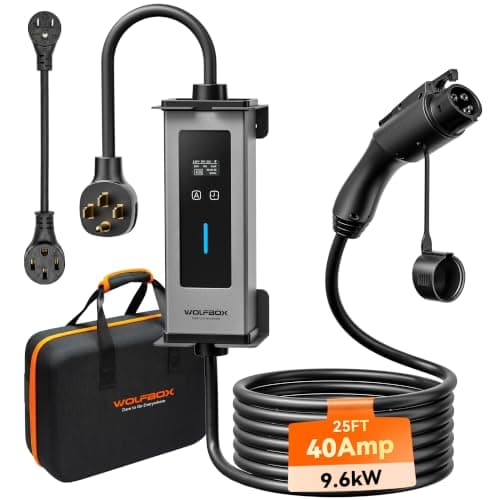
One charger for home and travel
WOLFBOX 40A Portable (Level 1/2)
A dual-level portable that doubles as a wall box — 40 amps on a NEMA 14-50, or Level 1 on a standard outlet with the included adapters. One weatherproof charger for the garage and the road.
#ad · As an Amazon Associate we earn from qualifying purchases.
Questions
Frequently asked
Is workplace EV charging usually cheaper than charging at home?
Free workplace charging is cheaper than anything. Paid workplace charging is usually somewhere between home electricity and public Level 2 rates. Convert whatever you are charged into a cost per kWh and compare it with your home rate directly.
Why is per-hour workplace charging a problem?
Because you pay for time rather than energy. A car that accepts a lower amperage receives fewer kilowatt-hours for the same money, and leaving a full car plugged in keeps costing. Work out the effective per-kWh rate before calling it a bargain.
Can workplace charging replace home charging entirely?
It can, and it is the strongest of the no-home-charging options because the car sits for eight hours. Plan a backup for days the stalls are full, and remember it does not help at weekends.
Do I need an adapter for workplace chargers?
Most public and workplace Level 2 stations use a J1772 plug. If your car has a native NACS port you need a small J1772-to-NACS adapter in the car. If your car has a J1772 or CCS port, nothing is needed.
Keep reading
Related
- Home vs Public Charging CostThe two ends of the range workplace charging sits between.
- Can You Own an EV Without Home Charging?Where workplace charging does the heavy lifting.
- Charging with Street ParkingThe situation workplace charging most often rescues.
- Off-Peak & Time-of-Use ChargingHow cheap the home side can get if you schedule it.
- NACS Adapter CompatibilityWhether you need an adapter for a J1772 workplace station.
More in this section
More Charging Costs
Receipts
Sources
- US DOE AFDC - charging an EV at home
- US EIA - average retail price of electricity by state and sector
- US DOE AFDC - laws and incentives database
We do not run a testing lab, and we do not pretend to. Where a measured number came from someone else's lab, we name them and link them. Where we could not verify something, we say so on the page rather than quietly leaving it out. Read our full method.