HUB 03 · Charging Guides
How Long Does It Take to Charge an EV at Home?
One formula, a clear table, and the reframe that ends the anxiety - at home you top up overnight, so the number that matters is not empty-to-full.
We earn a commission when you buy through our Amazon links, at no extra cost to you. It never affects our rankings, and we say so when the cheaper product is the better buy. How this works.
The honest short answer: at home you rarely charge from empty, so the time that matters is how much range you add overnight - and on Level 2 that is more than a normal day's driving, every night. Still, the full-charge number is easy to compute. It comes down to one formula: battery size divided by charging power, adjusted for the roughly 10 percent lost as heat. Here is the math and a table you can read your car off.
The formula
Charging time in hours is approximately the energy you need to add, divided by the charging power in kilowatts, divided by about 0.9 for losses:
Hours ~= kWh added / (kW x 0.9)
Example: adding 50 kWh at 11 kW (a 48-amp charger) = 50 / (11 x 0.9) = about 5 hours.
The power in that formula is set by the lowerof two things: your charger's output and your car's onboard AC limit. A 48-amp charger feeding a car capped at 32 amps charges at 32 amps - see what amp charger do I need. The specifics per model live on our cost and charging pages.
Level 1 vs Level 2, side by side
| Setup | Power | Range added / hour | Overnight (8 hrs) |
|---|---|---|---|
| Level 1 (120V outlet) | ~1.4 kW | ~3-5 miles | ~30-40 miles |
| Level 2, 32A | ~7.7 kW | ~25 miles | ~200 miles |
| Level 2, 40A | ~9.6 kW | ~30 miles | ~240 miles |
| Level 2, 48A | ~11.5 kW | ~35-40 miles | ~280-320 miles |
Read that last column again: even a modest 32-amp Level 2 setup adds around 200 miles across a normal night. Unless you drove nearly the whole battery down, you wake up full. That is why Level 2 changes the ownership experience - the empty-to-full figure stops mattering.
Why empty-to-full is the wrong question at home
Public fast charging is measured 10-to-80-percent because you are waiting at the station. At home you are asleep, so the useful metric is "did I replace what I drove today?" For a 40-mile commute, a 40-amp charger needs under 90 minutes - the car is done long before morning regardless of how full it started. The big empty-to-full number (say 9 hours for a 100-kWh pack at 11 kW) only matters the night before a road trip.
What actually changes your time
- Your car's onboard limit. The hard ceiling. A bigger charger cannot beat it - covered in 32 vs 48 amps.
- Charger amperage.Up to the car's limit, more amps means proportionally faster - the reason to consider a 48-amp unit for a big battery.
- Cold weather. A cold battery accepts power more slowly and spends some energy warming itself - see winter charging.
- State of charge. AC home charging holds a steady rate almost the whole way, unlike DC fast charging, so home time scales cleanly with the kWh you add.
Bottom line: pick a charger that matches your car's amperage, plug in nightly, and the "how long" question mostly disappears. The value pick for most homes is the Emporia; for a large battery that rewards 48 amps, the Grizzl-E Ultimate. See how both place against the rest in the best Level 2 chargers for home.
The gear
Recommended gear for this guide
The products this guide refers to, with prices pulled live from Amazon and dated on each card.
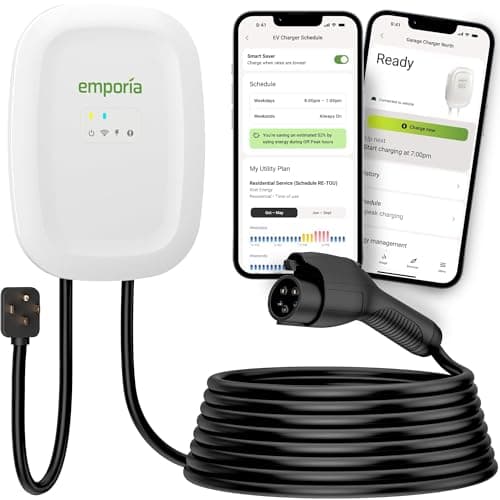
Most homes that want speed and smarts
Emporia Level 2 (48A)
The charger that refuses to charge you extra for being smart: full 48-amp speed and real energy monitoring at roughly the price of a plain plug-in box.
- Guide
A permanent, weatherproof 48A install
Grizzl-E Ultimate (48A)
A dedicated 48-amp charger in a cast-aluminum, IP67 shell - the toughest full-speed box here, built to be hardwired to a wall and left to work.
#ad · As an Amazon Associate we earn from qualifying purchases.
Questions
Frequently asked
How long to charge an EV at home overnight?
On Level 2, an overnight charge adds roughly 200-320 miles of range depending on amperage - far more than most people drive in a day, so the car is typically full by morning even if it was not fully charged from empty. On Level 1, expect only about 30-40 miles overnight.
How do I calculate my EV charging time?
Divide the energy you need to add (kWh) by the charging power (kW), then by about 0.9 for losses. Adding 50 kWh at 11 kW is roughly 50 / (11 x 0.9), about 5 hours. Use the lower of your charger's and your car's power ratings.
Why does my EV charge slower than the charger's rating?
Because the car's onboard charger sets the ceiling. If it accepts only 32 amps, a 48-amp charger still delivers 32. Cold weather and a nearly full battery can also slow the last stretch slightly.
Keep reading
Related
More in this section
More Charging Guides
Receipts
Sources
- US DOE / fueleconomy.gov - EV charging basics
- US DOE AFDC - charging at home
- US DOE Energy Saver - electric vehicles
We do not run a testing lab, and we do not pretend to. Where a measured number came from someone else's lab, we name them and link them. Where we could not verify something, we say so on the page rather than quietly leaving it out. Read our full method.