HUB 02 · Cables & Adapters
Does My Hyundai or Kia Need a Charging Adapter?
Hyundai and Kia went NACS first, which flips the usual answer: on the newest cars it is the home charger that needs the adapter, not the Supercharger. Here is which car you have.
We earn a commission when you buy through our Amazon links, at no extra cost to you. It never affects our rankings, and we say so when the cheaper product is the better buy. How this works.
Hyundai and Kia moved to the Tesla-style plug before anyone else, so their owners hit the adapter question in reverse. On a native-NACS Ioniq 5, EV6 or EV9, it is the home charger that needs a small adapter - not the Supercharger. On the CCS cars, the opposite. Here is which one you have and what to buy.
The model-year split, from the manufacturers
- Hyundai: the 2025 IONIQ 5 is the first Hyundai with a native NACS port - Hyundai says so in its own NACS FAQ, and it was the first mass-market non-Tesla to ship one. The 2026 IONIQ 9 also has a native NACS inlet. Note the exception Hyundai spells out: IONIQ 5 N vehicles do not have the native NACS port.
- Kia: the 2025 EV6 and 2026 EV9come standard with NACS ports, per Kia's own announcement.
- Everything older - pre-2025 Ioniq 5, Ioniq 6, 2024 EV6, 2024/2025 EV9, Niro EV, and the Genesis electrics - uses a CCS port whose AC half is a plain J1772 socket.
Both makers ran complimentary adapter programs for the CCS cars so they could reach Tesla Superchargers, ordered through the owner app against your VIN. Kia is explicit that its adapter is developed and tested for Kia vehicles only - manufacturer DC adapters are not universal accessories.
At home, the answer is the opposite of what people expect
A native NACS inlet on an Ioniq 5, EV6 or EV9 handles both AC and DC. That is good news at a Tesla Wall Connector and awkward everywhere else, because the enormous installed base of home and public Level 2 chargers is J1772. So on a 2025-or-newer NACS car you add a cheap, passive J1772-to-NACS adapter and keep buying ordinary J1772 wall chargers - which is exactly what our Hyundai and Kia charger roundup recommends.
On a CCS-port Hyundai or Kia, no home adapter is needed at all: a J1772 plug goes straight into the AC half of the inlet.
One warning worth repeating, because Hyundai prints it too: do not put a CCS adapter on a J1772 Level 2 charger. The CCS adapter that ships with a native-NACS Hyundai is for DC fast charging. For a J1772 wall charger you want a J1772-to-NACS AC adapter - a different part. Hyundai warns that getting this wrong can cause vehicle damage that is not covered by the warranty.
The 800-volt catch nobody mentions
Here is the part that gets left out of the celebratory NACS coverage, and it is the reason this site exists. Hyundai and Kia's E-GMP cars run an 800-volt architecture. Tesla's V3 Supercharger hardware was built around roughly 400 volts. So a native-NACS Ioniq 5 plugged into a V3 Supercharger - with no adapter, exactly as advertised - can charge slower than the same car on a CCS charger through an adapter. Reporting on the 84 kWh 2025 Ioniq 5 put it at about 20 minutes for 10 to 80 percent on CCS at a 257 kW peak, against roughly 30 minuteson a V3 Supercharger. Tesla's newer V4 cabinet hardware raises the ceiling, but the stall you pull into still decides the result.
None of that touches home charging - your onboard AC charger caps you near 11 kW either way, which is the point our Ioniq and EV6 home charging page makes. It matters on a road trip, and it is a good reason to read a charge curve rather than a peak kW number.
The bottom line
Native-NACS car (2025 Ioniq 5, 2026 Ioniq 9, 2025 EV6, 2026 EV9): buy a J1772 wall charger and a J1772-to-NACS adapter. CCS car: buy a J1772 wall charger and nothing else, and claim the factory NACS DC adapter for road trips. In both cases the wall charger is the same purchase, and it is the one worth spending time on.
The gear
Recommended gear for this guide
The products this guide refers to, with prices pulled live from Amazon and dated on each card.
A Tesla / NACS car using J1772 chargers
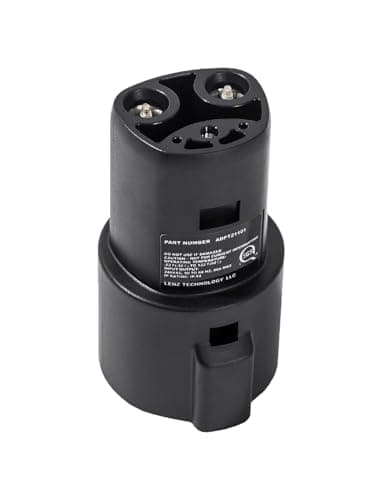
LENZ J1772 → NACS Adapter
A UL-2251-certified J1772-to-NACS adapter — the one a Tesla or a 2026+ NACS-port EV needs to use the enormous installed base of J1772 chargers.
A cheap J1772 → Tesla adapter
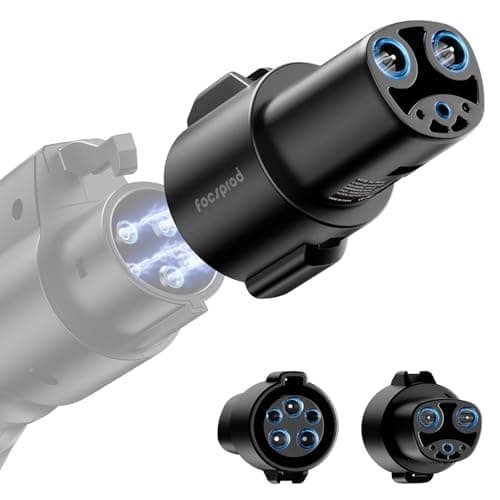
FOCSPROD J1772 → Tesla Adapter
A UL-2252-listed budget adapter for charging a Tesla at any J1772 station — cheap insurance for a road trip.
#ad · As an Amazon Associate we earn from qualifying purchases.
Questions
Frequently asked
Does a 2025 Ioniq 5 need an adapter for a home charger?
Yes, a small passive J1772-to-NACS AC adapter, because its native NACS inlet does not accept a J1772 plug directly. The wall charger itself is an ordinary J1772 Level 2 unit - see our Hyundai and Kia picks.
Can I use the CCS adapter that came with my Ioniq 5 on my home charger?
No. Hyundai explicitly warns against using a CCS adapter with a J1772 Level 2 charger and says the resulting damage may not be covered by the warranty. The DC adapter and the AC adapter are different parts for different jobs.
Why is my NACS Ioniq 5 slower at a Supercharger than on CCS?
Because it is an 800-volt car and older Supercharger hardware was built around 400 volts. Reporting on the 84 kWh 2025 Ioniq 5 showed roughly 20 minutes for 10-80 percent on CCS versus about 30 minutes on a V3 Supercharger. Newer V4 hardware raises the ceiling.
Does the Ioniq 5 N have a native NACS port?
Hyundai's own FAQ says IONIQ 5 N vehicles do not have the native NACS port that the standard 2025 IONIQ 5 has. Check your own inlet before buying any adapter.
Keep reading
Related
- Best Home Chargers for a Hyundai or KiaThe J1772 field an Ioniq or EV6 actually uses at home.
- J1772-to-NACS AdaptersThe AC adapter a native-NACS Ioniq, EV6 or EV9 needs.
- NACS Adapter Compatibility by BrandThe whole industry in one table.
- 400V vs 800V ChargingWhy an 800-volt car can be slower on 400-volt hardware.
- Ioniq & EV6 Home ChargingThe overnight time and cost, where the connector is irrelevant.
More in this section
More Cables & Adapters
Receipts
Sources
- Hyundai - NACS adapter FAQs (the 2025 IONIQ 5 is the first Hyundai with a native NACS port; IONIQ 5 N does not have one; free NACS adapters for CCS-port Hyundai and Genesis EVs)
- Kia Media - EV6, EV9 and Niro owners gain access to Tesla Superchargers (2025 EV6 and 2026 EV9 come standard with a NACS port)
- Kia - NACS adapter program (complimentary adapters for CCS-port Kia EVs; Kia warns the adapter is validated for Kia vehicles only)
- US DOE AFDC - charging an EV at home
We do not run a testing lab, and we do not pretend to. Where a measured number came from someone else's lab, we name them and link them. Where we could not verify something, we say so on the page rather than quietly leaving it out. Read our full method.