HUB 03 · Charging Guides
EV Charger Cable Length Guide
A tethered cable is fixed at purchase, so getting the length right matters. Here is how to measure, how much slack to add, and the safety ceiling to respect.
We earn a commission when you buy through our Amazon links, at no extra cost to you. It never affects our rankings, and we say so when the cheaper product is the better buy. How this works.
Because most home chargers are tethered - cable permanently attached - length is a decision you make once and live with. Too short and you are stretching or reparking; too long and you are wrestling a heavy coil. The sweet spot for most garages is a 24-to-25-footcable, but the right answer is whatever reaches your car's port from where the charger mounts, with slack to spare. Here is how to get it right.
Measure, do not guess
Park the car exactly where it normally sits. Find the charge port - it might be front-left, rear-left, front-right or rear-quarter depending on the car - and run a tape measure from the spot on the wall where the charger will mount, along the realistic path the cable will travel, to the port. That path is rarely a straight line: it drops to the floor, rounds the car, and rises to the port. Then add slack.
Rule of thumb: take your straight-line wall-to-port distance and add about 50 percent for the floor drop, the route around the car, and hanging slack. A 15-foot straight line usually wants a 20-to-25-foot cable in practice.
Plan for parking either way around
The port is on one side of the car, but you will not always park the same way - and a second EV may have its port on the opposite side. A cable that only just reaches when the car is nose-in becomes useless when it is backed in. Sizing for the farthest likely port position (worst-case parking, both cars) is why 24-to-25 feet is the popular default: it clears a two-car garage and reaches either side. Chargers like the Emporia (25 ft) and ChargePoint Home Flex (23 ft) ship long for exactly this reason.
Why longer is not always better
It is tempting to buy the longest cable available, but there are real downsides. A long Level 2 cable is heavy and stiff, especially in cold weather, so daily handling is more of a chore. It also needs somewhere to live - a cable hook or holster - or it drags on the floor and wears. And there is a code ceiling: NEC Article 625 limits the length of the charging cord (the output cable) to 25 feet for a fixed EVSE, so units cluster around 18-25 feet rather than offering 40. Longer is not an option past that, by design.
If the charger cannot reach the panel
Cable length is about reaching the car. Reaching the panelis a different question - that is the wiring run from your breaker box to the charger's location, which an electrician handles, and longer runs can need heavier wire for voltage drop. We cover that in how far can a charger be from the panel. Do not try to solve a mounting-location problem with a longer charge cable; solve it by mounting the charger where it needs to be and running the circuit to it.
Quick reference
| Cable length | Good for |
|---|---|
| 16-18 ft | Charger mounted close to the port; single, consistent parking spot |
| 20-23 ft | Typical single-car garage with some routing around the car |
| 24-25 ft | Two-car garage, either-side parking, or a second EV - the safe default |
Mount the charger, measure honestly, add slack, respect the 25-foot ceiling, and give the cable a hook to hang on. Get it right once and you never think about it again. Cable length is one of the four spec chips on every unit in our ranked Level 2 chargers, so you can filter on it before anything else.
The gear
Recommended gear for this guide
The products this guide refers to, with prices pulled live from Amazon and dated on each card.
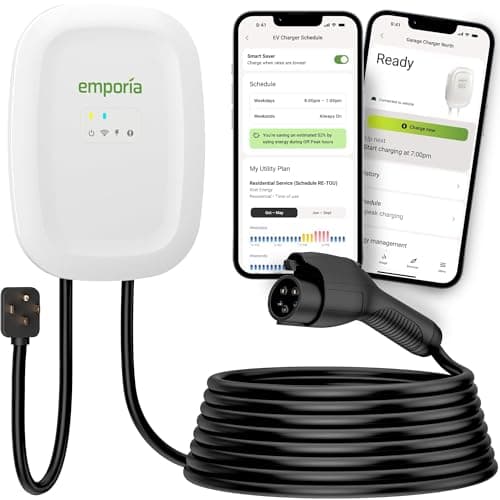
Most homes that want speed and smarts
Emporia Level 2 (48A)
The charger that refuses to charge you extra for being smart: full 48-amp speed and real energy monitoring at roughly the price of a plain plug-in box.
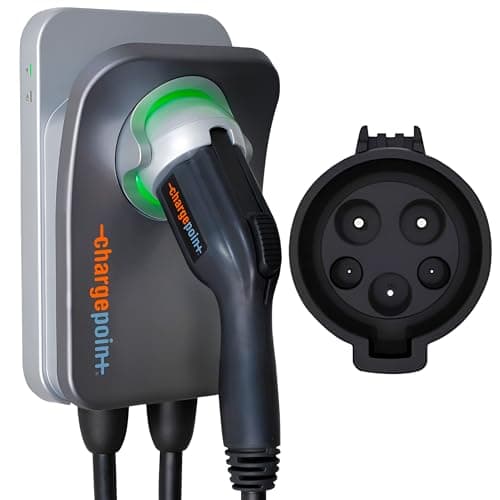
Buyers who want the established brand + one app
ChargePoint Home Flex
The mature, well-supported pick — amperage you dial in up to 50A, wired into the biggest public-charging app in North America. You pay for the polish.
#ad · As an Amazon Associate we earn from qualifying purchases.
Questions
Frequently asked
How long should an EV charger cable be?
For most homes, 24-to-25 feet - long enough to reach the charge port from a wall mount even when the car is parked the opposite way or a second EV has its port on the other side. If the charger mounts right beside the port, 16-18 feet can be enough.
Is there a maximum EV charger cable length?
Yes. NEC Article 625 limits a fixed charger's output cord to 25 feet, which is why home units top out around 18-25 feet rather than offering longer options. To reach a farther spot, you move the charger and run the circuit to it, not extend the charge cable.
Can I use an extension cord to reach my EV?
No - running a Level 2 charger through a household extension cord is a fire risk and against manufacturer guidance. Size the cable correctly or relocate the charger. See our extension cord safety guide.
Keep reading
Related
- EV Charging Cable ManagementStoring the length you chose with a holster and hook.
- Tethered vs untetheredWhy a fixed cable makes length a one-time call.
- Extension cord safetyWhy you never solve reach with an extension cord.
- How far from the panel?The wiring-run question, separate from cable length.
- Best extension cablesWhen the cable you have really is too short, ranked.
More in this section
More Charging Guides
Receipts
Sources
- EC&M - NEC requirements for EV equipment (Article 625: cord length, circuit sizing)
- US DOE AFDC - charging at home
We do not run a testing lab, and we do not pretend to. Where a measured number came from someone else's lab, we name them and link them. Where we could not verify something, we say so on the page rather than quietly leaving it out. Read our full method.