HUB 05 · The Charge Curve
Does Charging at 48 Amps Hurt Your Battery?
Short answer: no, and the fleet data is clear about where degradation really comes from. Here is what the numbers say, and the three cases where charging slower is still the right call.
We earn a commission when you buy through our Amazon links, at no extra cost to you. It never affects our rankings, and we say so when the cheaper product is the better buy. How this works.
No. Charging at 48 amps instead of 32 does not meaningfully shorten your battery's life, and the reason is a matter of scale: even the fastest home charger is a gentle, low-power trickle compared with the DC fast charging that the degradation data actually implicates. Geotab's analysis of real-world fleet data puts average EV battery degradation at 2.3 percent a year, and identifies high-power DC fast charging above 100 kW as the single largest stressor - up to 3.0 percent a year against 1.5 percent for vehicles that mostly charge at low power. A 48-amp home charger delivers 11.5 kW. It is in the low-power group, and so is a 32-amp charger.
This is a different question from does fast charging degrade your battery, which covers DC. People conflate the two because both are described as "fast charging", and the conflation leads to a specific, costly mistake: buying a cheaper, slower home charger to protect a battery that was never at risk from the faster one.
Why AC charging is a different physical problem
At a DC fast charger, the station pushes direct current into the pack directly, at 50, 150 or 350 kW. The pack's own thermal management is the only thing standing between that power and the cells, and the heat it has to move is proportional to the power.
At home on AC, nothing like that happens. The wall unit is not a charger at all in the technical sense - it is supply equipment that switches a 240-volt circuit on and tells the car how many amps it may take. The car's onboard charger does the AC-to-DC conversion, and it is a fixed-capability device: most EVs cap at 7.2, 9.6, 11 or 11.5 kW regardless of what the wall unit could supply. The pack never sees more than the onboard charger can make.
| Charging method | Typical power | Who converts to DC | Where it sits in the degradation data |
|---|---|---|---|
| Level 1, 120V, 12A | 1.4 kW | Car's onboard charger | Low-power group |
| Level 2, 240V, 32A | 7.7 kW | Car's onboard charger | Low-power group |
| Level 2, 240V, 48A | 11.5 kW | Car's onboard charger | Low-power group |
| DC fast charging, 50 kW | 50 kW | The station, straight into the pack | Moderate power |
| DC fast charging, 150 kW and up | 150-350 kW | The station, straight into the pack | The high-power group the data flags |
The gap between the third and fifth rows of that table is a factor of thirteen or more. The gap between the second and third - the entire 32-versus-48-amp question people agonize over - is a factor of 1.5, inside the band the data treats as low power either way.
What the degradation data actually points at
If you want to protect the pack, the fleet figures say to spend your attention on three other things.
1. How often you DC fast charge, and how hard
This is the one with a real measured effect: vehicles that frequently use high-power DC fast charging are projected at roughly 76 percent capacity after eight years, versus 88 percent for those relying on lower-power charging. Note the framing - frequently. Road trips are not the problem; making DC your everyday charging is. Which is, incidentally, the best argument for a home charger existing at all.
2. Heat
Vehicles operating in hot climates degrade about 0.4 percent per year faster than those in mild ones. You cannot change your climate, but you can park in shade, avoid leaving the car sitting at a high state of charge in summer heat, and prefer overnight charging when ambient temperatures are lowest. Our cold-weather battery guide covers the other end of the thermometer.
3. Time spent at the extremes of charge
Here the data is more reassuring than the internet is. Degradation only accelerates when a vehicle spends more than about 80 percent of its total time at or near full, or near empty - at that level of exposure the rate rises to around 2.0 percent a year, against 1.4 to 1.5 percent for low and medium exposure. For normal use there is no need to obsess about avoiding a full charge. What matters is not reaching 100 percent, it is sitting at 100 percent for days. See should you charge to 100 percent.
Notice what is not on that list: the amperage of your home charger. It does not appear because it does not materially move the number.
Three reasons to dial your charger down anyway
None of them is battery health, and all three are legitimate.
- Your panel cannot feed it. A 48-amp charger needs a 60-amp circuit. If the load calculation says 32 amps, you set 32 amps - and lose nothing you will notice overnight. Our chargers for a 100-amp panel roundup covers that case specifically.
- You are on a time-of-use rate with a narrow cheap window. Here the logic runs the other way: a higher rate is better, because it fits the whole charge inside the cheap hours. Dial down only if the window is wide.
- Your circuit, outlet or cord is marginal. If a receptacle runs warm, reducing the current is a sensible interim measure while you get it looked at. It is a symptom-management step, not a fix - see EV charger plug getting hot.
The one case where the charger does matter
Buy for the car, not for the battery. If your EV's onboard charger accepts 7.2 kW, a 48-amp wall unit cannot make it charge faster - you are paying for a 60-amp circuit to deliver 32 amps of useful work. If it accepts 11 or 11.5 kW, a 40-amp charger leaves real speed on the table. That is the decision this question should actually turn on, and it is the same arithmetic as how fast will my EV charge and 32 amps vs 48 amps.
One honest caveat on all of the above: these figures are fleet averages from a large real-world dataset, not a guarantee about your individual car, and chemistry differs. An LFP pack and an NMC pack have different tolerances, including for sitting at 100 percent - see NMC vs LFP charging. Your manufacturer's own guidance in the owner's manual always wins over a general average, including ours.
What to look for if you want the choice later
The practical conclusion is not "buy a slow charger". It is "buy one whose amperage you can change", so the setting follows your panel, your rate plan and your next car rather than being fixed at purchase.
- A published adjustment range, not just a maximum. 16 to 48 amps is far more useful than a fixed 48, and a unit that goes down to 12 or 16 covers a tight panel.
- A setting you can reach. In-app is convenient; an internal dial set at install is tamper-proof. Both are fine - what is not fine is a unit where the method is undocumented.
- Hardwire capability if you want the full 48 amps, since most plug-in units are limited to 40 by their NEMA 14-50 plug.
- A real safety listing - UL or ETL to UL 2594 - because the protective functions you are relying on are the listed part.
The four below are the adjustable registry picks that satisfy that list.
The gear
Recommended gear for this guide
The products this guide refers to, with prices pulled live from Amazon and dated on each card.
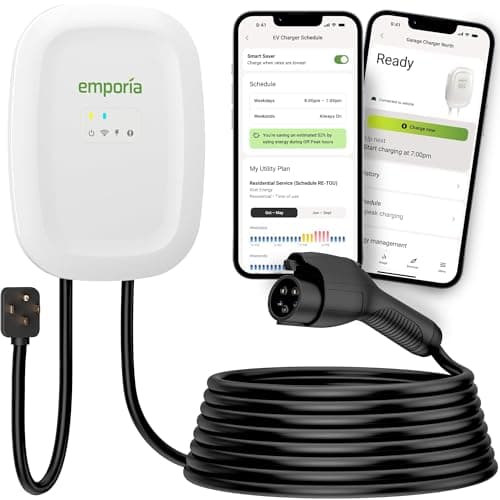
Most homes that want speed and smarts
Emporia Level 2 (48A)
The charger that refuses to charge you extra for being smart: full 48-amp speed and real energy monitoring at roughly the price of a plain plug-in box.
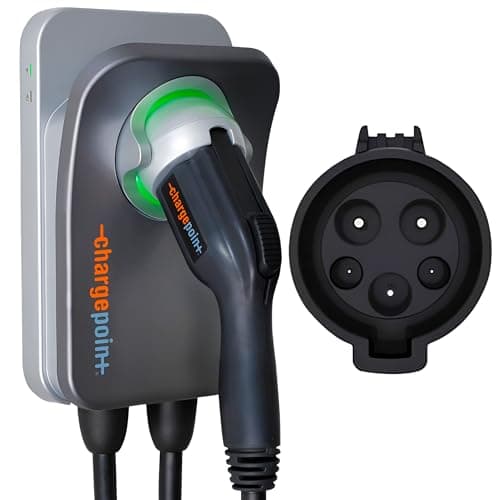
Buyers who want the established brand + one app
ChargePoint Home Flex
The mature, well-supported pick — amperage you dial in up to 50A, wired into the biggest public-charging app in North America. You pay for the polish.
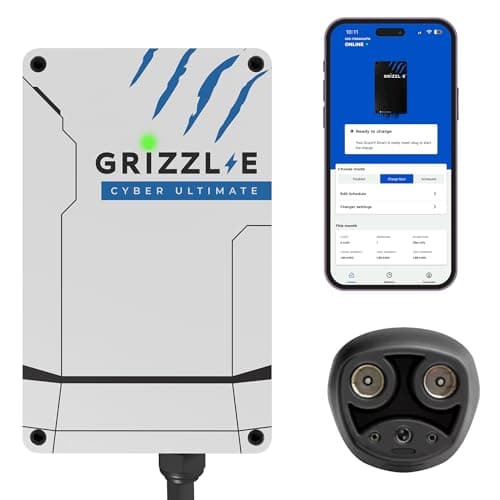
One charger that fits whatever circuit you end up with
Grizzl-E Ultimate 80A (NACS)
An 80-amp unit that is genuinely useful at every amperage below 80 too - adjustable in six documented steps down to 16 amps, in a UL Type 4 metal case.
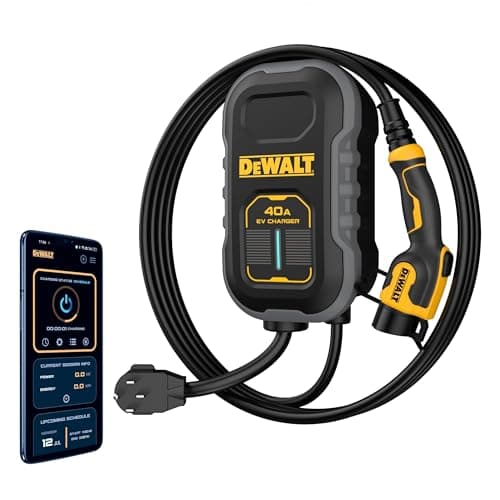
A tight garage that still wants an app
DEWALT Level 2 Compact (40A)
The rare charger with compact in the model name that publishes numbers to back it up - 4.6 inches deep, 10.7 pounds, and a plug-in install.
#ad · As an Amazon Associate we earn from qualifying purchases.
Questions
Frequently asked
Is it better to charge an EV slowly at home?
Not for the battery's sake. Every Level 2 rate - 16 amps or 48 - sits in the low-power band that the fleet degradation data treats as benign, because the car's onboard charger caps the power long before the pack is stressed. Charge at whatever rate suits your circuit and your electricity rate. The thing worth avoiding is making high-power DC fast charging your daily habit.
Does a 48-amp charger degrade the battery faster than a 32-amp one?
No measurable difference. 48 amps at 240 volts is 11.5 kW and 32 amps is 7.7 kW; both are a fraction of the 100 kW-plus DC charging that the data associates with roughly double the annual degradation rate. If your car accepts 11 kW or more and your panel can feed a 60-amp circuit, use the 48 amps.
What actually causes EV battery degradation?
In the fleet data: frequent high-power DC fast charging (up to 3.0 percent per year against 1.5 percent for low-power charging), heat (hot climates about 0.4 percent per year faster), and spending the large majority of the time at or near full or empty (about 2.0 percent per year at that exposure). Average degradation across all vehicles is about 2.3 percent a year. Home charging amperage is not on the list.
Should I avoid charging to 100 percent at home?
For most use, you do not need to worry about it. Degradation accelerates when a vehicle spends more than about 80 percent of its time at or near full - the issue is prolonged sitting at a high state of charge, not touching 100 percent before a trip. LFP packs are a separate case and many manufacturers explicitly ask for a periodic full charge; check the manual. More in should you charge to 100 percent.
Does the charger brand affect battery life?
No. A listed charger is supply equipment: it switches the circuit and tells the car a current limit over the J1772 control pilot. The car's own onboard charger and battery management system control everything that touches the cells, and they will reject anything out of spec. What a good charger protects is your wiring and your house, not your pack - which is why the safety listing matters even though the battery question does not.
Is 80 amps or 19.2 kW home charging bad for the battery?
It is still AC charging through the car's onboard charger, so it is still far below the DC power levels the degradation data flags - and only a handful of vehicles can accept 19.2 kW anyway. The reasons to think twice about an 80-amp install are electrical and financial: it needs a 100-amp circuit. See best 80-amp chargers.
Keep reading
Related
- Does fast charging degrade your battery?The DC version of this question, where the data does show an effect.
- Should you charge to 100 percent?State of charge, which matters more than amperage.
- 32 amps vs 48 ampsThe decision this question should actually turn on: your car and your panel.
- NMC vs LFP chargingWhy the 100-percent advice differs by chemistry.
- How fast will my EV charge?The onboard-charger ceiling that caps every home charging rate.
- Best adjustable chargersThe units that let you change the amperage after you buy.
More in this section
More The Charge Curve
Receipts
Sources
- Geotab - EV battery health (average 2.3 percent annual degradation; high-power DC fast charging up to 3.0 percent per year versus 1.5 percent for low-power charging; hot climates 0.4 percent faster)
- US DOE / fueleconomy.gov - how electric vehicles work (onboard charger and battery)
- US DOE / fueleconomy.gov - EV charging basics (Level 1, Level 2 and DC fast charging)
- EC&M - NEC requirements for EV equipment (Article 625: EVSE is a continuous load, circuits sized at 125 percent of the load)
- Tesla - onboard charger (the AC rate a vehicle can accept at home)
- Emporia - adjusting the amperage / charge rate on your EV charger
- ChargePoint - Home Flex amperage settings
- SAE J1772 specification (the AC coupler, control pilot and proximity detection)
We do not run a testing lab, and we do not pretend to. Where a measured number came from someone else's lab, we name them and link them. Where we could not verify something, we say so on the page rather than quietly leaving it out. Read our full method.