HUB 03 · Charging Guides
How to Choose an EV Charger
Five decisions settle it - amperage, plug-in or hardwired, smart or simple, connector, and cable length. Here is the plain rule for each, in the order that matters.
We earn a commission when you buy through our Amazon links, at no extra cost to you. It never affects our rankings, and we say so when the cheaper product is the better buy. How this works.
Choosing a home charger feels harder than it is because every listing shouts a different spec. In practice, five decisions settle almost every purchase, and they stack in a sensible order: how many amps, plug-in or hardwired, smart or simple, which connector, and how long a cable. Answer them in that order and the shortlist writes itself. We compile published specs and do the arithmetic - we do not run a bench lab - so treat this as a documented buyer's framework, not a product test.
Step 1: How many amps - and it starts with your car
The single biggest speed lever is amperage, but the ceiling is set by your car's onboard charger, not the wall unit. Most EVs accept either 32 amps (about 7.7 kW) or 48 amps (about 11.5 kW)of AC at home. Buying a 48-amp charger for a car capped at 32 adds nothing but a bigger breaker bill. Confirm your car's figure first, then match it - the full method is in what amp EV charger do I need.
A useful default: if your car accepts 48 amps and your panel can carry a 60-amp circuit, buy a 48-amp charger. If either is uncertain, a 40-amp unit on a 50-amp circuit is the no-regrets middle - see 32-amp vs 48-amp.
Step 2: Plug-in or hardwired
A plug-in charger hangs on a NEMA 14-50 outlet and can be unplugged and taken to a new house; a hardwired charger is wired straight to the circuit. Plug-in is more flexible and simpler to swap; hardwired is required for the full 48-amp tier and avoids a receptacle that can degrade under a continuous 40-amp draw. Most people are happy plug-in at 40 amps; go hardwired if you want 48 amps or a permanently weather-sealed install. The trade-offs are laid out in hardwired vs plug-in.
Step 3: Smart or simple
A smart charger adds Wi-Fi, an app, scheduling and energy monitoring. Those features earn their keep in two situations: a time-of-use electricity plan, where automatic off-peak scheduling shifts charging to cheaper hours, and a two-car home, where load management lets units share a circuit. On a flat rate with one car, a simple charger does the identical core job with nothing to fail. The good news is that smart no longer means expensive - the value picks bundle it in for roughly the price of a plain box, which is why we lean smart by default. See do I need Wi-Fi.
Step 4: Which connector - J1772 or NACS
Home Level 2 charging uses one of two plugs: J1772, the long-standing North American AC standard, or NACS (the Tesla-style connector, formally J3400). A J1772 charger serves a J1772 car directly and a NACS car through a small passive adapter, and the reverse holds too. Because adapters are cheap and reliable, connector shape rarely decides the purchase - most buyers get a J1772 unit and adapt if needed. The full matrix is in connector types explained.
Step 5: How long a cable
The last decision is the one people forget until the box arrives: cable length. Measure from where the charger mounts to where the car's charge port sits when parked, then add slack for wrapping and for parking either way around. A 24-to-25-foot cable clears a two-car garage; a 16-to-18-foot cable can leave you stretching. It is a cheap thing to get wrong - our cable length guide has the tape-measure method.
Put it together
Run the five steps and you land on a unit: amps matched to your car, plug-in or hardwired to match your ambitions, smart if you are on a variable rate or have two EVs, a connector you can adapt, and a cable long enough to reach. From there, the shortlist is short. The value winner for most homes is the Emporia Level 2; the budget pick is the EVIQO; and the rugged 48-amp option is the Grizzl-E Ultimate. Compare the full field in the best Level 2 roundup.
Whatever you choose, the circuit behind it - a new 240V line, a breaker, an outlet - is NEC work for a licensed electrician, not a weekend job. Pick the charger, then have a pro size and install the circuit it needs.
The gear
Recommended gear for this guide
The products this guide refers to, with prices pulled live from Amazon and dated on each card.
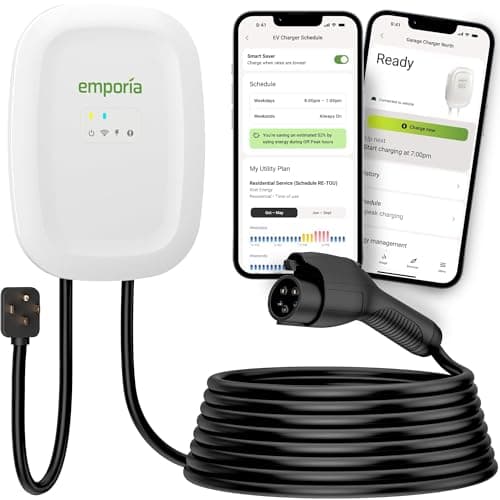
Most homes that want speed and smarts
Emporia Level 2 (48A)
The charger that refuses to charge you extra for being smart: full 48-amp speed and real energy monitoring at roughly the price of a plain plug-in box.
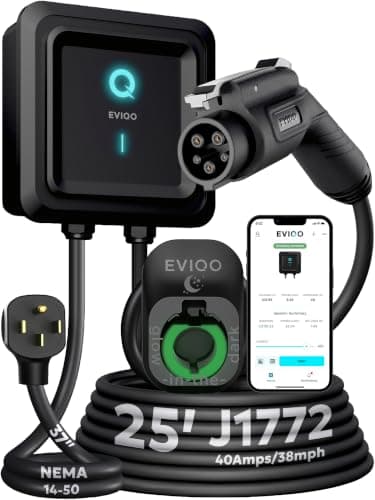
Budget buyers who still want smart features
EVIQO Level 2 (40A)
A double-listed (UL and ETL), IP66-weatherproof smart charger that keeps landing at the bottom of the price band — a lot of certified hardware for the money.
- Guide
A permanent, weatherproof 48A install
Grizzl-E Ultimate (48A)
A dedicated 48-amp charger in a cast-aluminum, IP67 shell - the toughest full-speed box here, built to be hardwired to a wall and left to work.
#ad · As an Amazon Associate we earn from qualifying purchases.
Questions
Frequently asked
What is the most important thing when choosing an EV charger?
Matching the amperage to your car. The car's onboard charger caps how much AC it accepts - usually 32 or 48 amps - so a charger rated above that adds nothing. Confirm your car's figure first, then match it and size the circuit to 125 percent of that current.
Do I need a smart EV charger?
Only if you are on a time-of-use electricity rate or plan to run two EVs on one circuit. In those cases scheduling and load management save real money. On a flat rate with one car, a simple charger does the same core job - though modern value units include the smart features for roughly no premium.
Is plug-in or hardwired better?
Plug-in is more flexible and easy to swap or take with you; hardwired is required for the full 48-amp tier and avoids a receptacle that can wear under continuous high current. For most 40-amp installs, plug-in is perfectly good; step up to hardwired for 48 amps or a sealed outdoor mount.
Does the connector type matter when buying a charger?
Rarely. A J1772 charger works with a NACS car through a cheap adapter and vice versa, so most buyers pick a J1772 unit regardless of car. Only get a native-NACS charger if you want to avoid carrying an adapter for a Tesla-style port.
Keep reading
Related
More in this section
More Charging Guides
Receipts
Sources
- US DOE / fueleconomy.gov - EV charging basics
- US DOE AFDC - charging at home
- EC&M - NEC requirements for EV equipment (Article 625)
We do not run a testing lab, and we do not pretend to. Where a measured number came from someone else's lab, we name them and link them. Where we could not verify something, we say so on the page rather than quietly leaving it out. Read our full method.