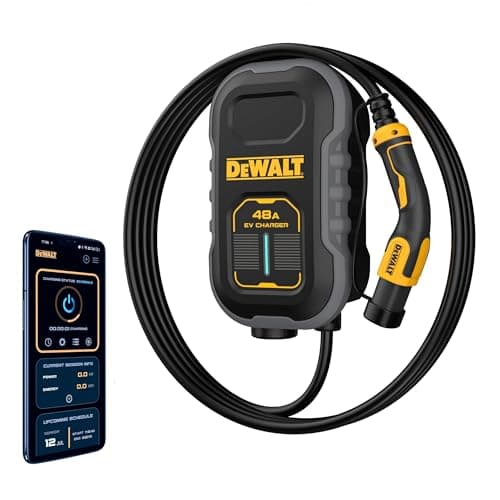
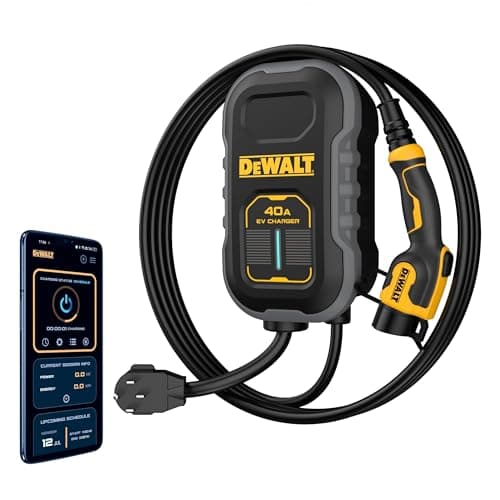
Buy the DEWALT Level 2 Compact if wall space is your constraint and you want an app without paying premium-brand money. It is the shallowest wall unit we track - a 4.6-inch projection - it is CSA certified, it carries a 3-year warranty with a free app and no subscription, and it ships prewired with a NEMA 14-50 plug so it installs on an existing EV outlet without an electrician. The thing to go in knowing: the cable is 20 feet, which is shorter than the 25 feet most rivals ship, and that is the spec most likely to annoy you in a two-bay garage.
We do not run a testing lab and we are not going to write "in our testing" as though we do. What follows is compiled from DEWALT's own published specifications and the live Amazon listings for both SKUs, checked on 6 October 2026, with the arithmetic done against the NEC continuous-load rule. Every figure is cited in Sources.
Which DEWALT is which
There are two SKUs under the Compact name and they are not the same charger. The listings are explicit, and the difference is more than the plug on the car end:
| DEWALT Level 2 Compact | DEWALT Level 2 Compact NACS |
|---|
| Connector | J1772 - every non-Tesla EV sold in the US | NACS - Tesla and NACS-port cars |
| Current ceiling, as listed | 40 A | 48 A |
| Power at 240 V | 9.6 kW | 11.5 kW |
| Circuit it needs | 50 A | 60 A |
| Cable | 20 ft | 20 ft |
| Adjustable from | 12 A | 12 A |
That 40-versus-48 split is the part buyers miss. The NACS version is the faster charger, and at 48 amps it needs a 60-amp circuit and - like every 48-amp unit - cannot run at full output through a NEMA 14-50 plug, because a 14-50 receptacle is rated for a 40-amp continuous load. If you buy the NACS version and plug it in, you are running a 40-amp charger with a 48-amp badge. Set it accordingly. Our hardwired vs plug-in guide covers why there is no such thing as a 48-amp plug.
One note on sourcing, because it tripped us up: DEWALT's own product page carries line-wide marketing copy that quotes a 48-amp ceiling and a 25-foot cable even on the 40-amp model's page. The per-SKU figures above come from the live Amazon listing titles, which state 40 A / 20 ft and 48 A / 20 ft respectively. Where a published figure conflicts, we use the listing for the unit you would actually receive.
What it gets right
The size is real, not marketing
The enclosure is published at 4.6 by 12.6 by 7.4 inches. The number that matters in a narrow garage is the first one - how far the box sticks out from the wall - and 4.6 inches is the shallowest projection of any wall unit in our registry. If the charger goes on the wall beside where a door opens, or in a single-car garage where you walk past it with a bag of groceries, that inch and a half against a chunkier rival is the difference between tidy and irritating. Our best compact chargers ranking compares the published dimensions across the field.
A real certification and a real weather rating
DEWALT publishes CSA certification and an IP66 rating described as a NEMA 4X type enclosure, rated for indoor and outdoor use. CSA is a Nationally Recognized Testing Laboratory, so this is a genuine third-party listing rather than a self-declaration - the thing a surprising number of cheap chargers on the same marketplace cannot claim. The practical reading of IP66 / NEMA 4X is that hose-directed water and dust are not a problem, so an exposed driveway wall is fair game. Our UL-listed roundup explains how to verify a listing rather than believe a bullet point.
An app with nothing behind a paywall
Bluetooth and Wi-Fi, with a free iOS and Android app and no subscription. DEWALT also publishes over ten safety functions including over-voltage, over-current, overheat, overcharge and surge protection, and advertises 24/7 technical support - which, for a brand people already own drills from, is a more plausible support promise than most EV-charging startups make.
It installs without an electrician, if an outlet exists
The 40-amp version ships prewired with a NEMA 14-50 plug. If you already have a rated 14-50 receptacle on a 50-amp circuit, this is a mount-and-plug job. If you do not, that is an electrician and probably a permit - what it costs and which receptacle to specify are both worth reading first, since a cheap outlet is the usual failure point under a sustained 40-amp draw.
The adjustable range goes properly low
Adjustable from 12 amps is lower than most, and it is the spec that makes this unit workable in an older house. If a load calculation leaves you 20 or 30 amps of headroom, a charger that dials to 16 or 24 amps still charges overnight - see chargers for a 100-amp panel.
What it gives up
The 20-foot cable
This is the real cost of the small box, and it is the one thing we would not downplay. Most rivals in this price band ship 25 feet. Five feet sounds trivial until you measure the route: over a workbench, round a support post, to a charge port on the opposite side of the car from the wall. In a two-bay garage where you want to charge in either bay, 20 feet frequently does not reach. Measure the actual path with a tape before you buy - our cable length guide shows how, and the long-cable roundup is the alternative if the answer is no. An EVSE extension cable is a last resort rather than a plan.
A badge, not a factory
DEWALT is a tool brand, and EV charging is not its own engineering heritage - the brand is licensed onto this product category the way it is onto generators and pressure washers. That is not a criticism of the hardware, which is CSA certified and carries a 3-year warranty, but it does mean you should buy it for its published specifications rather than for an assumption that yellow-and-black implies a jobsite pedigree in power electronics. Judge it against the spec sheet, which is what we have done here.
No published energy-monitoring or load-management story
The app does scheduling and control. We have not found a published whole-home load-management feature of the kind Wallbox calls Power Boost or Emporia drives from its energy monitor, so if a tight panel means you need the charger to throttle itself against the rest of the house in real time, this is not the unit - best load-balancing chargers is.
Stock comes and goes
At our last check the J1772 version was in stock and the NACS version showed only a handful of units left. Both are recent listings. If the price or availability on this page looks different from what you see at Amazon, the live price is the one that counts - which is why we date-stamp ours and show nothing rather than a stale number.
Who should buy it, and who should not
Buy it if the wall it is going on is tight, you want an app and a real certification at a mid-market price, and you have measured 20 feet as enough. The NACS version is a cleaner answer for a Tesla or NACS-port car than a J1772 unit plus an adapter, provided you hardwire it or accept 40 amps through a plug.
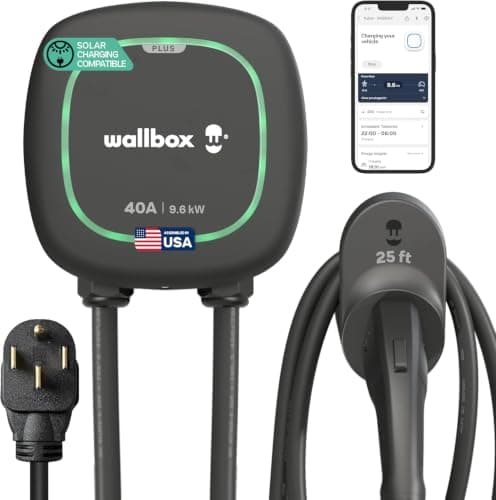
Skip it if your charge port is more than 20 feet from a sensible mounting point, if you need whole-home load management, or if you want the smallest wall face rather than the shallowest box - the Wallbox Pulsar Plus has a smaller face at 7.9 by 7.8 inches and ships 25 feet of cable, which is why it leads our compact ranking. If you would rather own a unit with no app and no cloud at all, the chargers without Wi-Fi ranking makes that case.
On value: at the time of writing both DEWALT SKUs sit below the established-brand 40-amp units while carrying a third-party certification and a 3-year warranty, which is a reasonable place to be. We quote brackets rather than numbers in prose on purpose - the live price in the buy row above is the one we stand behind, and it carries the date we checked it.