HUB 04 · Charging Costs
Kia EV9: Home Charging Time and Cost
What a three-row EV9 costs to charge overnight, how long its big 99.8 kWh pack takes at the 48-amp onboard limit, and the charger that fits its J1772 home port.
We earn a commission when you buy through our Amazon links, at no extra cost to you. It never affects our rankings, and we say so when the cheaper product is the better buy. How this works.
A Kia EV9 charges at home for roughly twelve dollarsfor a typical 10-to-80-percent top-up on the big 99.8 kWh pack, and it does it overnight. The number that sets the speed is the car's onboard AC charger: the EV9 accepts up to about 11 kW, or 48 amps, so a charger rated higher adds nothing at home. Here is the time, the cost and the charger that fits the EV9's J1772 home port - with the arithmetic shown.
The 48-amp ceiling is the car, not the charger
The EV9 rides on Kia's 800-volt E-GMP platform, which is built for very fast DC charging on a road trip. At home on AC, though, it is limited by its onboard charger to roughly 11 kW (about 48 amps at 240 volts). That cap lives in the car. Feed it from an 80-amp commercial unit and it still draws 48; buy a 40-amp charger and you leave a little speed on the table. Because the battery is large, the sweet spot is a full 48-amp charger on a 60-amp circuit - see our best 48-amp chargers.
How long it takes
At the full 11 kW, the EV9 adds roughly 28 to 33 miles of range per hour, a little slower per hour than a small EV because the three-row SUV is heavier and less efficient. The big pack means a full charge is a long, overnight affair - but a daily top-up rarely is.
Roughly, at 48 amps / 11 kW:
- Overnight 10 to 80 percent (~70 kWh): about 6.5 hours
- A 40-mile daily commute back: about 1.5 hours
- Empty to full (~96 kWh usable): about 9 hours - which is why you schedule it overnight
Plugged in every night, the EV9 is simply full every morning. The empty-to-full figure only matters before a road trip, and even then you would top up on DC on the way rather than wait at home.
What it costs
Cost follows the same formula as any EV: energy into the battery, divided by ~0.90 for charging losses, times your electricity rate. For an EV9 refilled 10 to 80 percent (~70 kWh into the pack):
- Energy drawn from the wall: 70 / 0.90 = ~77.8 kWh
- At the US average of about $0.16/kWh: 77.8 x $0.16 = about $12.45
- Cost per mile at ~2.8 mi/kWh: about 5.7 cents, or ~$5.70 per 100 miles
Your electricity rate is the whole story - it varies widely by state and utility, and charging overnight on a time-of-use plan can cut it further. Run your own numbers below, then see off-peak charging for how to pay the lowest rate on a pack this size.
Run it for your car
Cost-to-charge calculator
Put in your electricity rate, your battery size and your car's efficiency. The math is the same one shown above, with a 10% charging loss included so the number is realistic.
- $8.09
- A 10% to 80% charge
- $11.56
- A full (empty to 100%) charge
- $0.05
- Cost per mile
- $5.08
- Cost per 100 miles
Estimate only. Actual cost depends on your exact utility rate (including any time-of-use pricing and fees), your car's real efficiency, temperature, and charging losses. Check your electric bill for your true rate.
The charger: a J1772 port at home
For home AC charging the EV9 uses a J1772 connector (the AC portion of its CCS port), so any standard Level 2 J1772 charger plugs straight in - no adapter needed. Given the large battery, a 48-amp unit on a 60-amp circuit is worth the install; the value pick is the Emporia Level 2, and the rugged option is the Grizzl-E Ultimate. If you also road-trip on Tesla Superchargers, that is handled by Kia's separate NACS DC adapter and the car, not by your home charger - see the NACS transition explainer.
The gear
Recommended gear for this guide
The products this guide refers to, with prices pulled live from Amazon and dated on each card.
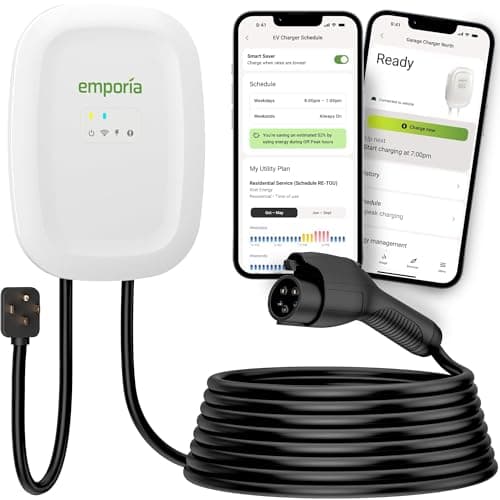
Most homes that want speed and smarts
Emporia Level 2 (48A)
The charger that refuses to charge you extra for being smart: full 48-amp speed and real energy monitoring at roughly the price of a plain plug-in box.
- Guide
A permanent, weatherproof 48A install
Grizzl-E Ultimate (48A)
A dedicated 48-amp charger in a cast-aluminum, IP67 shell - the toughest full-speed box here, built to be hardwired to a wall and left to work.
#ad · As an Amazon Associate we earn from qualifying purchases.
Questions
Frequently asked
What amp charger does a Kia EV9 need?
Up to about 48 amps (11 kW) - the onboard AC limit the EV9 accepts. Because the battery is large, a 48-amp charger on a 60-amp circuit is the fastest useful option and refills it meaningfully faster overnight than a 40-amp unit. A bigger charger cannot push more into the car.
Does the Kia EV9 use a Tesla (NACS) plug at home?
No - at home it uses a J1772 connector, so any J1772 Level 2 charger works directly. Kia's NACS adapter is for DC fast charging at Tesla Superchargers on the road, not for your home wall charger.
Can I charge a Kia EV9 on a regular outlet?
You can, on 120-volt Level 1, but it is impractical as a primary method - a ~100 kWh pack gains only 3 to 5 miles per hour that way. For a battery this size, a Level 2 charger is close to essential; see Level 1 vs Level 2.
Keep reading
Related
- Does My Hyundai or Kia Need an Adapter?The makes that went NACS first, and which adapter that means at home.
- Best 48-amp chargersThe full-speed units the big EV9 pack rewards.
- Best chargers for Hyundai & KiaThe brand roundup the EV9 belongs to.
- Hyundai Ioniq 9 home chargingThe EV9's three-row E-GMP cousin, compared.
More in this section
More Charging Costs
Receipts
Sources
- Recharged - Kia EV9 charging speed guide (onboard AC ~10.9-11 kW / 48A, 99.8 kWh, 800V)
- US EIA - average price of electricity (residential rates)
- US DOE / fueleconomy.gov - EV charging basics
- US DOE AFDC - charging at home
We do not run a testing lab, and we do not pretend to. Where a measured number came from someone else's lab, we name them and link them. Where we could not verify something, we say so on the page rather than quietly leaving it out. Read our full method.