HUB 03 · Charging Guides
How Far Can an EV Charger Be From the Electrical Panel?
There is no hard distance limit - but the farther the run, the thicker (and pricier) the wire has to be to fight voltage drop. Here is how the trade-off works.
We earn a commission when you buy through our Amazon links, at no extra cost to you. It never affects our rankings, and we say so when the cheaper product is the better buy. How this works.
There is no fixed maximum distance between your electrical panel and an EV charger - a long run is entirely doable. What changes with distance is voltage drop: the farther electricity travels down a wire, the more voltage it loses to resistance, so a long run needs thicker (and more expensive) wire to keep the charger working properly. This guide explains the trade-off and the cheaper ways around a far-flung install.
Voltage drop, not distance, is the real limit
Every foot of wire has a little resistance, and a continuous EV charging current makes that resistance bleed off measurable voltage. Too much drop and the charger sees low voltage, which can slow charging or trip faults. The common engineering target is to keep voltage drop under 3 percent on a branch circuit. As long as the wire is sized to hold the drop under that, the run can be long.
How distance drives wire size
The fix for a long run is simply heavier wire. A short 20-foot run to a 48-amp charger might use the minimum gauge; the same charger 100-plus feet away may need the conductors bumped up a size or two to keep the voltage drop in range. That extra copper is the real cost of distance - not a code prohibition, just a bigger wire bill. Your electrician runs the voltage-drop calculation for your exact distance and amperage; see wire and breaker sizing for the starting gauges.
Rough guide: under ~50 feet, distance rarely changes the wire size much. Past ~75 to 100 feet at higher amperage, expect the conductors to step up a gauge to control voltage drop - a real but manageable cost.
Cheaper ways to charge far from the panel
- Use a charger with a long cable. Many units ship with a 24- or 25-foot lead - a long-cable charger can cover the last stretch so you do not have to run the (thicker, pricier) 240-volt circuit all the way to the parking spot.
- Lower the amperage. A 32-amp charger drops less voltage than a 48-amp one over the same distance and needs thinner wire - if you do not need the speed, a smaller charger makes a long run cheaper. See 32 vs 48 amps.
- Consider a sub-panel. For a detached garage or a far outbuilding, a feeder to a small sub-panel can be more economical than a single very long branch circuit - a call for your electrician.
The bottom line
Put the charger where it is convenient. Distance is a wire-sizing problem your electrician solves with a voltage-drop calculation, not a barrier - just budget a bit more copper for a long run, or use a long charging cable and a sensible amperage to keep the circuit itself short. Cable length is one of the specs listed for every unit in the best Level 2 chargers for home.
The gear
Recommended gear for this guide
The products this guide refers to, with prices pulled live from Amazon and dated on each card.
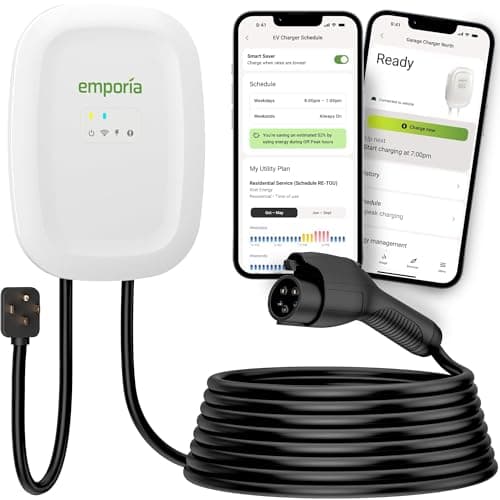
Most homes that want speed and smarts
Emporia Level 2 (48A)
The charger that refuses to charge you extra for being smart: full 48-amp speed and real energy monitoring at roughly the price of a plain plug-in box.
#ad · As an Amazon Associate we earn from qualifying purchases.
Questions
Frequently asked
Is there a maximum distance for an EV charger from the panel?
No hard code limit - the practical limit is voltage drop. As long as the wire is sized to keep drop under about 3 percent for your distance and amperage, a long run is fine. It just needs heavier, costlier wire the farther it goes.
Does a longer wire run slow down charging?
It can, if the wire is undersized for the distance - excess voltage drop makes the charger see low voltage and can reduce output or cause faults. Properly sized conductors keep the drop in range and charging at full speed.
How can I charge far from my panel without huge cost?
Use a charger with a long (24 to 25-foot) cable to cover the last stretch, keep the amperage modest, or feed a sub-panel for a detached structure. Each keeps the expensive thick-wire run shorter.
Keep reading
Related
More in this section
More Charging Guides
Receipts
Sources
We do not run a testing lab, and we do not pretend to. Where a measured number came from someone else's lab, we name them and link them. Where we could not verify something, we say so on the page rather than quietly leaving it out. Read our full method.