Ask what a Level 2 installation costs and honest electricians answer with a question: "where's your panel?" The charger is the fixed part; the electrical work varies by 5x or more between houses, from a few-hundred-dollar simple run to panel-upgrade territory. Rather than quote numbers that won't match your house, here are the five factors that actually set the price — and what each means for yours.
The five price drivers
- 1. Distance from panel to parking spot. The single biggest driver. Wire (thick copper, for a 50-60A circuit), conduit and labor all scale with every foot. Garage wall shared with the panel: the cheap end. Detached garage across the yard: trenching, and the expensive end.
- 2. Panel capacity. If a load calculation says your panel can't take a new 50-60A circuit, the project grows — though load-management chargers usually beat a full upgrade on price.
- 3. What the wire runs through.Open basement joists are fast; finished walls, ceilings and exterior masonry are slow. Labor is the meter that's running.
- 4. Permit and inspection. A legitimate install includes both; cost and hassle vary by city. Skipping them is how insurance claims get denied — treat any quote that omits the permit as a red flag, not a discount.
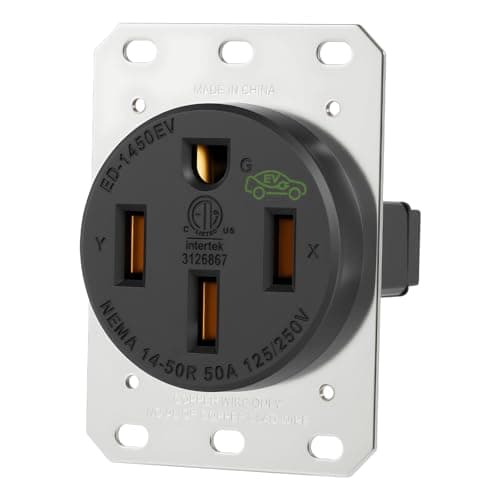
- 5. Plug vs hardwire. A NEMA 14-50 outlet and a hardwired run price similarly; the outlet route needs a quality receptacle (cheap ones are a known failure point), the hardwire route unlocks 48A.
How to land at the cheap end
Get two or three quotes, and send each electrician photos of your panel (door open), the parking spot, and the path between — quotes tighten when they're not guessing. Ask specifically for a load calculation before agreeing to any panel upgrade; ask whether a 40A circuit (cheaper wire) meets your car's actual onboard limit — for many cars it does, and it trims the bill. And check utility rebates: many cover a real slice of installation, not just hardware.
All 240V circuit work is licensed-electrician territory. The DIY savings on a 60-amp circuit are not worth what a mistake costs — this guide is for buying the work intelligently, not doing it yourself.
What the published numbers actually say
We would rather point you at your own quotes than a national average, but a range is useful for knowing whether the number on your estimate is normal. Qmerit, which runs one of the largest certified EV-charger installation networks in North America, publishes a $749 to $2,500 range for a residential Level 2 installation with an average around $1,700, and breaks the project down roughly as follows:
- The charger itself: $300 to $900. That is the part you control completely, and the part where the ranked picks below matter. Several capable 40-amp units sit at the bottom of that band.
- Electrician labour and permitting: $500 to $1,200. Driven almost entirely by how far the panel is from the parking spot and what the wire has to pass through.
- Materials - conduit, wire, breaker: $200 to $500. Copper for a 50- or 60-amp circuit is not cheap, and it scales with every foot of run.
- The permit: around $310 on average, ranging from about $50 to $800 depending on the jurisdiction. It is not optional and it is not the place to save money.
Then there is the one line item that dwarfs all of the above. If the house needs a service upgrade to 200 amps to carry the new circuit, Qmerit puts that at an extra $1,500 to $3,000. That single item is why quotes for "the same job" differ by a factor of five between neighbours, and it is why the first question to settle is not which charger but whether your panel needs touching at all - which is what a load calculation answers.
Treat these as orientation, not a quote.They are published national figures from an installer network, not a bid on your house. Nothing about your driveway, your panel or your city's permit desk is in them. Two or three real quotes are worth more than any average, and the eight questions to ask make those quotes genuinely comparable.
The federal credit that used to offset this has expired
Through mid-2026 the federal Section 30C credit covered 30 percent of a home charger and its installation, up to $1,000, for homes in eligible low-income or non-urban census tracts. That window has closed: the One Big Beautiful Bill Act moved the termination date to June 30, 2026, and the credit cannot be claimed for refueling property placed in service after that date. If your charger was in service on or before that day you can still claim it on Form 8911 with your 2026 return. If you are installing now, budget without it - and check state, utility and local programmes instead, which are unaffected and frequently cover installation rather than just hardware. Our rebates page tracks where to look.
What each pick saves on the bill
This page ranks on the install, not on charging speed, so this is the column that sets the order:
| Charger | What it saves on the install |
|---|
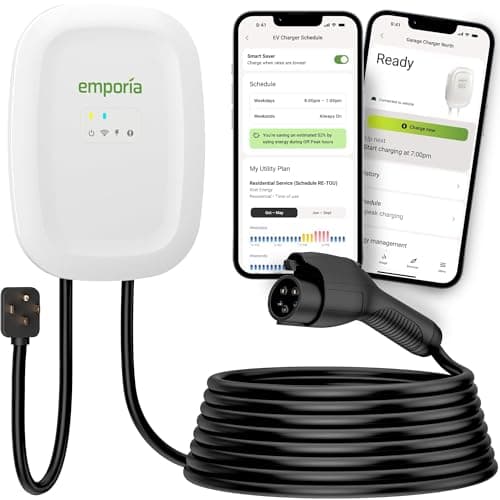
| Emporia Level 2 | Single-amp dial-down and app load management; installs plug-in or hardwired |
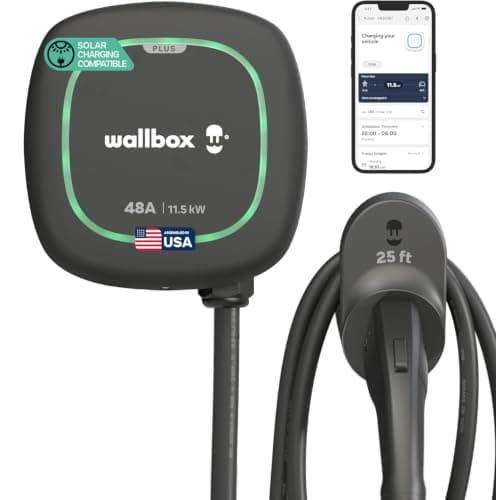
| Wallbox Pulsar Plus | Power Boost dynamic load management - can replace a service upgrade |
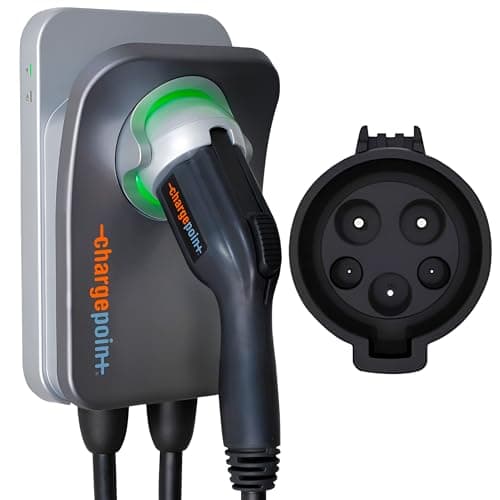
| ChargePoint Home Flex | Six selectable output steps, so the circuit can be sized to the budget |
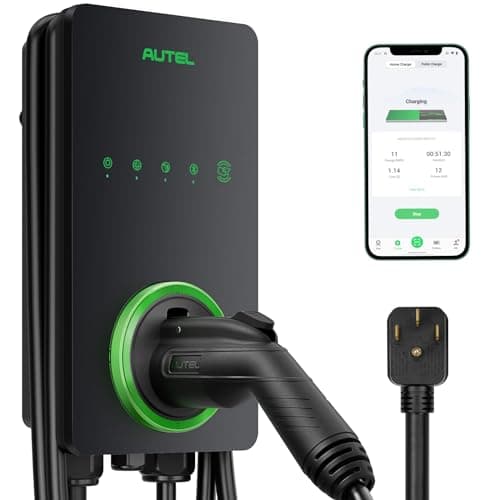
| Autel MaxiCharger | Plug-in only - a 50-amp circuit and a receptacle, no hardwire labour |
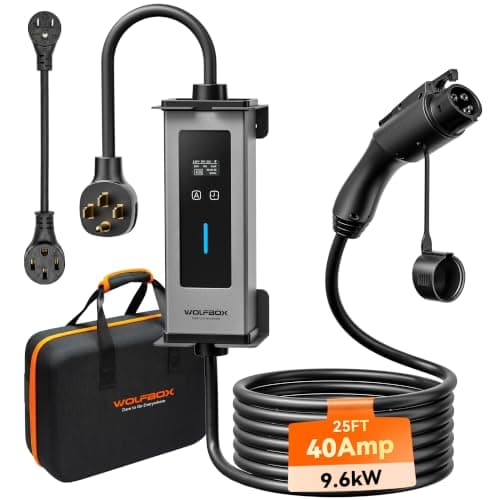
| WOLFBOX 40A Portable | Runs on an existing 240V outlet, or Level 1, with no new circuit at all |
| Industrial NEMA 14-50 outlet | The receptacle the cheap plug-in path depends on |
How the six compare on specs
| Charger | Amps / kW | Plug type | Cable | Smart / Wi-Fi | Safety listing | Price tier |
|---|
| Emporia Level 2 | 6-48A / up to 11.5 kW | NEMA 14-50 plug or hardwired | 25 ft | Wi-Fi, Emporia app | UL listed, Energy Star | Mid |
| Wallbox Pulsar Plus | 48A / 11.5 kW | Hardwired | 25 ft | Wi-Fi + Bluetooth, myWallbox | UL listed, Energy Star | Premium |
| ChargePoint Home Flex | 16-50A / up to 12.0 kW | NEMA 14-50 plug (to 40A) or hardwired (to 50A) | 23 ft | Wi-Fi, ChargePoint app | UL / cUL (UL 2594, UL 2231), Energy Star | Premium |
| Autel MaxiCharger | 40A / 9.6 kW | NEMA 14-50 plug | 25 ft + holster | Wi-Fi + Bluetooth, Autel Charge | NEMA 4X weather-rated shell; no UL mark named in our spec set | Mid |
| WOLFBOX 40A Portable | 6-40A / up to 9.6 kW | NEMA 14-50, plus 5-15 and 6-20 adapters | 25 ft | No app - on-box amp dial and 1-12h delay timer | ETL listed, IP66 / NEMA 4 | Value |
| Industrial NEMA 14-50 outlet | 50A / 125-250V receptacle | NEMA 14-50R, 3-pole 4-wire | n/a | n/a | ETL listed | Budget |
Every figure above is the manufacturer's published claim from its live listing, datasheet or install guide. We compile and compare documented specifications, safety listings, published cost data and code requirements; we do not bench-measure charging rates and we do not quote installs, and our methodology page says so in those words.
The buyer's guide: buying the charger to fit the wiring budget
Load management is the single biggest lever on the bill
A service upgrade is the most expensive thing that can happen to this project. Dynamic load management is the way to avoid it: the charger watches the whole-house draw and throttles itself when the dryer and the oven are running, so a full-speed unit can live on a panel a plain load calculation would fail. This is not a workaround - the National Electrical Code explicitly allows an automatic load management system to define the maximum load a service and feeder must be sized for. Wallbox calls it Power Boost and drives it from a clamp meter; Emporia does it through its app and energy monitor. Against a $1,500-$3,000 panel upgrade, the maths is usually not close. See the load-balancing chargers and smart panels vs a panel upgrade.
Amps to kilowatts - and why buying fewer amps is cheaper twice
Amps times 240 volts, divided by 1,000: 32A is 7.7 kW, 40A is 9.6 kW, 48A is 11.5 kW. The continuous-load rule then sets the circuit at 125 percent of that, so 32 amps needs a 40-amp breaker, 40 needs 50, and 48 needs 60. Every step up that ladder is heavier copper and a bigger breaker, and copper is priced by the foot. Right-sizing to what the car actually accepts - many EVs cap at 7.7 or 9.6 kW - trims the materials line and sometimes removes the panel question entirely. Work out your number in what amp charger do I need.
Level 1 vs Level 2: the cheapest install is no install
Before you price a circuit, check whether you need one. Level 1 on an existing 120-volt outlet costs nothing and adds roughly 5 miles of range per hour, which is 50 to 60 miles over a long night. If you drive under about 40 miles a day, that may simply be enough, and the whole $749-$2,500 question disappears. Run the daily-miles test in Level 1 vs Level 2 first - it is the only page on this site that can save you the entire cost of this project. If the answer is that you do need 240 volts, the hardware side of the bill starts at the best Level 2 chargers for home.
Hardwired vs plug-in barely moves the total
The circuit is most of the bill either way. A plug-in job is a 50-amp circuit plus a receptacle and the GFCI protection the code requires for EVSE receptacles; a hardwired 48-amp job is a 60-amp circuit with heavier conductors and no receptacle. Those roughly cancel. Choose on portability versus the last six miles per hour, not on install price - hardwired vs plug-in lays it out. If you do go plug-in, the outlet type is worth a minute of thought too: a NEMA 6-50 has one fewer conductor to pull, which is real money on a long run.
NACS vs J1772 has no effect on the install
The wiring is identical. A native-NACS charger and a J1772 charger of the same amperage need the same circuit, the same breaker and the same labour; the connector only decides whether your car needs an adapter. Do not let the connector question delay the electrical work, and do not pay extra for it. See J1772 vs NACS and future-proofing for NACS.
The safety listing protects the money you just spent
A permitted install with an unlisted charger on the end of it is a strange place to economise. Look for UL or ETL against UL 2594 and UL 2231 - ETL is not a lesser mark, since Intertek is an OSHA-recognised testing laboratory testing to the same standard. Some inspectors will ask, and some utility rebate programmes require a listed unit before they will pay. UL-listed chargers has the detail.