HUB 03 · Charging Guides
Portable vs Wall-Mounted EV Chargers
A packable cordset that plugs into an outlet, or a permanent box on the wall. Here is what each does best, and why the honest answer is often both.
We earn a commission when you buy through our Amazon links, at no extra cost to you. It never affects our rankings, and we say so when the cheaper product is the better buy. How this works.
A portable charger is a cordset you plug into an existing outlet - a 120V socket for Level 1 or a 240V NEMA 14-50 for Level 2 - and can throw in the trunk. A wall-mounted charger is a fixed box hardwired or plugged in at a set spot. They overlap in speed but differ in convenience, and for many owners the right answer is a wall unit at home plus a portable for the road. Here is how to decide.
Speed: closer than you think
A good portable Level 2 unit on a NEMA 14-50 outlet delivers up to 40 amps (about 9.6 kW) - the same as many wall chargers. The wall tier only pulls ahead at the top: the full 48-amp (11.5 kW) rate generally needs a hardwired wall unit. So for a car capped at 32 or 40 amps, a portable can match a wall charger's speed exactly; only 48-amp cars leave a little on the table with a portable.
Convenience: the wall unit's home turf
At home, day after day, a wall charger wins on convenience: the cable hangs ready, the connector is at car height, and there is nothing to set up. A portable asks you to plug the cordset into the outlet and manage the cable each time - a small friction that adds up over hundreds of sessions. If the car lives in one spot, the wall unit is simply nicer to live with.
Cost and installation
Here the portable often wins. If you already have (or add) a NEMA 14-50 outlet, a portable Level 2 charger is typically cheaper than a comparable wall unit and needs no charger-specific mounting. A wall charger adds the unit price plus, sometimes, hardwiring labor. Either way the 240V circuit is the real cost, and that is the same for both - see installation cost.
The outlet a portable plugs into carries a continuous 40-amp load, so it must be an industrial-grade, listed 14-50 receptacle installed by a licensed electrician - not a bargain-bin part. A cheap outlet is the classic overheating failure point.
Travel and flexibility
This is the portable's reason to exist. It rides in the trunk for a road trip, works at a friend's dryer outlet, a campsite, or an RV pedestal, and drops to Level 1 on a standard 120V socket when that is all there is. A wall unit does none of that - it charges in exactly one place. For anyone who travels or charges in more than one location, a portable is the flexible tool. See road-trip charging and charging at an RV park.
The honest recommendation: often both
If you must pick one: choose a wall-mounted charger if the car lives at one home and you value daily convenience and the option of 48 amps; choose a portable if you rent, move often, travel, or already have a 14-50 outlet and want to spend less. But the two are cheap enough that a lot of owners keep a wall unit at home and a portable in the trunk - the best of both, for not much more than a single premium charger. For the wall side of that pair, the best Level 2 home chargers we've compared is the ranking to start from.
The gear
Recommended gear for this guide
The products this guide refers to, with prices pulled live from Amazon and dated on each card.
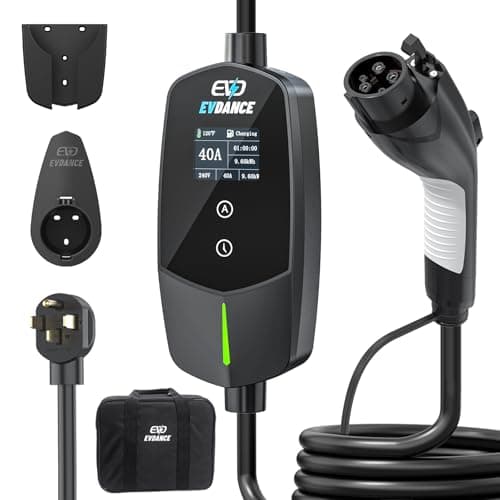
Off-peak charging without an app
EVDANCE 40A Portable
A 40-amp portable with adjustable current and a built-in delay timer on a long 25-foot cable — off-peak charging without needing an app.
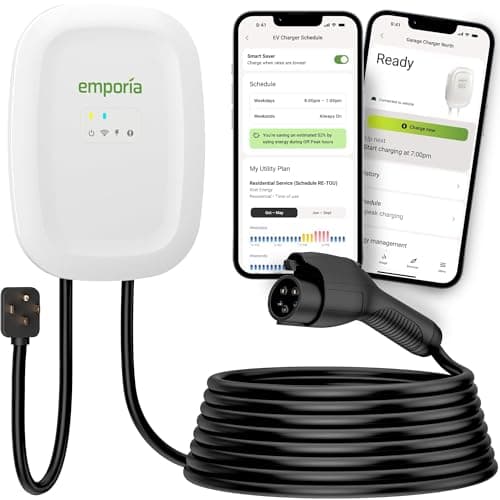
Most homes that want speed and smarts
Emporia Level 2 (48A)
The charger that refuses to charge you extra for being smart: full 48-amp speed and real energy monitoring at roughly the price of a plain plug-in box.
#ad · As an Amazon Associate we earn from qualifying purchases.
Questions
Frequently asked
Is a portable EV charger as fast as a wall charger?
On a 240V NEMA 14-50 outlet, a good portable delivers up to 40 amps (about 9.6 kW) - the same as many wall units. Only the top 48-amp / 11.5 kW rate generally requires a hardwired wall charger, so for 32- and 40-amp cars a portable matches a wall unit exactly.
Can I use a portable charger as my only home charger?
Yes. Plugged into a properly installed NEMA 14-50 outlet, a portable Level 2 charger is a perfectly good permanent home solution, and it doubles as a travel unit. The main downside is the small daily friction of plugging the cordset in versus a ready-to-grab wall cable.
Do portable chargers need special installation?
The charger itself just plugs in, but the outlet does not: a 240V NEMA 14-50 receptacle on a 50-amp circuit must be installed by a licensed electrician using an industrial-grade, listed part, because it carries a continuous 40-amp load.
Keep reading
Related
- Can a Portable Be Your Main Charger?Whether a portable can serve as the everyday charger.
- Portable Charger for EmergenciesThe backup case for keeping a portable in the trunk.
- Best portable EV chargersThe travel-ready units, ranked.
- Best Level 2 chargersThe wall units, ranked.
- NEMA 14-50 outletThe outlet a portable plugs into.
More in this section
More Charging Guides
Receipts
Sources
- US DOE AFDC - charging at home
- US DOE / fueleconomy.gov - EV charging basics
- EC&M - NEC requirements for EV equipment (Article 625)
We do not run a testing lab, and we do not pretend to. Where a measured number came from someone else's lab, we name them and link them. Where we could not verify something, we say so on the page rather than quietly leaving it out. Read our full method.