HUB 03 · Charging Guides
EV Charger Conduit: What Size, and Which Type
Three-quarter-inch conduit covers almost every home EV circuit. Here is the fill arithmetic that proves it, and the four materials your electrician will choose between.
We earn a commission when you buy through our Amazon links, at no extra cost to you. It never affects our rankings, and we say so when the cheaper product is the better buy. How this works.
For a typical home EV charger circuit - two 6 AWG THHN conductors and a 10 AWG ground, which is the usual 50-amp build - 3/4-inch conduit is the minimum size, and it works in EMT, Schedule 40 PVC, Schedule 80 PVC, rigid metal conduit or liquidtight flex. Indoors and exposed, EMT is the default. Outdoors, underground or on a masonry wall, Schedule 40 PVC. Where the conduit has to flex into the charger or around an obstruction, a short length of liquidtight flexible conduit. Go up to 1 inch if the run is long, if the conductors are bigger than 6 AWG, or if you want the option of pulling larger wire later without reopening anything.
This page is about the pipe, not the wire. Our wire and breaker size guide sizes the conductor and the overcurrent device - the inputs to everything below. Conduit sizing is the step after that, and it is where a cheap decision gets permanent: the conductors can be pulled out and replaced for the cost of wire, but the raceway is fastened to the structure.
The arithmetic, so you can check it
The NEC limits how much of a raceway's cross-section the conductors may occupy. For three or more conductors the limit is 40 percentof the conduit's internal area (Chapter 9, Table 1). Chapter 9, Table 5 gives each insulated conductor's area and Table 4 gives each raceway's. The sum of the conductor areas has to come in under the raceway's 40 percent figure. That is the whole rule.
Worked through for the common 50-amp EV circuit:
| Step | Figure |
|---|---|
| Two 6 AWG THHN conductors | 2 x 0.0507 = 0.1014 sq in |
| Plus one 10 AWG THHN ground | Adds roughly 0.0211 sq in |
| Total conductor area | About 0.123 sq in |
| 3/4-inch EMT, 40 percent limit | About 0.213 sq in |
| Result | Roughly 58 percent of the allowance used - compliant |
The published fill charts agree and give you the headline version: 3/4-inch EMT and 3/4-inch Schedule 40 PVC each take up to four 6 AWG THHN conductors at the 40 percent limit. A 50-amp EV circuit uses three. That is why 3/4-inch is the answer you will hear from every electrician who has wired one.
Why 1/2-inch is a false economy. It will sometimes pass the fill calculation for a 40-amp circuit with 8 AWG conductors, and it makes the pull genuinely difficult, leaves no room to upgrade, and saves a trivial amount of material. The labor of pulling wire through undersized conduit costs more than the pipe you saved.
When you need bigger than 3/4-inch
- Bigger conductors. A 60-amp circuit for a 48-amp charger typically moves to 6 AWG or 4 AWG depending on wire type and conditions; 4 AWG in a three-wire pull is where 1-inch starts to make sense.
- Long runs. Voltage drop on a long run pushes the electrician to a larger conductor than ampacity alone would require, and the raceway follows the conductor.
- Many bends. The code limits a pull to 360 degrees of bend between pull points; a tight route with several 90s pulls far more easily in a size up.
- Future-proofing. On a new build or a trench, 1-inch costs a little more and lets you pull a 48-amp or even an 80-amp circuit later through the same pipe. On anything underground this is the right call every time - see rough-in for new construction.
One correction to a common misreading: conduit size does not change your charging speed. Nothing about a bigger pipe delivers more power. The amps come from the breaker, the conductor and the car - see how fast will my EV charge for which of the three is actually limiting you, and EV charging slow at home if you suspect something is.
Which material, and where
| Type | Where it belongs | Notes |
|---|---|---|
| EMT (thin-wall steel) | Indoors, exposed on a garage wall or ceiling | The default for a visible interior run. Rigid, tidy, mechanically protective, inexpensive |
| Schedule 40 PVC | Underground, in or on masonry, damp and exterior locations | Will not corrode, cements together, the normal choice for a buried run to a detached garage |
| Schedule 80 PVC | Exposed to physical damage - where a run comes out of the ground | Thicker wall, smaller interior, so recheck the fill when you specify it |
| Rigid metal conduit (RMC) | Where maximum mechanical protection is required | Heaviest and most expensive; rarely needed on a residential EV circuit |
| Liquidtight flexible (LFMC) | The last short section into the charger, or around an obstruction | Short lengths only, with listed connectors; not a substitute for the main run |
Three details that come up on inspection and surprise people. Outdoor conduit is a wet location even where it is above ground, so the conductors have to be rated for it - which is why the common specification is THHN/THWN-2, the dual-rated wire. PVC expands and contracts with temperature, so long exterior runs want expansion fittings. And a run that transitions from outdoors to indoors can breathe moisture into the box, which is why a weather-resistant receptacle or a listed outlet box is the right termination outside, not an indoor device with a cover over it.
Hardwired versus plug-in changes the end of the run
The conduit is identical either way; what differs is what it lands in.
- Hardwired charger:the conduit runs into the charger's wiring compartment through a listed fitting, usually with a short length of liquidtight flex at the end. No receptacle, no plug, nothing to loosen. This is the build for 48-amp units, because there is no 48-amp plug.
- Plug-in charger: the conduit lands in a box with a NEMA 14-50 receptacle. Reversible, relocatable, and the receptacle becomes the highest-stress component in the install - so specify an EV-rated or weather-resistant one rather than a range outlet.
Our hardwired vs plug-in comparison takes that decision properly, and weatherproofing an outdoor install covers the exterior termination. The picks below are what the conduit actually ends in: an all-in-one listed outlet box for a surface or outdoor run, a weather-resistant receptacle, the EV-rated indoor receptacle, and a hardwired 48-amp charger for the run that has no receptacle at all.
What to confirm before the pull
- Conductor size and type first. The raceway is sized to the conductors, so the wire decision comes first - see wire and breaker size, and copper vs aluminum if the quote specifies aluminum.
- Then the fill. Three conductors at 40 percent; 3/4-inch takes up to four 6 AWG THHN.
- Then the location. Wet, buried, exposed to damage or indoors - that chooses the material, not price.
- Then the bends. 360 degrees maximum between pull points. Add a box, or go a size up.
- Then the termination. Listed fittings, and an EV-rated or weather-resistant receptacle if it is a plug-in install.
Final sizing is your electrician's call and depends on wire type, insulation temperature rating, run length, ambient temperature and bundling - the figures here are the planning arithmetic so you can read the quote rather than approve it blind.
The gear
Recommended gear for this guide
The products this guide refers to, with prices pulled live from Amazon and dated on each card.
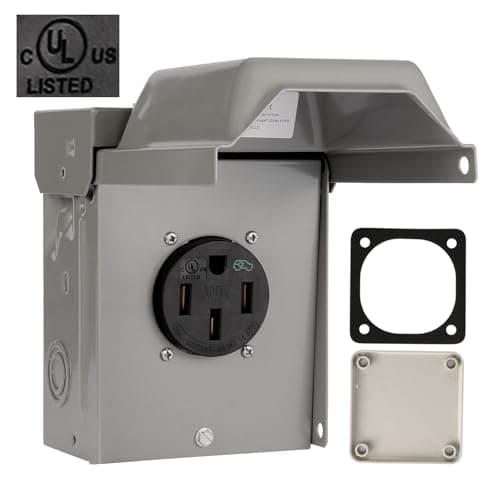
A surface-mount or outdoor install
Wayona 50A NEMA 14-50 Outlet Box
An all-in-one weatherproof outlet box - an EV-grade 14-50R receptacle inside an ETL-listed, lockable NEMA 3R metal enclosure - for mounting on exposed conduit or an outdoor wall where a recessed box is not an option.
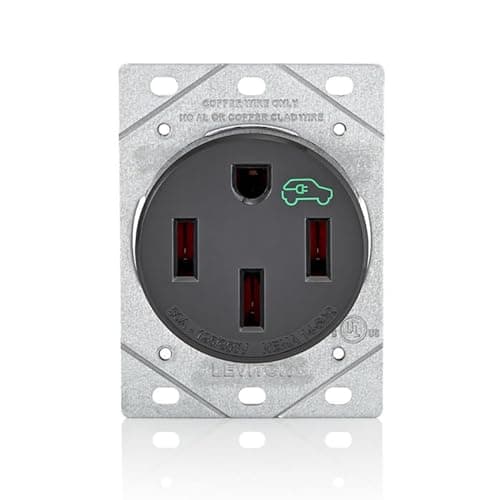
The dedicated EV-rated receptacle
Leviton 1450R EV Receptacle
The receptacle Leviton built specifically for EV charging - rated for the long charge sessions and constant plug cycles a home charger puts a range outlet through, from a brand electricians already trust.
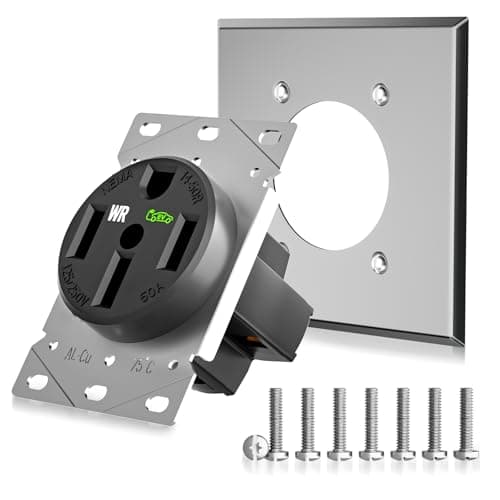
A weather-resistant receptacle on a budget
EPLESFTON Weather-Resistant 14-50R
An ETL-listed, weather-resistant 14-50 receptacle that ships with a wall plate - the value pick when the outlet lives in a damp garage or on an exterior wall and you want a UV-rated body.
- Guide
A permanent, weatherproof 48A install
Grizzl-E Ultimate (48A)
A dedicated 48-amp charger in a cast-aluminum, IP67 shell - the toughest full-speed box here, built to be hardwired to a wall and left to work.
#ad · As an Amazon Associate we earn from qualifying purchases.
Questions
Frequently asked
What size conduit do I need for a 50-amp EV charger?
Three-quarter inch. Two 6 AWG THHN conductors plus a 10 AWG ground come to about 0.123 square inches, inside the roughly 0.213 square inches that the NEC 40 percent fill limit allows in 3/4-inch EMT or Schedule 40 PVC. Published fill charts put the maximum at four 6 AWG THHN conductors in that size.
Can I use 1/2-inch conduit for an EV charger?
Sometimes it passes the fill calculation on a smaller circuit, and it is still a poor choice. The pull is harder, there is no room to upgrade the conductors later, and the saving is a few dollars of pipe against the labor cost of a difficult pull. Use 3/4-inch.
EMT or PVC for an EV charger?
EMT for an exposed indoor run - it is rigid, tidy and protective. Schedule 40 PVC for anything underground, in masonry, or outdoors, because it does not corrode. Schedule 80 PVC where a run is exposed to physical damage, such as coming up out of the ground; note its thicker wall means a smaller interior, so recheck the fill.
Do I need conduit at all, or can I use cable?
It depends on the installation method and the local code your inspector is enforcing. Cable assemblies are permitted in many concealed residential applications, while exposed runs, masonry and anything outdoors or buried generally want a raceway. Conduit also buys you something cable never will: the ability to change the conductors later without opening the wall.
Does bigger conduit make an EV charger faster?
No. Charging power comes from the breaker, the conductor and the car's onboard charger. A larger raceway only gives you an easier pull and room to upgrade later - which is a good reason to oversize it on a new build, and not a performance upgrade.
What conduit size for a 48-amp charger on a 60-amp circuit?
Usually still 3/4-inch, and 1-inch if the conductors come in at 4 AWG or the run is long enough that voltage drop pushes the wire size up. Confirm it against the actual conductor your electrician specifies rather than against the breaker size.
Keep reading
Related
- Wire and breaker sizeSize the conductor first - the raceway follows it.
- Rough-in for new constructionWhere oversizing the conduit costs almost nothing.
- How far can a charger be from the panel?Voltage drop, and why long runs change the wire size.
- Weatherproofing an outdoor installWhat the conduit lands in when the run ends outside.
More in this section
More Charging Guides
Receipts
Sources
- NEC Chapter 9 tables (Table 1 raceway fill percentages, Table 4 raceway dimensions, Table 5 dimensions of insulated conductors) - the arithmetic behind every conduit size on this page
- Conduit Fill Tool - what size conduit for a 50-amp EV charger (two 6 AWG THHN conductors plus a 10 AWG ground fit a minimum 3/4 inch EMT, Schedule 40 or 80 PVC, RMC or LFMC at the NEC 40 percent fill limit)
- Portlandia Electric Supply - conduit fill chart, maximum THHN conductors per EMT size (NEC Chapter 9)
- WireRef - EV charger wiring: wire size, breaker and GFCI (conductor and raceway selection for a 240-volt EVSE branch circuit)
- EC&M - NEC requirements for EV equipment (Article 625: EVSE is a continuous load, so the branch-circuit conductors and overcurrent device are sized at not less than 125 percent of the maximum load)
- Leviton Captain Code - NEC 2023 sections 625.40, 625.42(A)(B) and 625.43 (each outlet supplying EVSE over 16 amperes or 120 volts is supplied by an individual branch circuit; 625.42 permits multiple EVSE on one circuit under an energy management system or adjustable settings)
- Intertek - UL 2594 testing and certification for electric vehicle supply equipment
- United Chargers - Grizzl-E Ultimate 48 (48A, adjustable 16-48A, IP67 cast aluminum, hardwired)
- Wallbox - Pulsar Plus product overview and installation guide
We do not run a testing lab, and we do not pretend to. Where a measured number came from someone else's lab, we name them and link them. Where we could not verify something, we say so on the page rather than quietly leaving it out. Read our full method.