HUB 03 · Charging Guides
AC vs DC EV Charging Explained
The real dividing line in EV charging. AC goes through your car's onboard charger and is capped by it; DC skips it and feeds the battery directly. That is why home is AC and fast chargers are DC.
We earn a commission when you buy through our Amazon links, at no extra cost to you. It never affects our rankings, and we say so when the cheaper product is the better buy. How this works.
AC versus DC is the most useful distinction in EV charging, and it explains almost everything else - why home charging tops out where it does, why a fast charger is a big roadside cabinet rather than a wall box, and why the number on a public charger is not the number your car necessarily gets. The short version: a battery stores DC, so the electricity has to become DC before it goes in. AC charging converts it inside the car; DC charging converts it outside. That one difference drives everything.
Batteries are DC; the grid is AC
Your home and the grid deliver alternating current (AC). An EV battery stores direct current (DC). So somewhere between the wall and the battery, AC has to be rectified into DC. The only question is where that conversion happens - and that is the entire difference between the two charging types.
AC charging: the car does the conversion
When you charge at home - Level 1 on a 120-volt outlet or Level 2 on a 240-volt circuit - you are doing AC charging. The wall sends AC to the car, and the car's built-in onboard charger converts it to DC for the battery. That onboard charger is the bottleneck: it has a maximum rating (commonly 7.7 to 11.5 kW), and it does not matter how powerful your wall charger is - the car will only accept up to what its onboard charger can convert. This is why a car that caps AC at 7.7 kW gets nothing extra from a 48-amp charger, a point we make in what amp charger do I need. A home "charger" like the Emporia is really an EVSE - it safely delivers AC and lets the car do the converting. The levels themselves are broken down in types of EV chargers.
DC fast charging: the station does the conversion
A DC fast charger does the AC-to-DC conversion inside its own large cabinet and sends DC straight to the battery, bypassing the car's onboard charger entirely. That is why it can deliver far more power - 50, 150, even 350 kW - than any home AC setup: it is not limited by the small converter in the car. It is also why the hardware is big, expensive, and lives at highway stops rather than in garages. How that DC power actually flows - rising and then tapering as the battery fills - is the subject of DC fast charging explained and how to read a charge curve.
| AC charging | DC fast charging | |
|---|---|---|
| Conversion happens | Inside the car (onboard charger) | Inside the station |
| Typical power | 1.4-11.5 kW | 50-350 kW |
| Limited by | The car's onboard charger | The car's battery and charge curve |
| Where | Home, workplace, destinations | Highway and public fast-charge sites |
Why this matters for buying a home charger
Home charging is AC, full stop - you cannot install a DC fast charger at a house, and you do not need to. Overnight, a Level 2 AC charger adds far more range than you typically drive in a day, so the onboard charger's limit is rarely a problem at home. The practical takeaways: buy a home charger matched to what your car's onboard charger can actually accept (not the biggest number you can find), and save the DC question for road trips. The home side is covered in Level 1 vs Level 2, and the road side in how long DC fast charging takes.
So AC versus DC is not about which is better - it is about where the conversion happens and what that means for speed. AC for daily home charging, capped by your car; DC for fast top-ups on the road, capped by your battery. The AC side is the one you buy for the garage - the Level 2 home chargers we rank is that list.
The gear
Recommended gear for this guide
The products this guide refers to, with prices pulled live from Amazon and dated on each card.
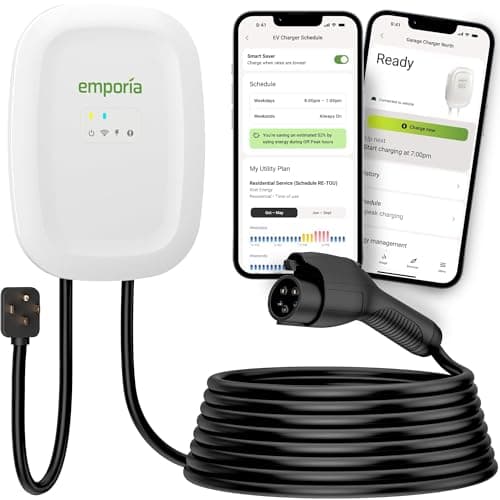
Most homes that want speed and smarts
Emporia Level 2 (48A)
The charger that refuses to charge you extra for being smart: full 48-amp speed and real energy monitoring at roughly the price of a plain plug-in box.
#ad · As an Amazon Associate we earn from qualifying purchases.
Questions
Frequently asked
What is the difference between AC and DC charging?
Where the AC-to-DC conversion happens. AC charging (home Level 1 and 2) sends AC to the car and lets the car's onboard charger convert it, so it is limited by that converter. DC fast charging converts to DC in the station and feeds the battery directly, so it can be far faster.
Is home charging AC or DC?
AC. Both Level 1 (120V) and Level 2 (240V) home charging are AC - the car converts it to DC internally. You cannot install a DC fast charger at a house, and for overnight charging you do not need one.
Why won't my car charge faster on a bigger home charger?
Because AC charging is capped by the car's onboard charger, not the wall unit. If your car accepts 7.7 kW, a 48-amp (11.5 kW) charger still only delivers 7.7 kW. Match the charger to your car - see what amp charger do I need.
Does DC fast charging use my car's onboard charger?
No - it bypasses it. The station converts to DC and feeds the battery directly, which is why it can deliver far more power than the onboard charger could handle. The rate is then set by the battery's charge curve.
Keep reading
Related
- Types of EV ChargersLevel 1, 2 and DC fast charging, and where each fits.
- DC Fast Charging ExplainedWhat happens once the station is feeding DC to the battery.
- Level 1 vs Level 2The two AC home options and how they compare.
- What Amp Charger Do I Need?Why your car's onboard charger caps AC charging speed.
- How Long Does DC Fast Charging Take?The road-trip side, set by the battery not the plug.
More in this section
More Charging Guides
Receipts
Sources
- US DOE AFDC - EV charging infrastructure & levels
- US DOE / fueleconomy.gov - EV charging basics
- US DOE Energy Saver - electric vehicles
We do not run a testing lab, and we do not pretend to. Where a measured number came from someone else's lab, we name them and link them. Where we could not verify something, we say so on the page rather than quietly leaving it out. Read our full method.