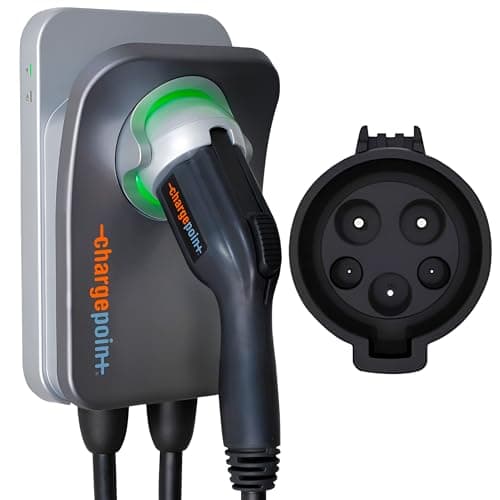
Buy the ChargePoint Home Flex if you want one charger that works with any EV on the road today - it uses the universal J1772 connector, dials in up to 50 amps, and can plug in or hardwire. Buy the Tesla Wall Connector if every car in your driveway is a Tesla: its native NACS plug means no adapter, and it costs less than Tesla's dual-connector Universal model. This one is decided less by the spec sheet than by what your car plugs into.
Both are excellent 48-to-50-amp home chargers, and both show up in our best Level 2 chargers roundup. The difference that matters is the connector on the end of the cable. We compile published specs and do the wiring math rather than bench-testing either unit.
The question that settles it: what does your car plug into?
The Tesla Wall Connector (Gen 3) has a native NACS plug - the connector Tesla uses, now the North American standard. A Tesla plugs straight in. A non-Tesla with a J1772 port would need a NACS-to-J1772 adapter on every charge. The ChargePoint Home Flex has a J1772 plug, which fits every non-Tesla EV directly and works with a Tesla using the small J1772 adapter Tesla already supplies. So the ChargePoint is the safer pick the moment a J1772 car is in the picture; the Tesla unit is cleanest in an all-Tesla household. Our connector guide covers the adapters if your driveway is mixed.
Speed
Effectively a tie. The ChargePoint is adjustable up to 50 amps; the Tesla Wall Connector is adjustable up to 48 amps / 11.5 kW. In practice both are limited by the same two things - the circuit you can install and the rate your car accepts - and most cars cap AC charging at 48 amps or less, so the pair charge at the same real-world rate on a 60-amp circuit. Neither's headroom is usable unless your panel and car can reach it; our amperage guide has the sizing.
App and ecosystem
Different apps for different lives. The ChargePoint app ties your home charger to the largest public-charging network in North America - one login for home and away, plus scheduling and energy monitoring. The Tesla app folds the Wall Connector into the same place you already manage the car, which is genuinely slick if you drive a Tesla and pointless if you do not. Both are Wi-Fi connected; pick the ecosystem you already live in.
Install and flexibility
The ChargePoint wins on flexibility. It comes in plug-in (NEMA 14-50) or hardwired form, so a renter can unplug and take it along. The Tesla Wall Connector is hardwired only - a permanent fixture with no plug-in option. If you might move, or you want the 40-amp plug-in convenience, that difference matters; if this charger is going on the wall for good, it is a non-issue.
Value
Close, with the edge going to whichever matches your car. The Tesla Wall Connector is priced aggressively for what it is and undercuts Tesla's own Universal Wall Connector, so for a Tesla owner it is a lot of charger for the money. The ChargePoint charges a modest brand-and-network premium that pays off if you will use the public-charging integration. If raw value is your only filter and you drive a J1772 car, note that the Emporiamatches most of the ChargePoint's capability for less - it is why the Emporia wins our overall roundup.
The verdict
Drive a Tesla and only a Tesla? The Tesla Wall Connector - no adapter, deep app integration, sharp price. Drive anything else, or a mix of cars, or want plug-in flexibility? The ChargePoint Home Flex. Read the full ChargePoint review, and before you buy either, confirm what your panel and car support in the amperage guide.
How to choose between them
Connector first: NACS vs J1772
A home charger is a decade-long purchase, so match the plug to your cars, not just this car. NACS is the Tesla-style connector and the new North American standard; J1772 is the Level 2 AC connector nearly every non-Tesla used through 2024. The Tesla Wall Connector is NACS; the ChargePoint is J1772. Either plug can reach the other car with a passive adapter, but the tidiest setup is a charger whose native plug matches the car you charge most.
Amps to kW, and why the number on the box is a ceiling
Level 2 charging is 240 volts, and power is roughly volts times amps: 48 amps at 240 volts is about 11.5 kW, 40 amps is about 9.6 kW. But EV charging is a continuous load, so a 48-amp charger needs a 60-amp breaker (48 x 1.25) and a 40-amp draw needs a 50-amp breaker. You only get the rated speed if the circuit and the car's onboard charger both allow it - many cars cap AC acceptance below the charger's maximum.
Hardwired vs plug-in
The Tesla Wall Connector is hardwired only. The ChargePoint offers plug-in (NEMA 14-50) or hardwired. Plug-in is capped at 40 amps and lets you take the unit with you; hardwiring unlocks the full amperage and looks cleaner but is permanent. Renters and movers should lean plug-in; an owner settling in can hardwire for the extra speed.