HUB 03 · Charging Guides
Can I Charge My EV With a Generator?
Technically yes. Practically it is a 2-to-5-mile-per-hour proposition that fails for one of two reasons - and both are knowable before you buy anything.
We earn a commission when you buy through our Amazon links, at no extra cost to you. It never affects our rankings, and we say so when the cheaper product is the better buy. How this works.
Yes - if the generator can supply the charger's full draw continuously, and if its neutral is bonded so the charger's ground check passes. Those two conditions decide every generator charging attempt, and both are answered in the generator's manual before you spend a dollar. What you get for it is slow: a 2,000-watt inverter generator running a 120-volt cordset is adding single-digit miles of range per hour, at a fuel cost far above grid electricity. It is an outage tool and a remote-property tool. It is not a charging strategy.
This page is the arithmetic and the two failure modes, in the order you need them. We have not bench-tested generators and we are not going to pretend otherwise - what follows is the math, the standards the charger has to satisfy, and what to read on your own equipment.
Start with continuous watts, not peak watts
Generators are advertised on starting (surge) watts and rated on running (continuous) watts. EV charging is the most boring possible load: a flat, unvarying draw for hours. The National Electrical Code classifies it as a continuous load for exactly that reason, which is why charging circuits are sized at 125 percent of the draw. Apply the same discipline to a generator and use its running figure, with headroom.
| Charger setting | Voltage | Power drawn | Generator running watts you want | Rough range per hour |
|---|---|---|---|---|
| 8A (Level 1, dialed down) | 120V | 0.96 kW | 1,200 W or more | About 3 miles |
| 12A (typical Level 1 cordset) | 120V | 1.44 kW | 1,800 W or more | About 5 miles |
| 16A (Level 2, minimum) | 240V | 3.84 kW | 4,800 W or more, 240V capable | About 13 miles |
| 24A (Level 2) | 240V | 5.76 kW | 7,200 W or more, 240V capable | About 20 miles |
| 32A (Level 2) | 240V | 7.68 kW | 9,600 W or more, 240V capable | About 27 miles |
Range figures assume roughly 3.5 miles per kilowatt-hour, a reasonable mid-point for a modern EV in mild weather. The headroom column is the charger's draw plus 25 percent, which is the same margin the code applies to the wiring and a sensible one to apply to an engine that also has to cope with altitude, heat and age.
Two consequences fall out of that table. A small 2,000-watt inverter generator - the common camping size - can run a Level 1 cordset and nothing more. And to get Level 2 charging you need a 240-volt generator, which in portable terms means something large, heavy and loud, typically with a NEMA 14-50 outlet on the panel.
Failure mode one: the charger will not start
This is the surprise that ends most first attempts. An EVSE is not a dumb socket. Before it closes its contactor and lets any current flow, it checks that a ground path exists, and it keeps monitoring for ground faults while it charges - that ground monitoring and the control-pilot handshake with the car are part of what the UL 2594 listing tests. A charger that cannot confirm a ground simply refuses to energize, and the light on the box blinks a fault at you with no explanation.
Generators differ in how they treat the neutral. Some bond the neutral to the frame internally; others leave it floating, which is a deliberate design choice for generators intended to feed a building through a transfer switch, where the bonding happens at the service instead. A floating neutral is a perfectly legitimate configuration - and it is also the configuration in which an EVSE's ground check can fail.
Read your generator's manual for the words "bonded neutral" or "floating neutral" before you buy a charger for it. Manufacturers document this. If the generator is floating-neutral and you need it to run an EVSE directly, that is a question for a licensed electrician about how the system should be grounded - not something to solve with a part from a forum post. Improvising a neutral-to-ground connection changes the fault behavior of the whole setup.
If the charger does start and then faults out intermittently, the other suspect is power quality. Every charger publishes an input voltage and frequency range; a generator under heavy load, or one whose governor is hunting, can drift outside it. Inverter generators hold voltage and frequency far more tightly than open-frame models, which is the practical reason they are the ones people succeed with.
Failure mode two: the breaker, or the engine
The second one is simple overload. An EVSE will draw its set current for as long as the car wants it, with no regard for what is upstream. Plug a 40-amp-capable charger into a generator that cannot feed 40 amps and you will trip the generator's breaker, or lug the engine down until it stalls.
The fix is to set the charger down, not to hope. This is the single most important step on this page, and it is why every pick in the gear block below is adjustable: a charger with a fixed 40-amp draw is the wrong tool for a generator at any size. Set the current limit to fit the generator's running watts using the table above, confirm it on the charger or in its app, and only then plug the car in. Our amperage guide covers how the setting is made on the main brands.
The safety rules that are not negotiable
- The generator runs outdoors, well away from the house, with the exhaust pointed away from doors and windows.Never in a garage, never in a breezeway, never "just inside with the door open". Engine exhaust contains carbon monoxide, and this is the hazard that actually kills people during outages.
- Never backfeed the house through a dryer outlet or a "suicide cord". If you want the generator to power the house circuits - including a hardwired charger - that needs a transfer switch or interlock installed by a licensed electrician.
- Do not refuel a running or hot generator, and do not charge in the rain without the generator being properly sheltered in a way its manual permits.
- Use the shortest adequately-sized cord you can, and read the extension cord safety guide before putting anything between the generator and the charger.
What it costs, honestly
Grid electricity is the cheapest fuel most drivers will ever buy, and generator electricity is close to the most expensive. You are burning gasoline in a small, inefficient engine to make kilowatt-hours, and the generator consumes fuel to idle whether the car is drawing or not. Running one for a 20-mile top-up is comfortably more expensive than the same miles from a wall outlet, and usually more expensive than a public DC fast charger. Our cost-to-charge calculator shows the baseline you are comparing against, and public charging cost shows the realistic alternative when the power is out.
Which brings up the thing worth saying plainly: in a power outage, an EV is usually better used as a way to get to working electricity than as something to pour generator fuel into. A functioning public charger a few towns over will refill the car faster and cheaper than any portable generator will. Some EVs can also power your house rather than the other way round - see bidirectional charging.
When a generator genuinely is the right answer
Three cases, and they are real. A remote property with no service - a cabin, a build site, a field - where the generator is the only electricity there is, and 20 miles overnight is enough to get back to civilization. A long outage where the car needs enough charge to reach somewhere useful. And a trailer or work truck that already carries a generator for tools, where topping up an EV is a bonus use of hardware you own.
In all three, the equipment list is the same: a generator whose running watts clear your target draw with margin, a bonded neutral or an electrician's sign-off, and an adjustable charger you can dial down to the generator's capability rather than the car's appetite.
What to look for in a charger you intend to run on a generator
This is a narrow spec list, and it is almost the opposite of what you would want on a wall.
- Adjustable current, with a low floor. The ability to set 8, 10 or 16 amps matters far more than a 40-amp ceiling. A fixed-current charger cannot be matched to a generator.
- The setting is made on the unit, not only in an app that needs Wi-Fi - because the place you need a generator is usually the place with no network.
- 120-volt capability, or both. A dual-voltage cordset covers the small generator case and the 240-volt case with one purchase.
- A real safety listing. UL or ETL to UL 2594. The ground monitoring you are relying on to protect you is the listed part of the product.
- Portability and a sane plug. A unit that ends in a NEMA 5-15 or 14-50 plug matches what a generator panel actually offers; a hardwired wall unit is the wrong product entirely.
The four below are the registry picks that fit that list - all adjustable, all portable, all set on the unit itself.
The gear
Recommended gear for this guide
The products this guide refers to, with prices pulled live from Amazon and dated on each card.
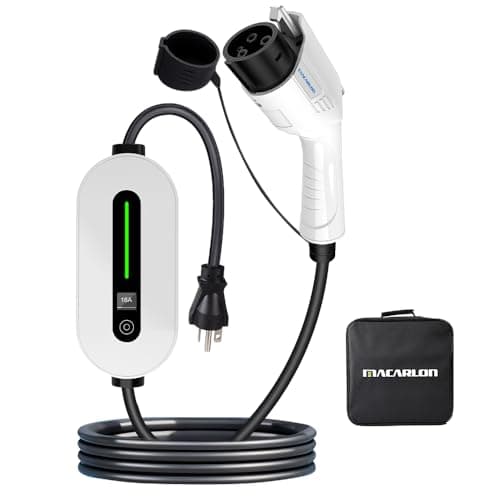
A 120V cord with a 240V upgrade path
MACARLON 16A Level 1/2
A 120-volt cord that also does Level 2 - it ships with a NEMA 6-20 plug and a 5-15 adapter, so a spare 240-volt outlet roughly doubles your charging speed for no extra hardware.
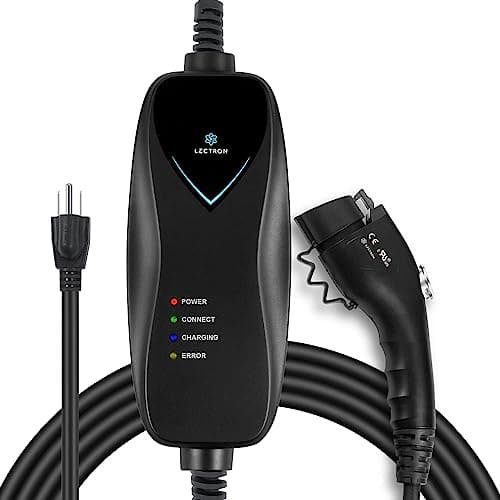
The certified 120V cord
Lectron Level 1 (15A)
The Level 1 cord to buy if you buy only one: ETL certified to UL 2594 and Energy Star listed, which most of the 120-volt field on Amazon cannot claim.
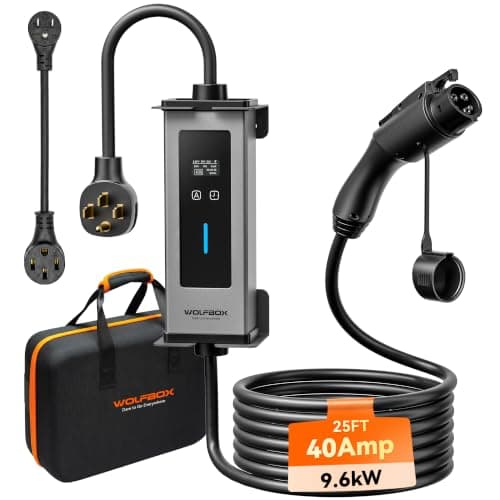
One charger for home and travel
WOLFBOX 40A Portable (Level 1/2)
A dual-level portable that doubles as a wall box — 40 amps on a NEMA 14-50, or Level 1 on a standard outlet with the included adapters. One weatherproof charger for the garage and the road.
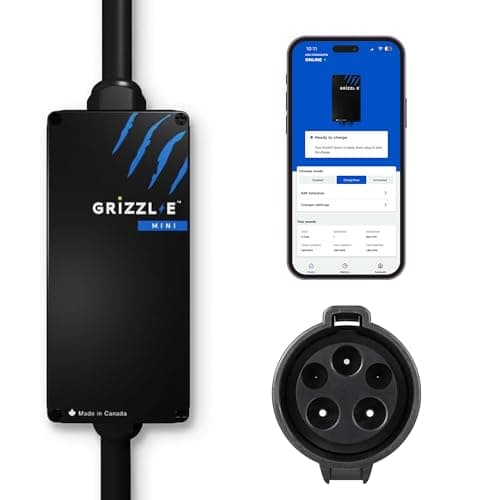
A dryer outlet now, a 14-50 later
Grizzl-E Mini (40A Portable)
A UL-certified, cast-aluminum 40-amp portable that ships with a NEMA 14-30P adapter - the one to buy if the dryer outlet is a stopgap and a 50-amp circuit is in your future.
#ad · As an Amazon Associate we earn from qualifying purchases.
Questions
Frequently asked
Can I charge an EV with a portable generator?
Yes, if the generator's running (not surge) wattage covers the charger's draw with about 25 percent headroom, and if its neutral bonding lets the charger's ground check pass. A 2,000-watt inverter generator runs a 120-volt cordset at roughly 3 to 5 miles of range per hour. Level 2 charging needs a 240-volt generator, which in portable terms means a large unit with a NEMA 14-50 outlet.
Why won't my EV charger work on my generator?
The usual cause is the generator's neutral. An EVSE checks for a ground path before it energizes and keeps monitoring for ground faults while charging; a floating-neutral generator can make that check fail, and the charger then refuses to start and shows a fault. Your generator's manual states whether its neutral is bonded. The other possibility is voltage or frequency drift outside the charger's published input range, which open-frame generators do more than inverter models.
What size generator do I need to charge an EV?
Work backwards from the charger setting you want. 12 amps at 120 volts is 1.44 kW, so you want about 1,800 running watts. 16 amps at 240 volts is 3.84 kW, so about 4,800 running watts and a 240-volt outlet. 32 amps at 240 volts is 7.68 kW, so about 9,600 running watts. Size on running watts, never on surge watts - EV charging is a flat continuous load for hours.
Is it cheaper to charge from a generator than from the grid?
No, substantially more expensive. A small gasoline engine is an inefficient way to make electricity and it burns fuel whether or not the car is drawing. Generator charging makes sense when there is no grid - a remote property, a long outage - not as a way to save money. Compare against your real rate with our cost-to-charge calculator.
Can I run the generator in my garage while the car charges?
No. Engine exhaust contains carbon monoxide and a garage - open door or not - is exactly where outage fatalities happen. The generator belongs outdoors, well clear of the building, with the exhaust directed away from any door, window or vent. If that means a longer cord to the charger, use a properly sized one and read the cord safety guide first.
Can I plug the generator into my house to run my hardwired charger?
Only through a transfer switch or interlock installed by a licensed electrician. Backfeeding a house through a dryer outlet or an improvised cord energizes the utility side as well and is genuinely dangerous to you and to line workers. If generator-powered charging is a goal, it belongs in the conversation when the charger circuit is designed - see the installation guide.
Will charging from a generator hurt my car's battery?
No. From the battery's point of view this is slow AC charging, which is the gentlest thing you can do to it - the car's onboard charger and battery management system handle the conversion and would reject anything out of spec. The risk in this setup is to the generator and to you, not to the pack. See does charging at 48 amps hurt your battery for what AC rate does and does not do.
Keep reading
Related
- What is bidirectional charging?The reverse case: using the car to power the house in an outage.
- Portable chargers for emergenciesThe cordset to keep in the trunk for exactly this situation.
- EV charger extension cord safetyWhat may and may not go between a generator and a charger.
- What amp EV charger do I need?How to set a charger down to a supply's real capability.
- Charging an EV at an RV parkThe other off-grid option, and usually the better one.
- Cost to charge at homeThe grid baseline that generator fuel is competing with.
More in this section
More Charging Guides
Receipts
Sources
- EC&M - NEC requirements for EV equipment (Article 625: EVSE is a continuous load, circuits sized at 125 percent of the load)
- Intertek - UL 2594 testing and certification for electric vehicle supply equipment
- SAE J1772 specification (the AC coupler, control pilot and proximity detection)
- US DOE AFDC - charging an electric vehicle at home (many owners meet their daily range needs charging overnight on Level 1 equipment, given an outlet on a dedicated branch circuit)
- US DOE / fueleconomy.gov - EV charging basics (Level 1, Level 2 and DC fast charging)
- Intertek - the ETL Listed Mark and OSHA Nationally Recognized Testing Laboratory (NRTL) status
- US DOE Energy Saver - electric vehicles
We do not run a testing lab, and we do not pretend to. Where a measured number came from someone else's lab, we name them and link them. Where we could not verify something, we say so on the page rather than quietly leaving it out. Read our full method.