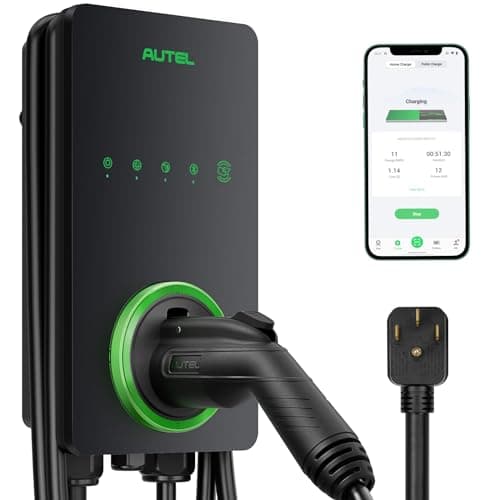
Buy the Autel MaxiCharger if every car you charge uses a J1772 port and you want a feature-complete unit - Wi-Fi and Bluetooth, a weather-rated shell, and a holster in the box - usually at a lower price. Buy the Tesla Universal Wall Connector if your driveway mixes a Tesla and a non-Tesla: it is the rare wall unit with a native NACS plug and an integrated J1772 adapter, so it charges both without juggling anything. What you park decides this one.
Both are excellent home chargers that show up in our roundups - the Autel leads our best smart chargers list, and the Tesla Universal is our pick for mixed-connector households. Here is how they compare on the things that decide it. We compile published specs and do the math rather than bench-testing either unit.
Connectors: the real dividing line
The Autel MaxiCharger has a J1772 plug - the universal Level 2 connector that fits every non-Tesla EV, and a Tesla using its supplied adapter. The Tesla Universal Wall Connector has a native NACS plug plus an integrated J1772 adapter, so it charges a Tesla and a J1772 car from the same unit with nothing to lose or misplace. If your household is single-standard, the Autel covers it simply; if you run both a Tesla and a J1772 car, the Universal is purpose-built for exactly that. Our connector guide explains the NACS-versus-J1772 split.
Speed
The Tesla, on paper. The Universal Wall Connector is adjustable up to 48 amps / 11.5 kW, against the Autel MaxiCharger's 40 amps / 9.6 kW. On a 60-amp circuit and a car that accepts 48 amps, the Tesla adds range a little faster. But the Autel's 40 amps is the plug-in ceiling most homes install anyway, and plenty of cars cap AC charging at or below 40 amps - in which case the two charge at the same rate. Confirm your panel and car before you pay for the headroom.
Features and install
The Autel is the more feature-loaded of the two out of the box. It carries both Wi-Fi and Bluetooth - so app control still works when garage Wi-Fi is weak - and it ships with a holster for a tidy install from day one. The Tesla Universal is cleanly integrated with the Tesla app, which is a real plus if you drive a Tesla, and its headline trick is the dual connector rather than a long feature list. Both are well-built, weather-rated units suitable for a garage or an exterior wall.
Value
The Autel, for a single-standard home. It usually costs less and gives you a fully-featured 40-amp charger with a holster included. The Tesla Universal costs more, and its dual-connector advantage only pays off if you actually charge both a Tesla and a J1772 car - if every car in your driveway is one standard, you are paying for a capability you will not use. Buy the Tesla for the mixed-fleet superpower; buy the Autel when you do not need it.
The verdict
Single-standard driveway - all J1772, or all Tesla with an adapter? The Autel MaxiCharger: more features, lower price. A genuine mix of a Tesla and a non-Tesla EV? The Tesla Universal Wall Connector, which charges both natively. See our best chargers for a Tesla for the Tesla-owner angle, and size your circuit in the amperage guide first.
How to choose between them
Match the connector to your whole driveway
The decision starts with what you charge. All J1772, or a single Tesla? A J1772 charger like the Autel keeps it simple. A real mix of a Tesla and a J1772 car? The Tesla Universal's native NACS plug and built-in J1772 adapter mean one unit serves both, with no loose adapter to lose. Buy for the cars you will own over the charger's decade on the wall, not just today's. If neither of these two is quite the fit, see how they rank against the rest of the field in our ranked Level 2 chargers.
Amps to kW, and the ceiling that applies
The Tesla Universal reaches 48 amps (about 11.5 kW) and the Autel 40 amps (about 9.6 kW). Charging is a continuous load, so 48 amps needs a 60-amp breaker and 40 amps a 50-amp breaker - and either figure is real only if your car's onboard charger accepts it. A 40-amp unit on a 50-amp circuit is the sweet spot for many homes; 48 amps pays off only when the panel and the car can both use it.
Hardwiring, plug-in and a second EV
Both are wall units for a permanent install. If you are weighing a second EV down the line, look at how each handles load management so two chargers can split one circuit safely rather than forcing a costly second line, and have a licensed electrician size any shared circuit. For the plug-in 40-amp route that suits most single-car homes, see our best 40-amp chargers.