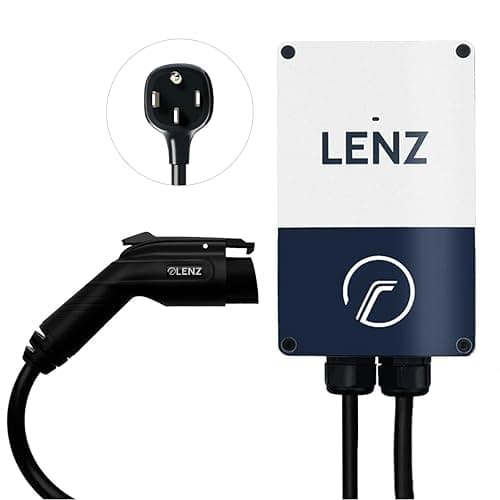
Buy the LENZ Level 2 if you want the cheapest wall charger whose safety listing you can personally verify, and you genuinely do not want an app. LENZ publishes 40 amps maximum output, a 240V input, a J1772 connector on a NEMA 14-50 plug, a NEMA 4X weatherproof and corrosion-resistant enclosure with an IP67 rating, and an ETL listing tested by Intertek - with the control number printed on its own product page. That last detail is rarer than it should be at this price, and it is the reason this unit earns a review rather than a dismissal. The case against it is equally simple: it does nothing else at all, and the warranty terms on LENZ's own page contradict each other.
The LENZ is the floor of our budget charger roundup and appears as the value option on several of our per-brand pages. This is the closer look. We compile published manufacturer specifications, certification records and retail listings and do the electrical arithmetic - we have not bench-tested this charger, so treat this as documented research rather than a lab measurement.
Who it is for
One buyer, very specifically: somebody who has, or can get, a properly installed NEMA 14-50 receptacle, whose car is fine at 40 amps, who pays a flat electricity rate or is happy to use the car's own charge scheduler, and who would rather spend nothing on software. That is a bigger group than the charger market behaves as though it is. A great many drivers set up an app once, never open it again, and would have been better served by a box with a light on it.
It is also a sensible charger for a rental property, where a unit with no cloud account attached to a departing tenant is an advantage rather than a limitation, and for a second charger in a two-car driveway where the first one already does the monitoring.
The certification, and why it is the story
Most of the value end of this category makes a safety claim you cannot check. LENZ does not. Its product page states the charger is ETL Listed and "Tested by Intertek to comply with North American safety standards," and it publishes the ETL Intertek listing number - 5026085 - on the page itself. There is also an independent ENERGY STAR certified EVSE recordfor a LENZ 40-amp wall unit, model EVSE-W1-40-A, in the EPA's own product finder.
Two things are worth being precise about here. First, ETL is not a lesser mark than UL: for EV supply equipment both laboratories test to the same standard, UL 2594, and both Intertek and UL Solutions are OSHA-recognized testing laboratories. Second, a safety listing is a different claim from an enclosure rating - the listing says the device was tested against a safety standard, the enclosure rating says what gets into the case. You want both, and neither implies the other, which we work through in NEMA vs IP ratings.
Why a published control number matters:it converts a marketing bullet into something falsifiable. With a control number you can look the listing up in the testing laboratory's own directory and see what was certified. Without one - which is the situation on most cheap chargers, including the WOLFBOX PE40 we also reviewed this month - you are trusting a listing title. Our UL-listed ranking explains how to run that lookup.
The enclosure: 4X at a price where 4X is unusual
LENZ publishes a NEMA 4X enclosure, explicitly described as weatherproof and corrosion resistant, and separately an IP67rating. The X is the part that matters and the part almost nothing at this price carries. NEMA's X suffix is the corrosion claim, and there is no digit in the IP system that covers corrosion at all - so a charger advertising IP66 or IP67 alone has not demonstrated what a 4X enclosure has.
Practically: this is a defensible choice for a charger on an exposed wall, including within reach of salt air, where most budget units are not. In the registry we rank, a published 4X rating otherwise means stepping up to the Grizzl-E Ultimate. If the charger is going outside at all, read weatherproofing an outdoor install first - a 4X box mounted with its cable entry facing up is no longer a 4X installation.
What you give up
Everything software. No Wi-Fi, no app, no energy monitoring, no load management, no remote start, no firmware updates. For some buyers that is a feature; for others it is the reason to spend more. Two consequences are worth planning around:
- Off-peak charging has to come from somewhere else.Nearly every EV sold in the last decade can schedule its own charging from the car's screen or phone app, and that is the correct solution here - the car knows its own state of charge. Set it in the car and the charger never needs to be clever. Our off-peak charging page covers both routes, and chargers with scheduling covers the units that do it themselves.
- No energy data means no cost tracking. If you want to know what charging costs you per month without reading a utility bill, this is the wrong charger and an energy-monitoring unit is worth the premium.
There is one ambiguity in the published material: LENZ's page refers readers to the instruction manual over DIP switch settings, which implies the unit has internal switches for current selection, but LENZ does not publish an adjustable range. We are not going to invent one. Treat it as a 40-amp charger and plan the circuit for 40 amps.
The 40-amp ceiling and the circuit behind it
40 amps at 240 volts is 9.6 kW. Because EV charging is a continuous load under NEC Article 625, the circuit is sized at 125 percent of the load, so a 40-amp charger needs a 50-amp circuit - and a NEMA 14-50 receptacle is itself rated for a 40-amp continuous load, which is why no plug-in charger on a 14-50 goes faster. If you want 48 amps you are hardwiring on a 60-amp circuit, and that is a different field at a different price.
For most cars 40 amps is not a compromise. It adds roughly 30 miles of range per hour for an efficient car, which refills a daily commute several times over in an overnight window. The cars that genuinely reward more are the big-battery trucks and SUVs, and should I upgrade to a 48-amp charger is the honest version of that calculation.
The honest cons
- The warranty terms contradict themselves.The product description says the charger "comes with a 3-year warranty which can be extended by 6-months when you register," while banners on the same page advertise a 10-year extended limited warranty for registering within 60 days of purchase. LENZ does not reconcile the two. Register the unit, keep the receipt, and do not buy it for the warranty until the terms are clearer.
- Several specifications are simply not published. No cable length, operating temperature range, weight or dimensions on the manufacturer page; the retail listings quote a 24-foot cable. For a charger going on an outdoor wall in a cold climate, a missing temperature range is a real gap.
- Stock on the Amazon listing runs thin.It read "Only 5 left in stock" when we checked it for this review. It is a small brand and this listing comes and goes; LENZ also sells the unit directly. If the link below is out of stock, the alternatives ranked beneath it are the ones to look at.
- No app means no diagnostics. When something goes wrong you have a status light, not an error log. Our fault codes and warning lights guide is more useful than usual with a charger like this.
How it compares
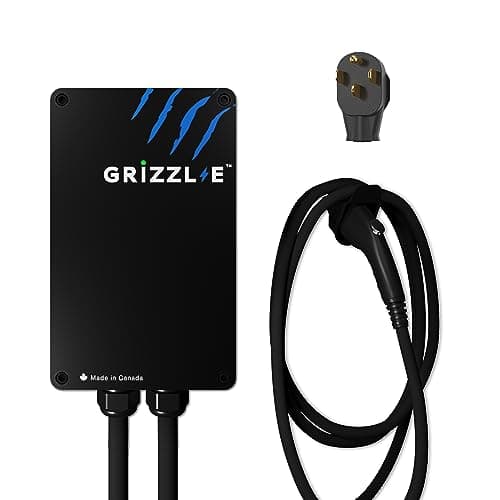
- Against the Grizzl-E Classic:the closest rival and usually priced within a few dollars. The Grizzl-E publishes more - a UL file number, a UL Type 4 indoor/outdoor rating, an operating range of -22F to 122F, adjustable 32/24/16-amp settings and a 25-foot cable - but Type 4 is not Type 4X, so the LENZ has the corrosion claim and the Grizzl-E has everything else. If the charger goes in a garage, buy the Grizzl-E. If it goes on a coastal wall, the LENZ's 4X rating is the one that answers the question.
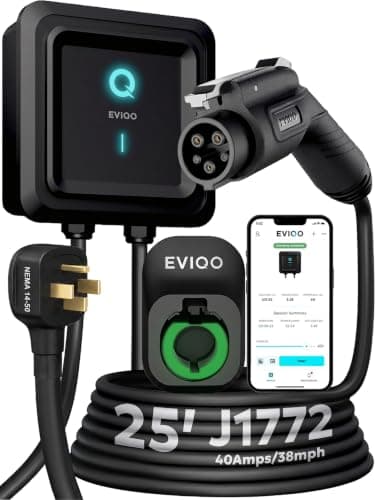
- Against the EVIQO Level 2: the EVIQO is double-listed (UL and ETL), IP66, and adds a real app with scheduling and energy monitoring for meaningfully more money. If you will use the software, it is the better buy. If you will not, you are paying for it anyway.
- Against a portable: a dual-level portablesells for about the same money and adds a 120-volt mode and the ability to travel, at the cost of a permanent, tidy installation and - in that unit's case - a verifiable certification number.
The short version
Verdict: an honestly cheap charger rather than a corner-cutting one. The certification is real and checkable, the enclosure claim is better than its price band, and the feature list is empty on purpose. Buy it if you want a listed metal box that charges a car and nothing more. Buy something else if you want scheduling, energy data, 48 amps, or a warranty you can read in one sitting.
How to buy at the bottom of the market without getting burned
The budget end of this category contains both honest engineering and genuinely dangerous rubbish, and the difference is not price. Four tests separate them.
1. Demand a safety listing, and prefer a number
UL or ETL, no exceptions, on a device that carries 40 amps for hours at a time. Then prefer the maker that publishes the file or control number - LENZ publishes an Intertek listing number, Grizzl-E publishes a UL file - because that is the claim you can check yourself rather than take on trust. Vague wording like "manufactured to UL standards" or "UL-listed components" is not a listing of the charger, and are cheap EV chargers safe explains what that distinction is hiding.
2. Read the enclosure rating for the location, not for the number
Inside a closed garage, almost any outdoor rating is over-specified. On an exposed wall you want Type 4 or IP66 upward. Within about a mile of salt air, or near a pool, you want the X - and that is where the LENZ's 4X claim stops being a marketing line and starts being the reason to buy it.
3. Budget for the outlet, not just the charger
A plug-in 40-amp charger is only as safe as the receptacle behind it. A 14-50 outlet sold for occasional RV use is not built for 40 amps held overnight, and that part - not the charger - is the one that chars. Buy an industrial-grade receptacle per our NEMA 14-50 outlet guide, and count the install in the price using what installation actually costs.
4. Decide about software before you shop, not after
If your utility charges one rate all day and your car can schedule itself, charger software buys you nothing. If you are on a time-of-use tariff and want to see where the money goes, it buys you a lot. Settle that first and the budget question gets much easier - do I need Wi-Fi for an EV charger is the five-minute version.
So, which one?
Buy the LENZ Level 2 for the cheapest verifiable listing with a corrosion-rated enclosure. Buy the Grizzl-E Classic for a better-documented box with adjustable amperage and a longer cable at about the same money. Buy the EVIQO Level 2 if you will actually use an app.