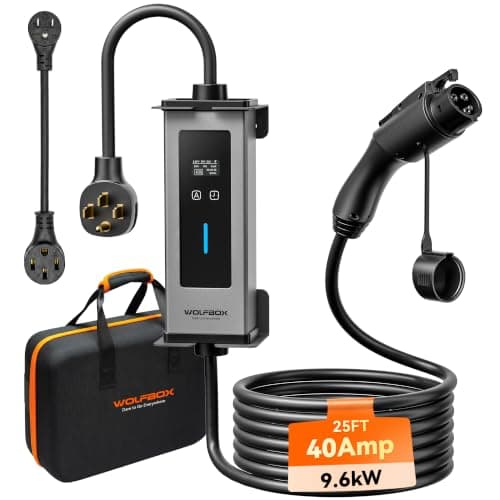
Buy the WOLFBOX PE40 if you want one charger that does both jobs: 40 amps of Level 2 on a NEMA 14-50 outlet at home, and Level 1 on an ordinary wall socket wherever you end up. The listing publishes 40 amps, a J1772 connector, a 25-foot cable, an ETL certification, an IP66 indoor/outdoor rating and 208-240V operation, with NEMA 5-15 and 14-50 plug adapters in the box. That is a genuinely useful combination, and it lands at roughly the price of a plain 40-amp wall box rather than at a premium. The reason this is a qualified recommendation rather than an easy one has nothing to do with how it charges: it is that WOLFBOX does not publish a specification page for this model at all, so every figure above comes from retail listings rather than from the manufacturer.
The PE40 is the dual-level anchor of our portable charger roundup. This is the closer look at the one unit. As on every page here, we compile published specifications, retailer listings and owner reports and do the electrical arithmetic ourselves - we have not bench-tested this charger, and we do not run a test lab, so treat this as documented research rather than a measurement.
What it is
A portable EVSE is a charger with a plug on the end instead of a conduit entry. The PE40 is the more capable kind: not a travel cord that trickles, but a full 40-amp Level 2 unit that happens to be removable. WOLFBOX ships it with a mounting bracket, so the normal pattern is that it lives on a garage wall plugged into a 14-50 receptacle for 51 weeks of the year and goes in the trunk for the other one.
What makes it a dual-levelunit, and what separates it from most 40-amp portables, is the NEMA 5-15 adapter in the box. With that fitted it runs on a standard 120-volt household outlet as a Level 1 charger. That is slow - the Department of Energy puts Level 1 at a few miles of range per hour against Level 2's tens - but the point is that it works at all, in a rental, at a relative's house, or at a job site where nothing but a wall socket exists.
The published specifications, and where the trail goes cold
Here is every figure we could attribute, with the source for each. Note which column each one comes from, because that distinction is the main finding of this review.
| Specification | Published figure | Published by |
|---|
| Maximum current | 40 amps | Amazon listing title |
| Adjustable range | 6A to 40A | Retail listing |
| Input voltage | 208-240V (and 110-240V through the adapters) | Amazon listing title / retail listing |
| Connector | SAE J1772 | Amazon listing title |
| Plug and adapters | NEMA 14-50 and NEMA 5-15 | Amazon listing title |
| Cable length | 25 ft | Amazon listing title |
| Enclosure rating | IP66, also described as NEMA 4 | Amazon listing title / retail listing |
| Safety certification | ETL Certified | Amazon listing title |
| Delay timer | 1-12 hours | Retail listing |
| Housing | Aluminum alloy | Retail listing |
| Warranty | 3 years, with 24/7 support | Retail listing (seller claim) |
| Operating temperature range | Not published anywhere we could find | - |
| Weight and dimensions | Not published anywhere we could find | - |
The finding worth your attention:a search of WOLFBOX's own store for "PE40" returns zero results. The brand publishes a proper product page for its WE40 wallcharger - complete with its certification claims and a recommended breaker size - but nothing for the portable. So there is no manufacturer datasheet to check a retailer's bullet point against, and no published operating temperature range, which is exactly the specification a portable charger owner wants before leaving one in a car overnight in February. That is not evidence the unit is bad. It is a reason to buy it from a seller with a returns policy, and a reason this page quotes a source for every number.
The 40-amp claim and the outlet it actually needs
40 amps at 240 volts is 9.6 kW, and that is the whole speed story: a 40-amp portable charges exactly as fast as a 40-amp wall unit, because the car and the circuit set the rate, not the shape of the box. What the plug does change is what has to be behind it. EV charging is a continuous load under NEC Article 625, so the circuit is sized at 125 percent of the load - the same thing as saying the load may not exceed 80 percent of the breaker. A 40-amp draw therefore needs a 50-amp circuit and a properly rated NEMA 14-50 receptacle.
That receptacle is the part that fails, not the charger. A 14-50 outlet sold for occasional RV duty is not built for a 40-amp load held for eight hours a night, which is why our NEMA 14-50 outlet guide pushes industrial-grade receptacles, and why the outlet roundup exists at all. If the outlet you are plugging into is of unknown vintage, dial the PE40 down to 32 amps on its own control panel and have an electrician look at the receptacle before you run it flat out.
The adjustable 6-40A range is more useful than it sounds for a travel charger. It means one unit can sit at 40 amps at home, drop to 24 amps at an older 30-amp circuit through an appropriate adapter, or go down to 12 amps on a shared outlet - and the car will obey, because the charger tells it the available current over the J1772 control pilot and the car draws no more than that.
Level 1 on the 5-15 adapter: what you actually get
Do not buy this expecting the 120-volt mode to be a real charging solution. On a standard household outlet the ceiling is a 12-amp continuous draw on a 15-amp circuit, which is about 1.4 kW - roughly a seventh of what the same unit does on 240 volts. The retail listing's own framing, "7x faster than Level 1," is an accurate description of its Level 2 mode and an accurate warning about its Level 1 mode.
What Level 1 is good for is the overnight top-up that gets you out of trouble, and the plug-in-anywhere insurance that a 14-50-only portable cannot offer. If you want to understand where that boundary sits before relying on it, our Level 1 vs Level 2 guide runs the numbers for both, and portable chargers for emergencies covers the trunk-charger case specifically.
Build, controls and weather
Three things about the hardware stand out in the listings, and all three are the right calls for something that spends time outdoors.
- Physical buttons, not a touch panel.The retail listing is explicit that this "eliminates touch issues in rain, snow, or freezing cold," and it is correct - capacitive panels are the worst possible interface for a device you operate with wet gloves on.
- An aluminum alloy body with an IP66 rating. IP66 is dust tight and protected against high-pressure water jets from any direction, which is more weather than a wall-mounted charger ever sees. Note that the listings describe it as both IP66 and NEMA 4 - those are two different rating systems measuring different things, and we explain why that pairing is not interchangeable in NEMA vs IP ratings. Neither rating includes a corrosion claim, so this is not the charger for a wall a mile from salt air.
- A delay timer with no app. Set 1 to 12 hours on the unit itself and charging starts when your off-peak rate does. No Wi-Fi, no account, nothing to drop at 2 am. On a time-of-use tariff that is where the real money is, as our off-peak charging page works through.
One discrepancy worth recording: the delay timer is published as 1-12 hours on this model and 0-12 hours on the NACS sibling, from the same brand, on the same retailer. We have not resolved it, and we are not going to pretend we have.
What "ETL Certified" does and does not tell you
ETL is not a lesser mark than UL. It is the same safety standard - for EVSE that is UL 2594 - tested by Intertek instead of by UL Solutions, both of them OSHA-recognized testing laboratories. A charger carrying a genuine ETL listing has been evaluated for the things that matter when a device pushes 40 amps for eight hours: ground-fault protection, thermal behavior, insulation.
What the listing does notgive you is the control number that would let you look the listing up in Intertek's directory. That is the difference between the PE40 and a unit like the LENZ Level 2, whose maker publishes its ETL control number on its own product page, or the Grizzl-E family, which publishes a UL file number. If you want a charger whose certification you can personally verify, our UL-listed ranking explains how to do that lookup and which units make it possible.
How it compares
Two other portables in our registry bracket it, and the choice between the three is genuinely about what you value.
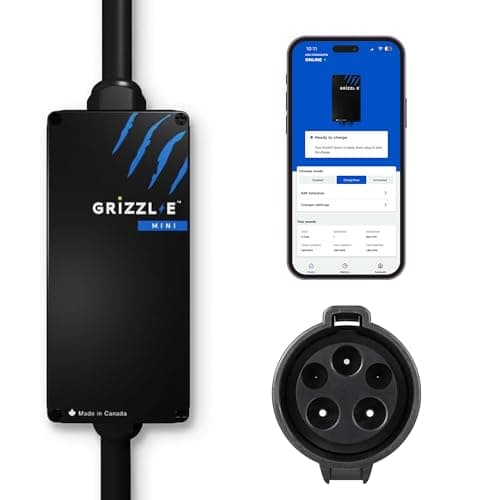
- Against the Grizzl-E Mini: the Mini is the better-built and far better-documented unit - cast aluminum, a published UL file, a published operating range, four plug adapters, a 3- or 5-year warranty - and it costs substantially more for identical charging speed. If the specification trail matters to you as much as it does to us, pay the difference. If it does not, the PE40 adds the 120-volt mode the Mini does not have.
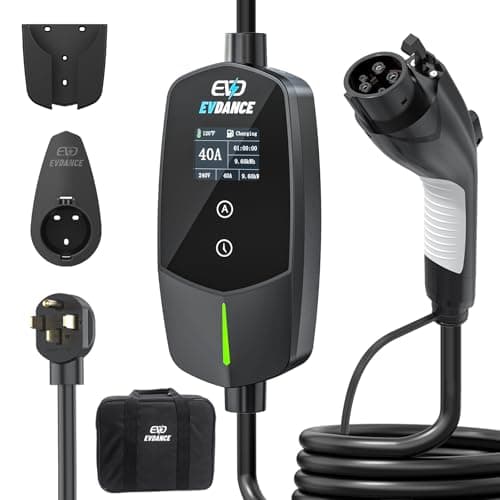
- Against the EVDANCE 40A: the closest rival on paper and usually the cheaper one. The EVDANCE matches the PE40 on the things that decide charging speed - 40 amps, a J1772 connector, a NEMA 14-50 plug, a 25-foot cable and a delay timer with no app - so what you are paying the difference for is the 120-volt mode and the published IP66 and ETL claims. If the charger will only ever meet a 14-50 outlet, the EVDANCE does the same job for less.
- Against a wall unit: if the charger is never going to move, buy a wall unit. A hardwired or plug-in box on a bracket is tidier, and at this price the field includes genuinely well-certified 40-amp units. Our portable vs wall-mounted comparison is the honest version of that argument.
The honest cons
- No manufacturer datasheet. Covered above, and it is the main one. No published operating temperature range on a product designed to live in a car.
- No verifiable certification number. The ETL claim is almost certainly real - it is on the listing title, which carries consequences - but you cannot check it yourself.
- A portable has nowhere to live. A hook, a bracket or the floor. 25 feet of heavy cable is a lot to manage, and a holster is not optional if you want the garage to stay walkable.
- 40 amps is the ceiling. If your car accepts 48 amps and you want it, this is not the unit - a 14-50 plug caps at 40 amps regardless. That is the 48-amp field, and it means hardwiring.
- The "37 miles of range per hour" figure is the maker's.It is a reasonable number for an efficient car at 9.6 kW, and it will be wrong for a heavy truck. Your car's efficiency decides it, not the charger.
The short version
Verdict: a capable, well-shaped product with thin paperwork. If you want one charger for a garage wall and a trunk, and you are buying somewhere you can return it, the PE40 is a sensible buy at the price it sells for. If you want to be able to verify every claim about a device that carries 40 amps through your house for years, buy the Grizzl-E Mini and pay more, or buy a properly documented plug-in wall charger and give up portability.
Five checks before you buy any portable charger
1. Confirm the outlet, not the charger
A 40-amp portable is only as good as the receptacle it hangs off. Check that the 14-50 outlet is on its own 50-amp breaker, that nothing else shares the circuit, and that the receptacle is a proper industrial-grade part rather than the cheapest RV outlet on the shelf. If you cannot confirm all three, run the charger at 32 amps until an electrician has looked at it.
2. Decide whether you actually need the 120-volt mode
The 5-15 adapter is the PE40's main advantage over cheaper portables, and it is worth real money to a renter, a two-home household or anyone who parks somewhere unpredictable. If your car never leaves a garage with a 14-50 outlet in it, you are paying for a feature you will not use - and a cheaper 14-50-only portable does the same job.
3. Insist on a safety listing, and prefer a verifiable one
UL or ETL, with no exceptions, on anything that carries 40 amps continuously. Where you have the choice, prefer a maker that publishes the file or control number so the listing can be looked up in the testing laboratory's own directory. Our are cheap EV chargers safe guide covers what an uncertified unit is actually risking.
4. Measure the cable run before you trust 25 feet
25 feet sounds like plenty and often is not, once the cable has to come down a wall, round a bumper and across to a port on the far side of the car. Measure the real path, not the straight line. The cable length guide has the method.
5. Buy somewhere you can send it back
This applies to the whole value end of the category and it applies double to a unit with no manufacturer datasheet. A returns window is the practical substitute for a specification sheet.
So, should you buy it?
Yes, if you want a dual-level portable at a wall-charger price and the Level 1 fallback matters to you. No, if you want documentation you can audit - in which case the Grizzl-E Mini is the portable to buy, and a properly documented wall unit is cheaper than both.