HUB 03 · Charging Guides
EV Charger Theft Prevention: What Actually Works
The economics are absurd: a stripped charging cable is worth single-digit dollars and costs you a whole charger. Here is how to stop being the easy target on your street, ranked by what each measure costs you.
We earn a commission when you buy through our Amazon links, at no extra cost to you. It never affects our rankings, and we say so when the cheaper product is the better buy. How this works.
The single most effective thing you can do is make your charger harder to reach than the one next door - park to block it, put it inside if you can, light the approach, and holster the connector so it is not hanging at waist height in the dark. None of that costs more than an evening. The expensive measures matter less than people expect, because nothing you buy stops a determined person with a cable cutter in thirty seconds. What you are actually buying is the few seconds of hesitation that sends someone to a softer target.
Before the measures, the economics - because they explain both why this happens and why most advice about it is wrong.
What a thief gets, and what it costs you
A 25-foot Level 2 charging cable contains roughly $23 of copper. Stripping the insulation off is slow, dirty work, and once it is done the metal is worth about $5 to $7. A police sergeant quoted by the Associated Press put the scrap-yard value of a whole cable at $15 to $20 and said plainly of the thieves: "they're not making a significant amount of money."
Your side of the ledger is not symmetrical. Replacing a single cable on a public charger runs about $1,000 in Minneapolis, and charging networks report costs of up to $4,000 per cable. At home it is usually worse in a different way: most home chargers are not field-serviceable. The cable is not a part you order; a cut cable means a new charger plus, on a hardwired unit, an electrician to swap it. A handful of commercial-grade units - the Enphase CS-100 in our 80-amp roundup is the example - are built so the lead can be replaced, which is a serviceability feature almost no residential charger has.
So: a few dollars of gain, a four-figure loss, and a crime that takes under a minute. That asymmetry is why prevention is about friction and visibility rather than about hardening.
How much of this is actually a home problem?
We want to be straight about the evidence here, because the numbers that get quoted in these articles are almost all about public chargers.
The measured data is solid and it is all network data. Electrify America ran 968 stations and 4,400 plugs and recorded 129 cable cuts through May 2024 - four more than in the whole of 2023. Seattle police had logged seven cable-theft cases by mid-2024, matching the full prior year. Houston went from no known cases to eight or nine in roughly a month, with one Tesla station losing 18 of its 19 cords in a single incident.
For homechargers there is no equivalent count that we could find - no police category, no insurance figure, no utility tally. What there is: reporting that thieves moved on to personal wall chargers after the public ones, and the observation that a home charger's cable holds less copper but is thinner and therefore easier to cut. Treat your risk as real but unquantified, and weight it by where you live and whether your charger is visible from the street. If it is in a locked garage, you can stop reading after the next section.
The measures, cheapest first
1. Park to block it (free)
If the charger is on a garage wall or an exterior wall the car parks against, the car itself is the barrier. Reversing in so the charge port - and therefore the connector and the last few feet of cable - sits between the vehicle body and the wall removes the casual approach entirely. This is free, works every night, and is the measure people most often overlook because it feels too simple to count.
2. Put it inside, or at least out of sight (free to cheap)
A charger inside a closed garage is a different risk category from one on a driveway wall. If the only option is outside, the question is sightlines: can someone walking past the end of the drive see a connector hanging there? Our where to mount an EV charger guide works through the placement trade-offs, and garage vs outdoor charging covers the weather side of the same decision. If the charger has to live in a detached garage, that page covers the wiring and the security together.
3. Light it and watch it (cheap)
Motion-sensor lighting over the charging spot and a camera with a view of it are the two measures police consistently recommend for this specific crime, and they are the two that cost least per unit of deterrence. A cable theft is a quiet, dark-hours crime; a floodlight coming on is the friction. A camera is less about catching anyone - these cases rarely resolve - and more about the fact that a visible camera changes the calculation before the cutter comes out.
4. Holster the connector (cheap)
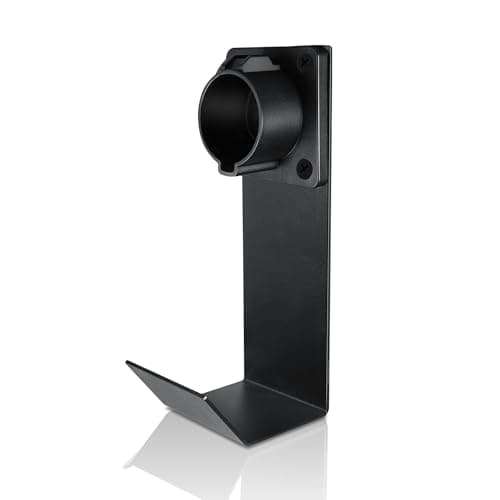
A loose connector dangling on its cable, or coiled on the garage floor, is both the easiest thing to grab and the part most likely to be damaged anyway. A wall holster and J-hook puts the head in a dock at a chosen height and the cable in a loop off the ground. The Lectron nozzle holster dock and J-hook combo is the one we point people at for a J1772 setup, and there is a NACS version of the same thing. It is a tidiness product that happens to be a security product - mount it high and behind the parked car and the connector stops being at grab height. Our holster roundup ranks the field, and cable management covers the full routing question.
5. Lock the outlet, not just the charger (cheap)
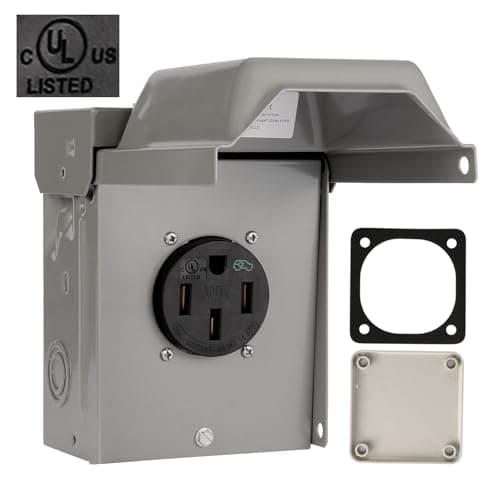
If your charger is plug-in on a NEMA 14-50, the receptacle is a second exposure - someone can unplug the whole charger and walk off with it, and on a shared driveway they can also simply plug in their own car on your meter. A metal outlet box with a lockable cover closes both. The Wayona 50-amp EV/RV power outlet box is a NEMA 3R weatherproof metal enclosure around a 14-50R receptacle whose hinged cover locks and still closes over a connected 50-amp plug - UL certified and ETL listed as an assembly. That last detail is the one that matters: plenty of covers will not shut over a plug that is in use, which makes them useless for this. The NEMA 14-50 guide covers the receptacle itself, which is the part cheap installs get wrong for reasons that have nothing to do with theft.
Electricity theft is its own version of this problem for anyone charging in shared parking - our street-parking guide gets into the metering side.
6. Hardwire instead of plugging in (moderate, if you are installing anyway)
A hardwired charger has no plug to pull. It is bolted to the wall with the conductors inside the wall, which means stealing the unit means unwiring it. A plug-in unit on a 14-50 is designed to come off easily - that is the whole point of it, and it is genuinely the right choice for renters and movers. If you are weighing the two anyway, security is one more item on the hardwired side of the sheet alongside 48-amp capability. Our hardwired roundup and plug-in roundup cover each path.
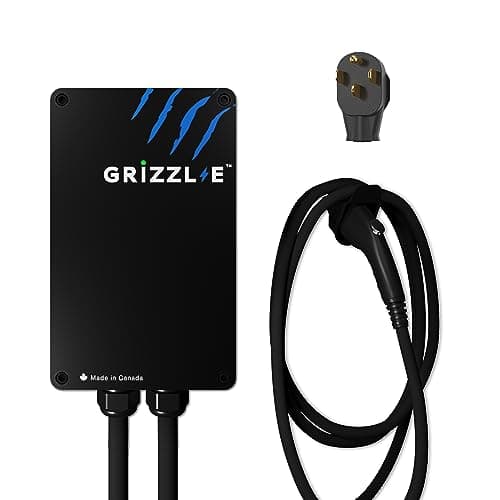
A note on enclosures: a metal-cased charger like the Grizzl-E Classic is harder to damage casually than a plastic one, and its UL Type 4 aluminum body is the reason it shows up on our outdoor roundup. Be clear-eyed about what that buys, though - it protects the box, and the box is not what gets cut. Nobody is stealing a charger enclosure for scrap.
7. Use a locking adapter, if an adapter is in the chain (moderate)
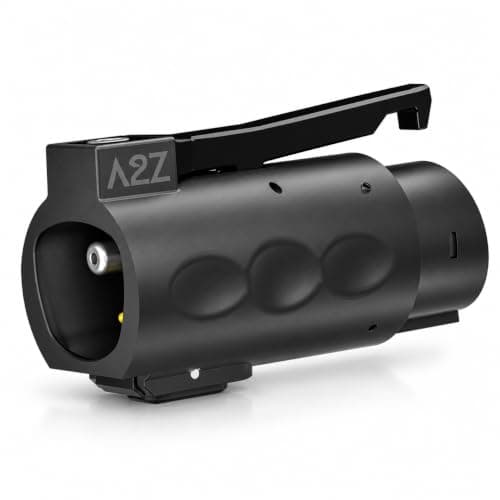
An adapter is the most stealable item in a charging setup: small, valuable, and not attached to anything. If you run a NACS-to-J1772 adapter and leave it on the connector between sessions, that is the part that walks off first. The A2Z EV Stellar Plugis the one in this class with an integrated locking pin - it latches into the car's port so it cannot be lifted off while connected - alongside UL 2252 and CSA certification, dual thermal sensors and a hard case to store it in. The honest version of this advice is simpler, though: take the adapter inside. A hard case on a shelf beats any lock.
8. Check what your insurance actually covers (free, and worth an evening)
This is the measure with the best return and the one nobody does. A hardwired charger may be treated as a fixture under your dwelling coverage; a plug-in unit may fall under contents; and either way the deductible may be larger than the loss. Finding out before you need to know changes how much the rest of this list is worth to you. Our guide on whether home insurance covers an EV charger walks through the questions to ask, and the answer determines whether you should spend $40 on prevention or $400.
What is theater
- A padlock through a cable loop. The cable is the thing being cut. Locking it to itself, or to a hook, does not protect the only part a copper thief wants - and it makes the cable harder for you to use every night, which means you will stop doing it within a week.
- Buying an expensive charger for its anti-theft features. Tamper-resistant screws and remote locking are real features on units like the Autel MaxiCharger, and they address someone using your charger rather than someone cutting it. Useful if your charger is reachable by the public; not a reason to upgrade otherwise.
- Cable armor and sleeving. Nothing you can wrap a flexible charging cable in stays flexible and also resists a cutter. The products that claim both are solving a different problem, usually rodents or abrasion - which, to be fair, is a far more common cause of a damaged home charging cable than theft is.
- Alarms on the charger itself. By the time an alarm sounds the cable is cut. Spend the money on the light instead, which fires before rather than after.
If it already happened
- Do not touch a cut cable. Kill the breaker to the charger circuit first. Charging cables are de-energized when not connected to a car, but a damaged unit is not a thing to assume anything about.
- Photograph everything before you tidy up - the cut end, the mount, the surroundings. Both the police report and any insurance claim will want it.
- File the police report even though it likely goes nowhere. The aggregate numbers in this article exist because reports were filed; the absence of a residential figure is partly because they often are not.
- Check serviceability before you buy a replacement. On the small number of units with a field-replaceable lead, you need a cable and a visit, not a new charger.
- Charge on Level 1 in the meantime. A 120-volt cord in a standard outlet adds a few miles of range per hour, which covers an average commute overnight. Our Level 1 roundup covers what to keep as a backup - and keeping one is good practice regardless.
The short version
Park to block it. Put it inside if you can. Light it. Holster the connector high and behind the car. Lock the outlet box if the charger is plug-in. Hardwire if you are installing anyway. Take the adapter indoors. Read your insurance policy. Total spend for the hardware on that list is well under a hundred dollars, which is the correct amount to spend defending against a crime that nets the perpetrator about six.
The gear
Recommended gear for this guide
The products this guide refers to, with prices pulled live from Amazon and dated on each card.
A surface-mount or outdoor install
Wayona 50A NEMA 14-50 Outlet Box
An all-in-one weatherproof outlet box - an EV-grade 14-50R receptacle inside an ETL-listed, lockable NEMA 3R metal enclosure - for mounting on exposed conduit or an outdoor wall where a recessed box is not an option.
Docking a J1772 connector
Lectron J1772 Holster + J-Hook
A connector dock and cable hook in one — the cheapest fix for a J1772 plug that otherwise sits on the garage floor.
The most certified option
A2Z EV Stellar Plug (NACS to J1772)
The most thoroughly certified NACS-to-J1772 adapter you can buy — UL2252 and CSA certified, dual thermal sensors, IP67 body, and it locks into the port while charging.
People who want a charger, not an app
Grizzl-E Classic (40A)
A UL-certified cast-aluminum box with no app to update and nothing in the cloud to fail — the durability default for people who want a charger, not a gadget.
#ad · As an Amazon Associate we earn from qualifying purchases.
Questions
Frequently asked
Why do people steal EV charging cables?
For the copper, and not much of it. A 25-foot Level 2 cable holds roughly $23 of copper, and stripping it down leaves about $5 to $7 of sellable metal; a scrap yard may pay $15 to $20 for a whole uncut cable. Replacing one costs the owner far more - about $1,000 on a public charger, and often a whole new unit at home because most residential chargers have no replaceable cable.
Are home EV chargers actually being stolen, or just public ones?
The measured data is all about public chargers - network and police counts from 2023 and 2024 show cable cuts roughly doubling year over year at the biggest US networks. For home chargers there is no comparable count that we could find. There is reporting that thieves turned to personal wall chargers after the public ones, and the plain fact that a home cable is thinner and easier to cut. So: a real risk, an unquantified one, and one that depends heavily on whether your charger is visible from the street.
Does a lock on the charging cable stop theft?
Not the kind of theft that matters. Copper thieves cut the cable; locking it to a hook or to itself does not protect the cable, and it adds friction to every single charge, so most people abandon it. Locks are worth it on two things: the outlet box, which stops the whole charger being unplugged and walked off, and an adapter, which is small and genuinely pocketable.
Is a hardwired charger safer from theft than a plug-in one?
Against theft of the unit, yes - there is no plug to pull, and removing it means unwiring it. Against a cut cable, no: the cable is just as exposed either way. Hardwiring is worth choosing for this reason only if you were already weighing it, since plug-in installs are the right answer for renters and anyone who might move.
Will home insurance cover a stolen EV charger?
It depends on the policy and on whether the charger counts as a fixture or as contents, which often turns on whether it is hardwired. The deductible is frequently in the same range as the loss, which is the detail that decides whether prevention spending is worth it. Check before you need to - our guide on whether home insurance covers an EV charger covers the questions to ask your insurer.
What is the cheapest effective thing I can do?
Park so the car blocks the charger, and add a motion-sensor light. Both are free or close to it, and between them they remove the two things this crime depends on: easy access and darkness. After that, a wall holster that puts the connector high and behind the parked car costs about the same as a takeout meal.
Can someone use my EV charger without my permission?
On an open driveway, yes - that is energy theft rather than equipment theft, and it is a different fix. A lockable outlet box prevents someone plugging their own charger into your 14-50 receptacle. Chargers with access control or remote locking prevent someone using the unit itself, which is worth having if the charger is genuinely reachable by the public rather than just visible.
Keep reading
Related
- Best EV charger cable holstersThe dock that gets the connector off the floor and out of reach.
- Where to mount an EV chargerPlacement decides most of your exposure before you buy anything.
- Does home insurance cover an EV charger?Whether the loss is covered, and whether the deductible eats it.
- NEMA 14-50 outlet guideThe receptacle a lockable box goes around, done properly.
- EV charging cable managementThe tidiness version of the same routing problem.
- Best hardwired chargersNo plug to pull, and the 48-amp option while you are there.
More in this section
More Charging Guides
Receipts
Sources
- AP via PBS NewsHour, Tom Krisher, June 12 2024 - thieves are taking EV charging cables for the copper wires (Electrify America: 968 stations and 4,400 plugs, with 129 cable cuts through May 2024, four more than in all of 2023; Seattle police recorded seven cable-theft cases by that point in 2024, matching the full 2023 total; Houston police went from no known cases to eight or nine in about a month, with 18 of 19 cords taken from one station; Sgt. Robert Carson estimates $15 to $20 per cable at a scrap yard and says "they're not making a significant amount of money"; replacing one cable in Minneapolis costs about $1,000)
- autoevolution, July 19 2024 - EV charger cable theft ("A Level-2 25-foot charging cable contains copper worth about $23", falling to "$5-$7 per cable" once stripped, against a replacement cost to charging companies of "up to $4,000 each"; over 130 cords stolen from Electrify America in the first five months of 2024; and the residential turn - thieves later targeted "people's personal wall chargers", whose cables contain less copper but are "thinner and thus easier to cut")
- Wayona 50 Amp EV/RV power outlet box Amazon listing B0GKGF5HDN, verified live 2026-11-03 ("50 Amp EV/RV Power Outlet Box, NEMA 14-50R Receptacle EV Charger Outlet Box, Heavy Duty Metal Box, NEMA 3R Weatherproof Enclosure Lockable Cover for Indoor/Outdoor EV Charging (UL Certified + ETL Listed)")
- Lectron EV charger nozzle holster dock and J-hook combo Amazon listing B07FC9M4YF, verified live 2026-11-03 ("Lectron Electric Vehicle Charger Nozzle Holster Dock & J-Hook Combo for All J1772 EVs")
- A2Z EV Stellar Plug NACS-to-J1772 AC adapter Amazon listing B0BQ89MBTR, verified live 2026-11-03 ("A2Z EV Stellar Plug NACS to J1772 AC Adapter, 80A 19.2kW | J1772 EVs using NACS Level 1 & 2 AC chargers; UL2252/CSA certified; dual thermal sensors; IP67 enclosure; hard case")
- United Chargers - Grizzl-E Classic (40A / 10 kW marketed, adjustable 32A / 24A / 16A, SAE J1772, 25 ft cable, NEMA 14-50 or 6-50 plug, aluminum enclosure, UL Type 4 indoor/outdoor, UL file E510712, Energy Star, -22F to 122F, no internet connection)
- Enphase CS-100 Amazon listing B0DJJMQ23W, verified live 2026-11-03 ("80 Amp Hardwired EV Charger - Enphase CS 100, Level 2 Charger, Safety Certified, Indoor/Outdoor, 25ft Rugged Cable & J1772 Connector, 19.2 kW Power")
- EC&M - NEC requirements for EV equipment (Article 625: EVSE is a continuous load, branch circuits sized at 125 percent of the load, which is the same as capping the load at 80 percent of the breaker)
- US Department of Energy, Alternative Fuels Data Center - charging electric vehicles at home (Level 1 on a 120V outlet, Level 2 on 208-240V, and the charging-speed ranges each delivers)
We do not run a testing lab, and we do not pretend to. Where a measured number came from someone else's lab, we name them and link them. Where we could not verify something, we say so on the page rather than quietly leaving it out. Read our full method.