Skip to content
The Charge Curve

HUB 01 · Home EV Chargers

Enphase HCS-80 Review: 64 Amps, 80-Amp Circuit

An overbuilt, sealed, deliberately dumb charger with a name that promises 80 amps and an output of 64. It is among the best-made units on this site, and we still would not recommend it to most people - because of arithmetic, not quality.

By Stephen V.Updated How we compare
#ad

We earn a commission when you buy through our Amazon links, at no extra cost to you. It never affects our rankings, and we say so when the cheaper product is the better buy. How this works.

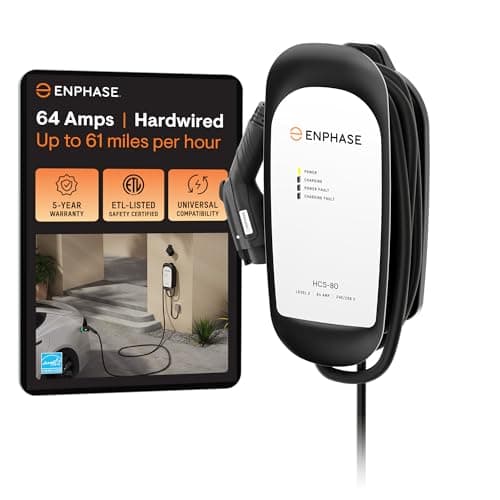
Enphase Energy Enphase HCS-80 (64A)

Our top pick

Best Overbuilt Unconnected Charger

Enphase HCS-80 (64A)

7.4/10
$1,600.00Check Price

In stock at Amazon as of November 5, 2026.

#ad · we may earn a commission

Best for: Cars that accept 15.4 kW, on an 80A circuit

The unit that explains the category's naming trap: HCS-80 is the 80-amp CIRCUIT, not the output. It delivers 64 amps - and for the cars that can use it, that is the point.

Read the full review ↓Compare all 3 picks ↓

The short answer

Quick picks

  • Enphase Energy Enphase HCS-80 (64A)
    01 Enphase HCS-80 (64A)
    7.4

    The unit that explains the category's naming trap: HCS-80 is the 80-amp CIRCUIT, not the output. It delivers 64 amps - and for the cars that can use it, that is the point.

    Best for: Cars that accept 15.4 kW, on an 80A circuit

    $1,600.00Amazon
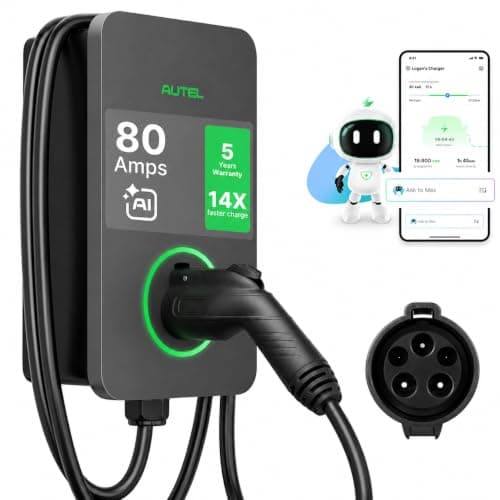
  • Autel Autel MaxiCharger 80A
    02 Autel MaxiCharger 80A
    9.0

    The only 80-amp charger here priced like a normal home unit rather than a commercial one - and the one to buy if your car can genuinely take 19.2 kW.

    Best for: A home 19.2 kW install on a normal budget

    $1,069.00Amazon
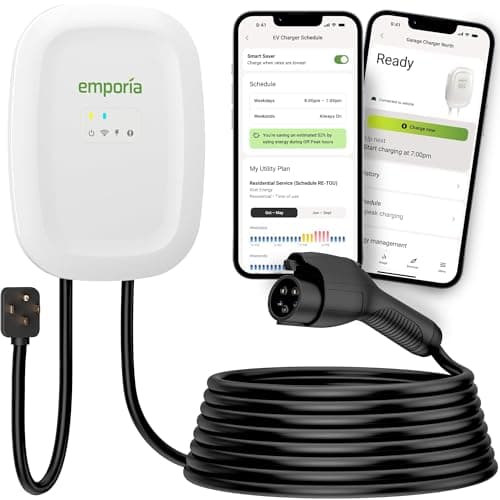
  • Emporia Emporia Level 2 (48A)
    03 Emporia Level 2 (48A)
    9.0

    The charger that refuses to charge you extra for being smart: full 48-amp speed and real energy monitoring at roughly the price of a plain plug-in box.

    Best for: Most homes that want speed and smarts

    $449.00Amazon

#ad · Live prices from the Amazon Product API, as of November 5, 2026. Where we have no verified live price, we show none — we would rather leave a gap than print a number that has gone stale.

The Enphase HCS-80 is among the best-built chargers we have looked at, and we would tell almost nobody to buy it. The hardware is not the problem: 64 amps continuous, 15.4 kW, a fully sealed NEMA Type 4 enclosure, a 25-foot ruggedized cable with a watertight Type 4X overmolded J1772 connector, a published operating range of -22F to 122F, ENERGY STAR certification, a five-year US warranty, continuous ground monitoring and automatic circuit reclosure. The problem is the number on the box. HCS-80 is the size of the circuit it needs. The output is 64 amps. And 64 amps is a tier almost no car on sale can put to use.

This is the former ClipperCreek flagship - the Amazon listing title still reads "Formerly ClipperCreek" - and ClipperCreek earned its reputation for sealed, appliance-grade EVSE that outlives the car it was bought for. That reputation is intact here. What follows is an honest accounting of a very good product sold into a tier the car market moved away from. It appears in our 80-amp charger roundup and our no-Wi-Fi roundup; this is the closer look at the one unit. We compile published specifications, distributor spec listings and retail listings and do the electrical arithmetic ourselves - we have not bench-tested this charger and we do not run a test lab, so treat this as documented research rather than measurement.

The published specifications

One quirk to flag before the table. Enphase's own store page is for the 18-foot SKU; the unit commonly sold on Amazon is the 25-foot one. Both exist. The figures below are the 25-foot version from distributor spec listings, with Enphase's own page used where the two agree.

SpecificationPublished figurePublished by
Maximum current64 A continuousEnphase and distributors
Power output15.4 kWEnphase
Input voltage208-240 VAC, single-phaseDistributor spec listing
ConnectorSAE J1772, watertight Type 4X rubber overmoldedDistributor spec listing
Cable length25 ft (18 ft on the SKU Enphase lists)Amazon listing / Enphase
Enclosure ratingNEMA Type 4, indoor/outdoorDistributor spec listings
Operating temperature-22F to 122F (-30C to 50C)Distributor spec listing
Weight17.8 lbs (8.07 kg)Distributor spec listing
CertificationsENERGY STAR; "compliant with rigorous safety standards including UL and NEC"Distributor spec listing
Warranty5-year limited, United StatesEnphase
MountingWall or pedestalEnphase
ConnectivityNone - filed under "Unconnected EV Chargers For Home"Enphase

One gap deserves naming. Enphase's own page says only that "all our EV chargers are safety certified" - it does not name a standard, a laboratory or a file number. The distributor listing goes further with ENERGY STAR plus "UL and NEC", but "UL" used as an adjective is not the same thing as a UL Listing with a file you can look up. The safety standard that applies to Level 2 EVSE is UL 2594, and the brands that take documentation seriously publish their number: Grizzl-E publishes a UL file, and the budget LENZ Level 2 publishes its ETL Intertek control number. At this price, we would expect the same.

The 64-amp problem

This is the heart of the review, so here is the arithmetic in full.

EV charging is a continuous load under NEC Article 625, which sizes the branch circuit at 125 percent of the load - equivalently, it caps the load at 80 percent of the breaker. So:

  • 64 amps of charging x 1.25 = an 80-amp circuit. Hence the model name.
  • 64 amps x 240 volts = 15.4 kW. Hence the power figure.

Now the other side of the equation: what cars accept. The market has settled into two tiers. The large majority of battery EVs top out around 11.5 kW, which is 48 amps. A short list of big-battery cars - the Lucid Air, the F-150 Lightning Extended Range, and certain Cadillac, GMC and Chevrolet trims - accept 19.2 kW, which is 80 amps. Almost nothing is sold in between.

So consider who the HCS-80 is actually for.

  • If your car caps at 48 amps - most EVs, including the Tesla Model 3 and Y, Rivian R1T and R1S, Ioniq 5, EV6, Mustang Mach-E and ID.4 - the HCS-80 charges it at 48 amps. That is exactly the same speed a 48-amp charger delivers on a 60-amp circuit. You would have paid four figures and installed an 80-amp circuit to match what a far cheaper unit does on a smaller one.
  • If your car accepts 80 amps, the HCS-80 throttles it to 64. You would have done the electrical work for an 80-amp circuit and left 3.8 kW of the car's capability unused. The Autel MaxiCharger 80A delivers the full 19.2 kW for meaningfully less money.
  • If your car sits between 48 and 80 amps- this is the HCS-80's natural home, and it is a short list of mostly older cars. Some earlier Tesla Model S configurations with an upgraded onboard charger are the usual example.

That is the whole case. Nothing about build quality, weather sealing or warranty changes it. The HCS-80 is an excellent answer to a question the car market stopped asking.

What the money does buy

If you have already decided you want a sealed, software-free appliance and budget is not the binding constraint, the HCS-80 does several things the cheap units do not.

Automatic circuit reclosure

A minor fault - a transient ground reading, a brief over-temperature - normally leaves a charger dead until a person walks out and resets it. The HCS-80 resets itself. For a car that has to be charged by 6am, that is the difference between a full battery and a bad morning. It is a habit borrowed from commercial equipment rather than home gear, and it is the one feature here we would genuinely miss. Our guide on how to reset an EV charger is the manual version of what this does by itself.

Continuous ground monitoring

Not a one-time check at plug-in but a constant watch on the ground path - the protection that matters most in exactly the install this unit suits: outdoors, on a pedestal, in weather. That same exposed install is the one worth reading our charger theft prevention guide for, because a pedestal in the open is the most reachable place a charger can live.

A sealed enclosure with a published temperature range

NEMA Type 4, and -22F to 122F stated as numbers. Most budget units publish an ingress rating and no temperature range at all, which matters because the part that actually misbehaves in deep cold is usually the cable rather than the box. Our cold-weather roundup ranks on precisely this, and the HCS-80 is at the top end of what gets published.

Nothing to log into

No account, no firmware updates, no cloud service that can be discontinued, no Wi-Fi to drop in a detached garage. Enphase files it under "Unconnected EV Chargers For Home" and that is the pitch. On a flat electricity rate, with a car that can schedule its own charging - and nearly every modern EV can - a smart charger's software is solving a problem you do not have.

The honest cons

  • The name misleads. HCS-80 reads as an 80-amp charger. It is a 64-amp charger that needs an 80-amp circuit. Enphase is not hiding it, but the naming convention costs buyers real money in install quotes.
  • The output tier has almost no customers. Covered above. This is the main finding of the review.
  • The certification trail is thin for the price.No named standard, no laboratory and no file number on Enphase's own page.
  • Two SKUs, two cable lengths, one spec page. Enphase documents the 18-foot unit; the 25-foot unit is the one usually sold. Check the part number before ordering if cable length matters, and it usually does.
  • No scheduling, no energy monitoring, no diagnostics beyond a status light, at a price where every rival has all three. Deliberate, but a real trade.
  • An 80-amp circuit is a serious electrical job. Many 200-amp residential services cannot spare it without a load calculation and sometimes a subpanel. That cost is often larger than the charger.
  • Thin stock. The Amazon listing shows single-digit quantities on the day of writing, which is typical of a product near the end of its commercial life.

So, should you buy it?

Probably not, and the reason is arithmetic rather than quality. Buy the HCS-80 if you specifically own a car whose onboard charger accepts more than 48 amps but not a full 80, you already have or are installing an 80-amp circuit, and you actively want a sealed appliance with no software in it. That is a narrow but real set of people, and for them this is close to the ideal charger.

For everyone else: if your car caps at 48 amps, a good 48-amp charger gives identical speed on a smaller circuit for a fraction of the price, and the Emporia Level 2 is our pick there. If your car genuinely accepts 19.2 kW, the Autel MaxiCharger 80A delivers all of it for less than the HCS-80 costs at 64 amps, and adds an app. And if what appeals is the sealed-no-software philosophy at a sane price, the Grizzl-E Classic is the same idea in a 40-amp box with a published UL file.

In detail

The picks, in full

01
Enphase Energy Enphase HCS-80 (64A)

Cars that accept 15.4 kW, on an 80A circuit

Enphase HCS-80 (64A)

64A / 15.4kWJ177225ft cableETL to UL 2594 · NEMA 4
7.4/10

The unit that explains the category's naming trap: HCS-80 is the 80-amp CIRCUIT, not the output. It delivers 64 amps - and for the cars that can use it, that is the point.

Charge speed
9
Build & weather
10
Smart features
3
Cable & connector
9
Value
6

Pros

  • ETL listed to UL 2594 by an OSHA-recognized NRTL and ENERGY STAR certified - the certification is spelled out, not implied
  • The ClipperCreek lineage: no app, no cloud account, no Wi-Fi to drop, in a fully sealed NEMA 4 enclosure with a 5-year warranty
  • The manufacturer names the cars it suits - Cadillac Lyriq, F-150 Lightning Extended Range, Lucid Air Dream, Tesla Model S 90D/100 - instead of implying every EV benefits
  • Integrated cable wrap and wall-mounted holster included, so 25 feet of heavy cable has somewhere to live

Cons

  • The name says 80 and the output is 64 - it still needs a full 80-amp dedicated circuit for its 15.4 kW
  • No app, scheduling or energy monitoring at a price where every rival has all three

Don't buy this if…

…you want off-peak scheduling or energy data. This is deliberately a dumb, extremely durable appliance; if the app matters, the Autel 80A does more for less.

$1,600.00View on Amazon

Price as of November 5, 2026. Prices change — Amazon's is the one that counts.

#ad · we may earn a commission from this link to Enphase HCS-80 (64A)

02
Autel Autel MaxiCharger 80A

A home 19.2 kW install on a normal budget

Autel MaxiCharger 80A

Up to 80A / 19.2kWJ177225ft cableUL cert. by CSA
9.0/10

The only 80-amp charger here priced like a normal home unit rather than a commercial one - and the one to buy if your car can genuinely take 19.2 kW.

Charge speed
10
Build & weather
9
Smart features
9
Cable & connector
9
Value
8

Pros

  • Delivers the full 80A / 19.2 kW on a 100A circuit, and the manufacturer states the 100A requirement plainly rather than burying it
  • UL certified by CSA, with internal temperature monitoring and a flame-retardant enclosure, on a 5-year warranty
  • Dual-network Wi-Fi plus Wi-SUN, so the app keeps working when a single garage Wi-Fi link drops
  • Tamper-resistant screws and remote locking - the practical answer to a charger mounted where the public can reach it

Cons

  • Hardwired only, and a 100A dedicated circuit is a serious electrical job many 200A services cannot spare
  • Almost no EV can use all 80 amps, so most buyers are paying for headroom the car will never draw

Don't buy this if…

…your car's onboard AC charger tops out at 11.5 kW, which covers the large majority of EVs on sale. You would be paying for a 100-amp circuit to feed a 48-amp car. Check the vehicle's AC acceptance rate first - if it is 11.5 kW, a 48-amp charger is the correct purchase.

$1,069.00View on Amazon

$1,299.0018% off

Price as of November 5, 2026. Prices change — Amazon's is the one that counts.

#ad · we may earn a commission from this link to Autel MaxiCharger 80A

03
Emporia Emporia Level 2 (48A)

Most homes that want speed and smarts

Emporia Level 2 (48A)

Up to 48A / 11.5kWJ177225ft cableWi-Fi + app
9.0/10

The charger that refuses to charge you extra for being smart: full 48-amp speed and real energy monitoring at roughly the price of a plain plug-in box.

Charge speed
10
Build & weather
8
Smart features
9
Cable & connector
8
Value
10

Pros

  • 48-amp capable when hardwired — quicker than the 40-amp plug-in default most units top out at
  • Genuine energy tracking and scheduling in the app, priced below almost every other smart charger
  • The 25-foot cable reaches either side of a two-car garage

Cons

  • You only get 48 amps hardwired on a 60-amp circuit; the plug-in version is capped at 40A like everything else
  • The app and Wi-Fi are central to the experience, so first-time setup takes longer than a plug-and-go box

Don't buy this if…

…you never intend to open an app. A lot of what you are paying for is the software; if a sealed, silent box is what you actually want, the Grizzl-E Classic is the honest call.

$449.00View on Amazon

Price as of November 5, 2026. Prices change — Amazon's is the one that counts.

#ad · we may earn a commission from this link to Emporia Level 2 (48A)

Before you buy any 64- or 80-amp charger

1. Find your car's AC acceptance rate first

It is the number that decides everything on this page and it is in the owner's manual. If it reads 11.5 kW or lower, stop - nothing above 48 amps will charge your car faster, and the difference goes entirely into the electrician's invoice. If it reads 19.2 kW, you want a charger that delivers 80 amps, not 64.

2. Get the load calculation before the charger

An 80-amp continuous circuit is a large block of a residential service. On a 200-amp panel it is frequently only possible with a formal load calculation, load management, or a service upgrade. Order in the wrong sequence and you own a charger you cannot energize. Our chargers for a 100-amp panel page covers the opposite end of the same problem.

3. Decide whether you want software at all

The HCS-80's pitch is that it has none. That is a legitimate preference, not a compromise - see our no-Wi-Fi roundup for the full field. But if you are on a time-of-use rate and your car cannot schedule reliably, a connected charger earns its price back in a way this one cannot.

The three ways out of this decision

  • Car caps at 48 amps: a 48-amp charger on a 60-amp circuit. Same speed, far less money, far less electrical work.
  • Car accepts 19.2 kW: a true 80-amp charger. The Autel MaxiCharger 80A is the value route; the Enphase CS-100 is the commercial-grade one if you also need load management and access control.
  • Car sits in the middle, or you want this exact philosophy: the HCS-80, eyes open about the tier.
How we picked

We do not run a testing lab

We compiled published specifications from manufacturer manuals and spec sheets, verified the safety listings (UL / ETL), computed the real running and installation costs, checked the wiring math against the NEC continuous-load rule, and read aggregated owner reviews — then scored each product against a published rubric. The scores are judgments from documented research — they are not bench measurements, because we do not have a test lab and we are not going to pretend we do. Every spec and cost figure is cited in Sources.

Questions

Frequently asked

Is the Enphase HCS-80 an 80-amp charger?

No. It delivers 64 amps continuous and 15.4 kW. The 80 in the name is the size of the circuit it requires: 64 amps of continuous load at the NEC Article 625 125-percent factor comes to an 80-amp breaker. For an actual 80-amp, 19.2 kW output you need a different unit, such as the Autel MaxiCharger 80A or the Enphase CS-100.

What circuit does the Enphase HCS-80 need?

A dedicated 80-amp circuit, hardwired. EV charging is a continuous load, so the branch circuit is sized at 125 percent of the 64-amp draw. Whether a given house can supply that without a service upgrade is a load-calculation question rather than a charger question, and on many 200-amp services the answer is no. Have the calculation done before you buy.

Will the HCS-80 charge my car faster than a 48-amp charger?

Only if your car's onboard AC charger accepts more than 48 amps, and most do not. The large majority of battery EVs cap around 11.5 kW, which is 48 amps - on those cars the HCS-80 and a 48-amp charger finish at the same minute. Check the AC acceptance rate in the owner's manual first; that number decides this, not the charger.

Is the Enphase HCS-80 the same as a ClipperCreek charger?

It is the ClipperCreek product under Enphase ownership - the Amazon listing title still reads "Formerly ClipperCreek". ClipperCreek built sealed, unconnected, appliance-grade EVSE and that design philosophy is exactly what you are buying: NEMA Type 4, a published temperature range, a ruggedized connector, and no app at all.

Does the Enphase HCS-80 have an app or scheduling?

No. Enphase sells it under "Unconnected EV Chargers For Home". There is no Wi-Fi, no app, no scheduling and no energy monitoring. Schedule off-peak charging in the car instead - nearly every modern EV can, and the car's timer does not depend on garage Wi-Fi.

Is the HCS-80 UL listed?

Enphase's own page says only that its chargers are "safety certified", naming neither a standard nor a laboratory. A distributor spec listing describes the unit as ENERGY STAR certified and "compliant with rigorous safety standards including UL and NEC". We could not locate a published UL file number for it. The standard that applies to Level 2 EVSE is UL 2594; brands that publish their file or control number make the claim checkable, and at this price we would expect that.

HCS-80 or Enphase CS-100?

The CS-100 is the genuine 80-amp, 19.2 kW station and it costs considerably more again. It is a commercial product sold to homeowners: field-serviceable cable, access control and load management. If you need the full 19.2 kW at home but not the site-management features, the Autel MaxiCharger 80A is the cheaper route to the same charging speed. The CS-100 earns its price on a shared lot or a fleet, which our 80-amp roundup goes into.

How much range per hour does the HCS-80 add?

Enphase publishes "up to 61 miles of range per hour", which corresponds to its full 15.4 kW. Treat that as a ceiling rather than an expectation: you will only see it on a car that can accept 64 amps. On a typical 48-amp-capped EV the same unit delivers the 11.5 kW figure any 48-amp charger does, and the miles-per-hour number depends on the car's efficiency as much as on the charger.

Keep reading

More in this section

More Home EV Chargers

All home ev chargers →

Receipts

Sources

We do not run a testing lab, and we do not pretend to. Where a measured number came from someone else's lab, we name them and link them. Where we could not verify something, we say so on the page rather than quietly leaving it out. Read our full method.