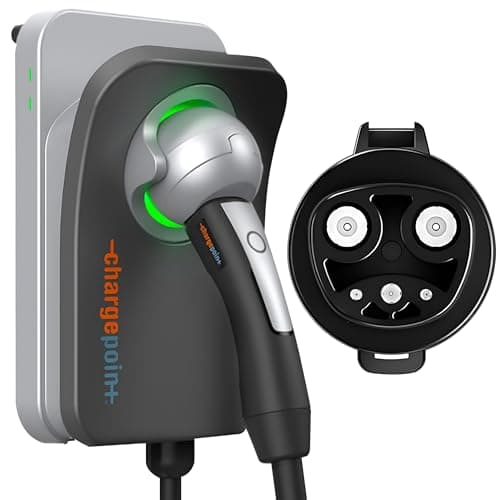
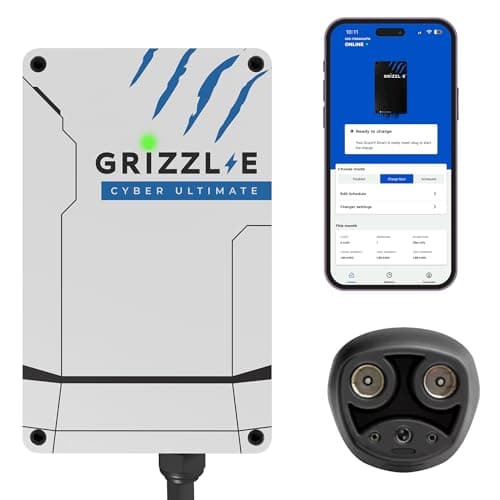
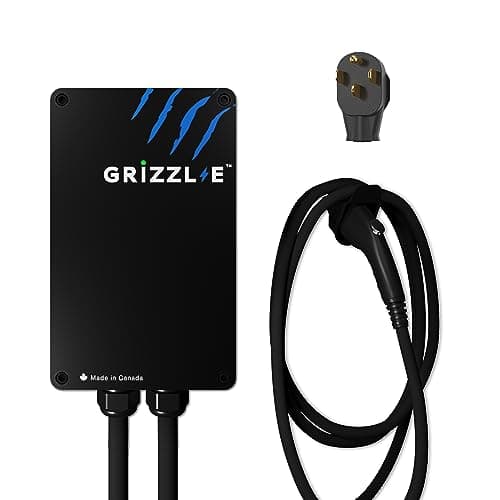
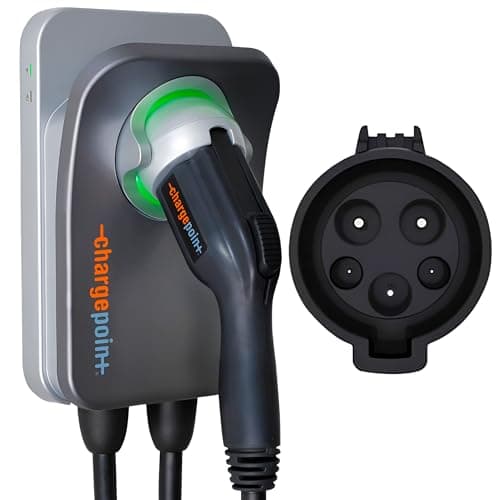
If you want a charger that actually pulls 50 amps, buy the ChargePoint Home Flex - its selectable output runs to 50 amps, which almost nothing else in the mainstream home field does. If what you actually have is a 50-amp outlet or breaker, the right buy is a 40-amp charger, and our budget pick there is the Grizzl-E Classic. Those are two different questions wearing the same number, and getting them mixed up is the most expensive mistake on this page. A 50-amp circuit does not support a 50-amp charger. A 50-amp charger does not run on a 50-amp circuit. Both of those sentences are true, and the next two sections explain why.
Why "50 amp" means two opposite things
The National Electrical Code treats EV charging as a continuous load and sizes the branch circuit at 125 percent of the load. Inverted, that is the 80 percent rule every electrician quotes: the charger may draw no more than 80 percent of the breaker feeding it. So the arithmetic runs in both directions, and the direction you read it in changes the answer completely.
| If you start from | You get | Power at 240V | What to buy |
|---|
| A 50-amp breaker or NEMA 14-50 outlet | 40 amps of charging | 9.6 kW | A 40-amp charger |
| A charger set to 50 amps | A 70-amp breaker, minimum | 12 kW | Hardwired, new circuit |
| A 60-amp breaker | 48 amps of charging | 11.5 kW | A 48-amp charger |
| A 100-amp dedicated circuit | 80 amps of charging | 19.2 kW | An 80-amp charger |
Row two is the one that surprises people. Fifty amps of continuous draw needs 62.5 amps of breaker, and breakers are not sold in that size - the next one up is 70. That is why the 50-amp setting exists almost nowhere: it falls in a gap between the two circuit sizes anybody actually installs, the 60-amp circuit that feeds a 48-amp charger and the 100-amp circuit that feeds an 80-amp one. If you are starting from the panel rather than from a product page, read wire and breaker size and what amp charger do I need before you spend anything.
The 48-amp question, since it is the one most readers really have
Between 48 amps and 50 amps there is 480 watts - about four percent. No car on sale is limited in a way that notices. Tesla publishes an 11.5 kW ceiling on its own onboard charger, which is exactly 48 amps at 240 volts, and the rest of the mainstream field sits at or below that. So unless your car is one of the handful that accept more than 11.5 kW, the 48-amp tier is the real top of the useful range and our best 48-amp chargers page is the one you want. The 50-amp setting earns its keep in one place: a charger you can dial anywhere from 16 to 50 amps is a charger that fits whatever circuit the electrician finds room for, and that flexibility is what the Home Flex is really selling.
How we ranked these
- Does it reach 50 amps at all? Published selectable output, from the manufacturer datasheet. Two units here do it as a mainstream home product; two more pass through 50 on the way to 80.
- Is it adjustable downwards? Decisive on this page. A 50-amp capable unit that cannot be dialed down is useless on the 60-amp circuit you will probably end up with.
- A real safety listing. UL or ETL to UL 2594, tested by an OSHA-recognized laboratory. At 12 kW continuous, for hours, unattended.
- Connector, honestly stated.Two of these are NACS and two are J1772. The one that matches your car's port saves you an adapter every single night.
- What it costs to reach the setting. A 70-amp circuit is electrician work and panel capacity, not a setting in an app. We say so per pick.
The short version
- You want the 50-amp setting itself: ChargePoint Home Flex, in the hardwired configuration, on a 70-amp circuit. The NACS version does the same for a factory-NACS car.
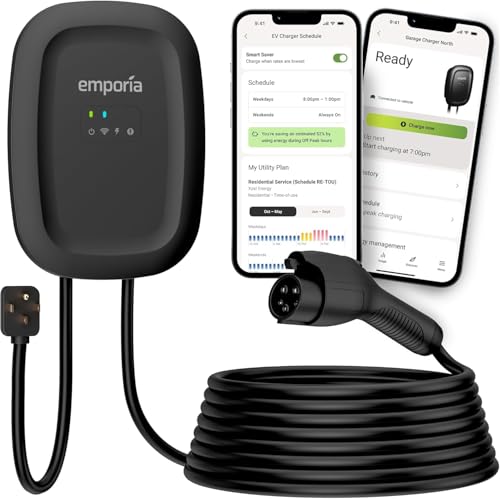
- You have a 50-amp outlet already: a 40-amp charger. The Grizzl-E Classic is the budget pick and the Emporia is the one worth the step up, because it can be hardwired to 48 amps later if you ever upgrade the circuit.
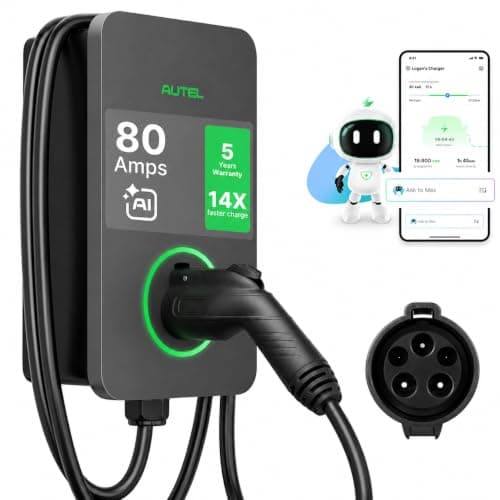
- Your car accepts more than 11.5 kW: skip 50 entirely and go to the 80-amp tier. The Grizzl-E Ultimate 80A and the Autel 80A both pass through 50 amps as a setting on the way there.
- You are not sure what your panel can carry: run the load calculation first. It is free and it decides this page for you.
Before you buy: three checks
- Read the breaker, not the outlet. A NEMA 14-50 receptacle is legal on a 40-amp circuit as well as a 50-amp one, and the plug shape tells you nothing. If the breaker says 40, your ceiling is 32 amps.
- Ask what the car accepts. The charger never pushes current - the car pulls it, and the J1772 control pilot simply tells the car what is available. A 50-amp charger on a 32-amp car charges at 32 amps forever.
- Price the circuit, not just the box. Going from a 50-amp outlet to a 70-amp hardwired circuit can cost more than the charger. Our installation cost guide has the ranges, and panel upgrades covers the case where the answer is no.
What we will not tell you
We have not metered any of these units at 50 amps - we do not have a lab, and our methodology pagesays so plainly. What is on this page is each manufacturer's published selectable output, the safety listing checked against the testing laboratory's own description of the standard, and NEC continuous-load arithmetic, which is arithmetic. Prices are live and carry the date the price layer checked them.