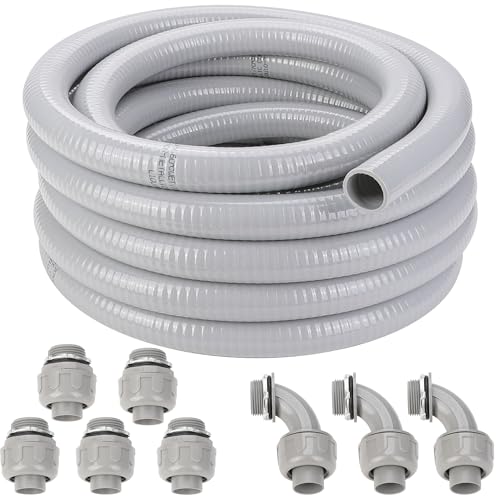
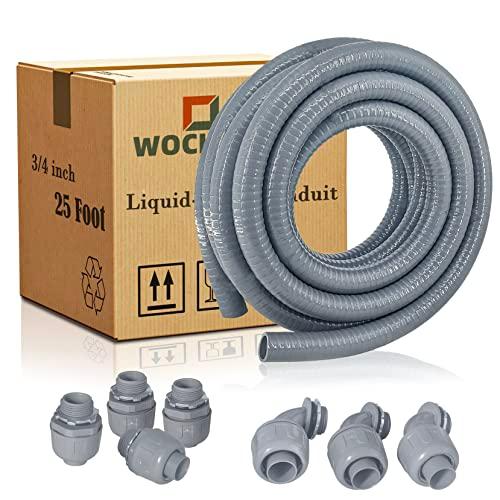
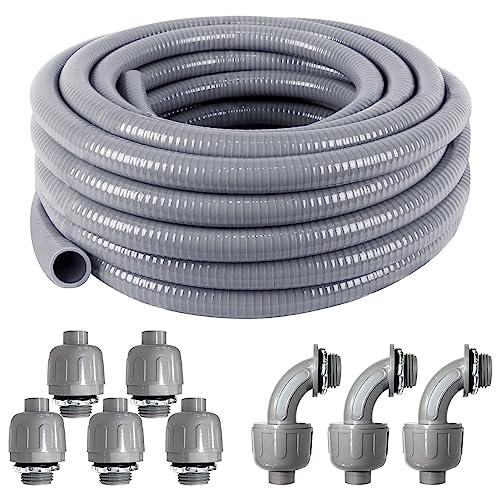
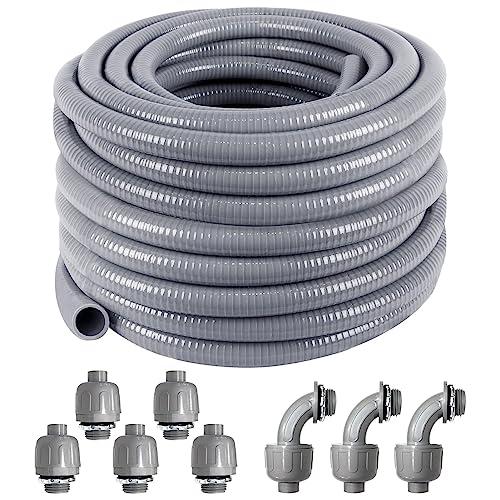
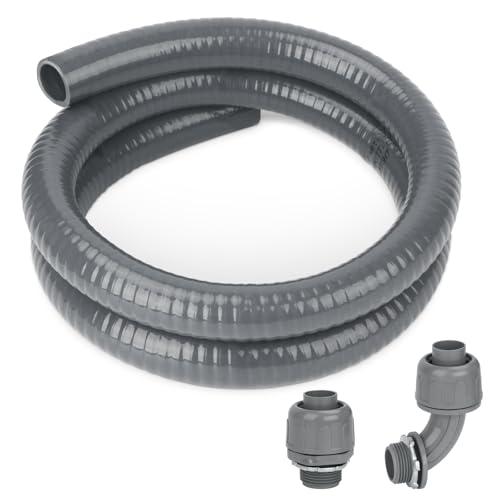
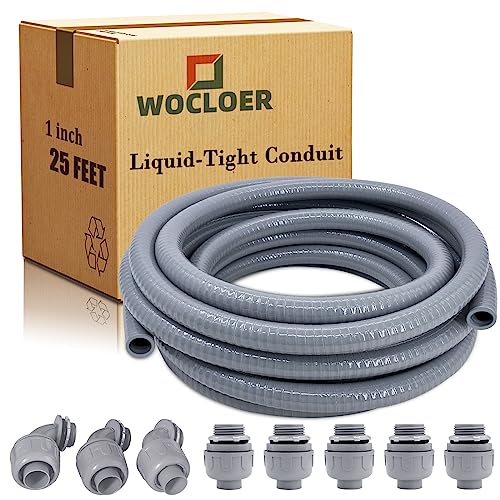
For a 6 AWG charger circuit, buy the Wocloer 1-inch liquid-tight kit in 25 feet: the trade size that gives 6-gauge conductors room, with its straight and angle connectors in the box. If your run has several corners, the WYNNsky 1-inch kit ships three 90-degree connectors instead of one and costs slightly less. On an 8 AWG, 40-amp circuit the 3/4-inch Wocloer kit is the right and cheaper call. And our budget pick is the four-foot liquid-tight whip, which on a hardwired charger is often the only conduit the job needs at all.
Conduit is the component people skip and then have to retrofit. It does two things no cable can do on its own. First, it is the only legal way to take a charger circuit outdoors, along an exterior wall, or out to a detached garage, because Type NM-B cable is a dry-location product and nothing changes that. Second, conductors in a raceway are terminated at 75 degrees C rather than the 60 degrees NM-B is capped at - which is why 6 AWG THHN in conduit carries the 60-amp circuit a 48-amp charger needs, and 6/3 Romex does not.
What size conduit, and why we will not print a number
The honest answer is that conduit fill is arithmetic, not a rule of thumb. The number of conductors a trade size may carry comes out of NEC Chapter 9 - Table 4 for the internal area of each conduit type and Table 5 for the cross-sectional area of each conductor - and it differs between EMT, PVC, flexible metallic and flexible non-metallic conduit of the same nominal size. We are not going to print a count on a product card, because the count depends on a conduit type we did not choose for you.
What we will say is what the sizes are for in practice. 3/4 inch is the common residential trade size and it is comfortable with 8 AWG. 1 inch is the size to buy when the conductors are 6 AWG, because 3/4 inch is where people get the pull half-finished and stop. If you are unsure, go up a size: conduit is the cheapest component in the entire project, and pulling twice is the most expensive mistake in it.
| Your run | Buy | Why |
|---|
| 6 AWG conductors, 25-foot run | 1 in. Wocloer kit, 25 ft | A full trade size up from 3/4 inch, with connectors included |
| Several corners between panel and charger | 1 in. WYNNsky kit | Three 90-degree connectors in the box, not one |
| 8 AWG conductors, 40-amp circuit | 3/4 in. Wocloer kit, 25 ft | The standard residential size, and the cheapest complete kit |
| Exposed garage wall where things get leaned on it | 3/4 in. flexible metallic kit | A metal jacket survives impact that non-metallic does not |
| Detached garage or far end of the house | 1 in. kit, 100 ft | No junction boxes, and the lowest cost per foot here |
| Hardwired charger, panel or disconnect right beside it | 4 ft liquid-tight whip | Budget pick: the flexible last stretch into the charger gland |
Non-metallic or metallic
Five of these six are liquid-tight flexible non-metallic conduit, which is the format most homeowners and plenty of electricians use for a charger run: it is light, it absorbs an out-of-square wall without a bender, and it is weather-rated. Its one catch matters and we will state it plainly - non-metallic conduit is not an equipment grounding conductor, so the ground wire has to be pulled with the circuit like any other conductor.
Flexible metallic liquid-tight is the one to buy where the conduit is going to get hit. Garages are full of bicycles, ladders and car doors, and a crushed non-metallic run is a crushed cable. Metallic also happens to be what most electricians reach for on the last few feet into a wall-mounted charger, because it looks like a finished job.
How we picked these six
- Kits, not bare conduit. Every pick here includes connectors. Conduit without fittings is a second order and a second trip, and the fittings are where the liquid-tight rating actually lives.
- One pick per trade size and length. 3/4 inch and 1 inch, in 25, 100 and 4 feet, plus the metallic option. We did not rank two near-identical kits for one job.
- A live price on the refresh behind this page.Every pick returned a live price from Amazon's Product Advertising API.
- Liquid-tight only. A charger circuit transitions from inside to outside, or sits in an unheated garage. Dry-location-only raceway is the wrong product for this job and we did not rank any.
- Published fitting counts. Where a listing states how many straight and angle connectors are in the box, we used that to rank, because running out of 90s mid-job is the actual failure mode here.
Conduit is half of an outdoor install
If the charger itself is going outside, the raceway is only the first part. The charger needs a weather-rated enclosure or a shield, the receptacle needs a weatherproof box, and the whole assembly needs to be mounted so water runs off rather than in. Weatherproofing an outdoor install is the guide, lock boxes and weather covers is the hardware, and NEMA vs IP ratings explains what the numbers on the charger body actually promise.
Every price above is live, read from Amazon's Product Advertising API and stamped with the date our price layer last checked it. Nothing on this page is a price typed into prose.
Three checks before you buy a kit
- Run the fill arithmetic, or ask the electrician who will. NEC Chapter 9, Table 4 and Table 5. If you are not going to do it, buy 1 inch for 6 AWG and 3/4 inch for 8 AWG and you will almost certainly be fine - but the arithmetic is the authority, not this sentence.
- Count your corners before you count your feet. Kits ship a fixed mix of straight and angle connectors. Walk the route and count the 90s; a kit with one angle fitting and a route with four is a stalled afternoon.
- Decide where the conduit ends.At a disconnect box, at a receptacle box, or at the charger's own gland. That decision sets which fittings you need and whether you also want a disconnect in the middle of the run.
When you do not need conduit at all
If the charger is on the inside face of a garage wall, the panel is in the same building, and the whole run is through framing in a dry location, a single NM-B cable does the job with no raceway and no fittings. That is the majority of home installs. Conduit becomes mandatory the moment the run is exposed to weather or physical damage, and becomes useful the moment you want 48-amp charging on 6 AWG.
What we have not done
We have not tested any conduit and we have no lab. Trade size, length, fitting count and metallic-or-not are the live listings' own published figures. Conduit fill is NEC Chapter 9 arithmetic and we deliberately print no count. The scores are judgments from documented research against the rubric on our methodology page, not measurements. Where a listing claims a certification, we describe it as the listing's claim.