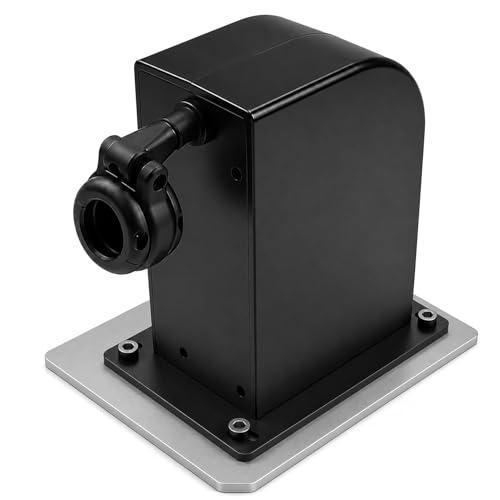
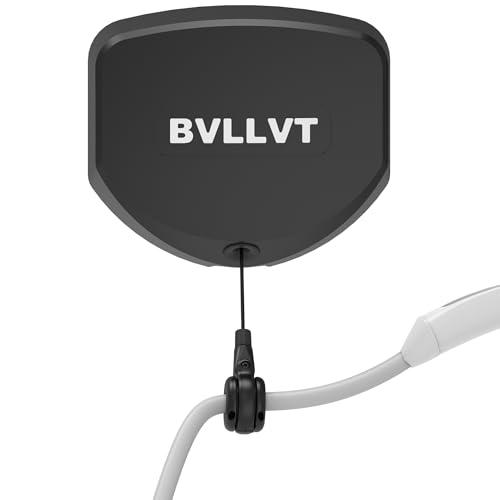
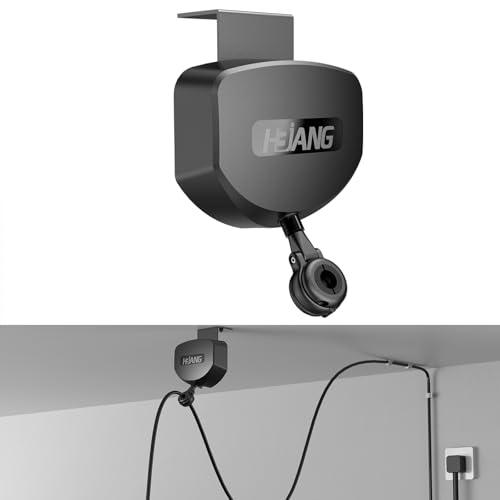
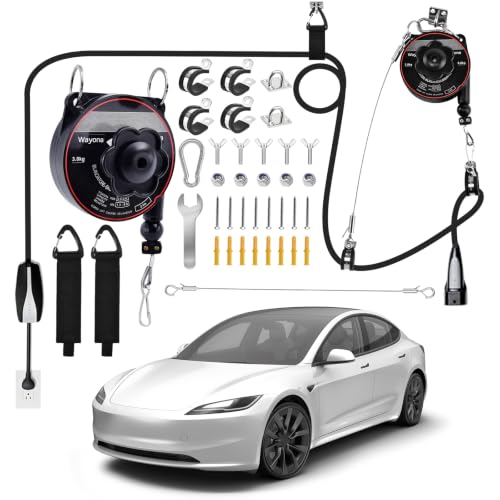
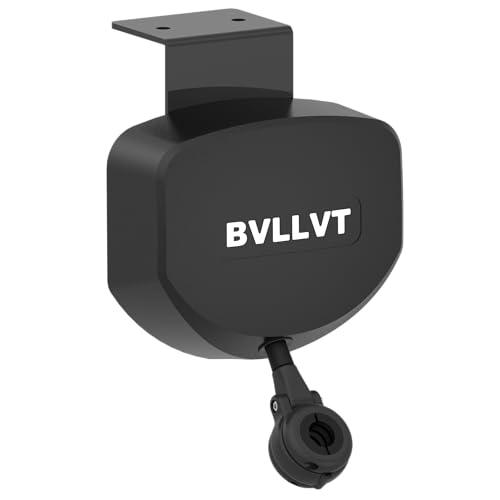
For most attached garages the retractor to buy is the 11.5-foot ceiling-mount unit: it hangs over the parking spot, takes the whole cable off the floor, and pays for itself the first time you do not run over the connector. If your cable is a thick 48-amp one, buy the controlled-rewind unit instead - it is the only pick here that publishes a pull force and a cable diameter range, and an uncontrolled spring on a heavy cable is how a connector ends up cracked. If the ceiling is finished, low, or full of storage racks, the wall-mount version of the same design is the answer. And if you simply want the cable off the concrete for the least money, the Wayona unit is our budget pick.
This is the cheapest meaningful upgrade in home charging, and almost nobody buys it until something goes wrong. A Level 2 home charger is a 240-volt appliance with a long, heavy umbilical: NEC 625.17 allows a listed charger up to 25 feet of usable output cable, and unless the unit ships with its own cable management system that is roughly what you get. That cable has to be somewhere between charges, and the two places people put it - looped over a hook, or on the floor - are the two places that damage it.
What a retractor actually fixes
Three failure modes, in the order they cost you money.
- Driving over the cable. A cable on a garage floor ends up under a tire eventually, and the connector housing is the part that loses. This is the failure that turns a cable-management accessory into a bargain, because a replacement cable assembly on a hardwired charger often means replacing the charger.
- Abrasion and tight coiling. Dragging a cable across a concrete slab twice a day wears the jacket, and coiling it tight around a hook puts a repeated bend in the same spot. Neither kills a cable quickly; both age it.
- The connector on the floor. The contacts are the expensive part. A connector that lives in the dust and the meltwater is one that eventually gives you a charging fault you will blame on the car. Our charger fault and stuck plug pages both start with the same advice: look at the connector face.
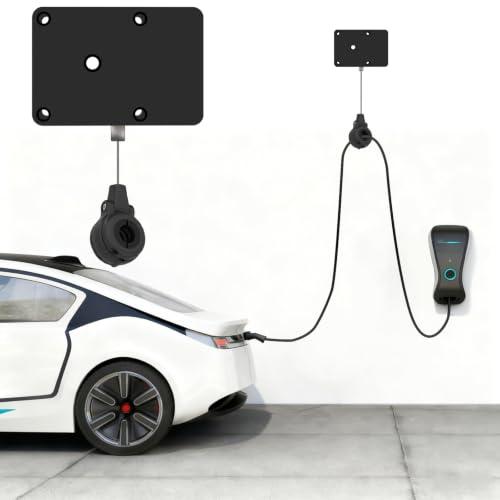
A retractor answers all three at once by taking the cable vertical. It is a spring or counterweight on a pulley, with a cord that clips to the charging cable and pulls it back up to the ceiling or the wall when you let go. That is the whole mechanism. Nothing about it touches the 240-volt side of your install, which is why this is a purchase you can make without an electrician.
Take two measurements before you order
This category fails for exactly two reasons, and both are measurements you can take in five minutes with a tape.
- The drop you need.Measure from the mounting point - the joist, or the wall above the charger - down to the height of your car's charge port, then add the slack you want at the port so the cable is not under tension while it charges. Most picks here publish 11.5 feet of travel, which suits a normal 8 to 10-foot garage ceiling. One publishes a 2.5-meter drop, which is roughly eight feet and is short for a tall garage.
- Your cable's diameter and weight.A 48-amp charger's cable is substantially thicker and heavier than a 32-amp portable's, and this is the spec that decides whether a given retractor will hold it up. Only two picks here publish a number - one a 0.6 to 0.8 inch diameter range, the other a 4.5-pound rated load - and those two numbers are why those picks are ranked where they are.
If your cable is thick enough that you are unsure, that is itself the answer: buy the controlled-rewind unit. The failure mode of an under-rated retractor is not that it breaks, it is that it never quite lifts the cable and you stop using it.
How we picked these six
- One unit per job. Ceiling, wall, both-ways, heavy cable, light cable, cheapest. We did not rank two products that answer the same question, which is how a page like this normally turns into six listings of the same part.
- A live price and an in-stock offer.Every pick returned both from Amazon's Product Advertising API on the refresh behind this page. In a category this full of short-lived listings, that check removed more candidates than any editorial judgment did.
- Published numbers over published adjectives.Travel length, rated load, cable diameter range and mounting surface are the four specs that matter, and we ranked the units that state them above the units that say "heavy duty" instead.
- No safety claim, because there is no safety standard here.A retractor is mechanical. Your charger's own listing - UL 2594 for the equipment, and the connector standards for the coupler - is unaffected by hanging the cable from a pulley. Any retractor that advertises a safety certification is advertising something irrelevant.
- Universal fit treated as a claim, not a fact."Fits 95 percent of cables" is a seller's sentence. Where a listing publishes an actual diameter range we say so; where it does not, we flag it in that pick's cons.
Mount it where the car actually parks
The single most common installation mistake is mounting the retractor above the charger instead of above the charge port. The charger is on a wall because that is where the circuit came out; the port is on the car, two to twelve feet away. Park the car where it normally sits, plug in, and look at where the cable wants to hang. That spot - not the spot above the charger - is where the pulley goes.
Everything above the drywall is a joist hunt. A retractor holding a 48-amp cable is carrying real weight with a dynamic load every time it snaps back, so it goes into framing, not into a drywall anchor. If your ceiling is finished and you do not want to find joists, buy the wall-mount version and put it into studs beside the charger instead.
One geometry check that saves a scratched roof: with the retractor mounted and the cable retracted, the connector should hang clear of the car's highest point, not over it. On a tall SUV in a low garage, a ceiling retractor with 11.5 feet of travel may simply not have the headroom, and the wall mount is the better answer.
Retractor, holster, or neither
A retractor is not the only answer and it is not always the right one. If the cable already reaches comfortably and the only problem is tidiness, a holster or wall organizer costs a fraction of this and does the job - and our cable management page lays out the whole decision, hooks included. If the cable does not reach the car at all, no retractor fixes that: either you are in the market for a charger with a longer cable, or you need an EVSE extension, which is the only safe way to add length and comes with its own rules. And if the real problem is that the cable gets driven over where it crosses the drive, the fix is the cable protectors and ramps page, not this one.
Every price on this page is live, read from Amazon's Product Advertising API and stamped with the date our price layer last checked it. We do not type prices into sentences, because this category discounts constantly and a number in prose would be wrong within a week.
The four specs that decide this purchase
- Travel, in feet. How far the cord pays out. Eleven and a half feet is the category norm and suits a standard ceiling; 2.5 meters is the short option and belongs on a wall or a low ceiling. A listing that does not publish travel is asking you to guess at the only number that cannot be fixed after it arrives.
- Rated load, in pounds or kilograms. Published as a pull force or a weight rating. This is the spec that separates a retractor for a Mobile Connector from one for a hardwired 48-amp unit, and most listings omit it.
- Cable diameter range, in inches.The clamp or sleeve has to grip your cable without crushing it. A published 0.6 to 0.8 inch range is a real spec you can check with a tape; "universal" is not.
- Mounting surface. Ceiling, wall, or either. This is not a preference - it is dictated by where your framing is and whether the ceiling is finished. Decide it before you shop, because it halves the field.
Where a retractor is the wrong purchase
Three cases, and we would rather you keep the money. If the charger sits beside the driver's door and the cable reaches the port with slack to spare, you have no problem to solve. If you park outdoors with no overhead structure, there is nothing to mount to and a pedestal with an integrated holster is the better buy - see EV charger pedestals and stands. And if the cable is already damaged - a cut jacket, a cracked connector housing, exposed copper - a retractor is not a repair. Stop using it and replace the cable or the unit.
Living with one
Two habits make the difference. Let the cable retract under control rather than releasing it from the port and letting it go, because an unmanaged snap-back is what cracks a connector housing against a joist. And clip the cord to the cable a foot or two behind the connector, not to the connector itself, so the pull is on the cable jacket and not on the coupler.
Check the clip and the mounting screws twice a year. A retractor is a spring under constant tension in an unheated space, and the two things that age are the cord where it enters the housing and the fastener in the joist.
What we have not done
We have not tested a retractor and we do not have a lab. Travel, rated load, cable diameter range and mounting options are each pick's live retail listing's own published figures; where a listing publishes nothing, we say so in that pick's cons rather than filling the gap. The scores are judgments from that documented research against the rubric on our methodology page, not measurements. We make no claim about any of these sellers' long-term durability, and in a category where most listings are unbranded we think the honest advice is to buy on the published specs and the return window.